


Protocols Set for 11-Player Football Finals
January 18, 2021
By Geoff Kimmerly
Second Half editor
To provide for the convenience and safety of spectators attending the MHSAA 11-Player Football Finals on Jan. 22 and 23 at Ford Field in Detroit, attendees are being advised of a variety of items related to transportation and security – including policies regulating specified parking, entrances and exits for each team’s spectators and types of bags allowed into the stadium.
Parking, entrance/exits and seating all have been assigned on a per game basis to keep spectators from home and away teams from mixing as much as possible as part of COVID-19 precautions.
Visiting team fans will park in Ford Field lots 4 and 5 and enter through Gate D only. Home team fans will park in the Ford Field parking structure and enter through Gate G only. Parking costs $6 and must be paid for with credit card. Spectators may not enter Ford Field until receiving notification that the Gate is open – school administrators will have details on how that announcement will be made for their spectators, and Gate openings also will be announced on the MHSAA Twitter feed.
Upon arrival in the building, fans will find their designated seating areas on the south side of the field if their team is the designated home team for their contest and on the north side for the designated visiting team. Home teams this weekend are Centreville, Muskegon Mona Shores, Montague, Cadillac, New Lothrop, Davison, Grand Rapids Catholic Central and DeWitt. Fans must sit in the sections assigned for their school for that game. For information including maps, go to the MHSAA Website Football Finals.
Fans also are advised that the consumption of alcohol is prohibited in Ford Field parking facilities and lots, and smoking – including use of electronic cigarettes and vaporizers – is prohibited inside the stadium. Tailgating, including the setting up and use of grilling equipment, also is not allowed.
Tickets are priced at $19.90 (with service charge) and good only for that game. Tickets may be purchased only via GoFan with a code supplied by the participating team’s athletic department. No tickets will be available at the door. Spectators must leave immediately at the conclusion of their game to allow for cleaning of that section.
Security measures also will be in place to help assure spectator safety. Fans will be subject to metal detector screening, and Ford Field personnel reserve the right to request patrons open their coats, bags and other item-carrying vessels for visual inspection and deny entrance to individuals who do not cooperate. Spectators should remove cell phones, cameras, keys and other large metal objects before passing through the metal detectors.
Items which fans will be prohibited from bringing into the building include, but are not limited to, the following:
* Bottled beverages, of all types including water.
* Purses larger than a clutch bag, coolers, briefcases, backpacks, cinch bags, grocery & paper bags, duffle bags, diaper bags, luggage of any kind, computer and camera bags and large camera cases.
* Aerosol cans (hairspray, mace, pepper spray, etc.)
* Animals (except service animals to aid guests with disabilities)
* Balloons (air or helium)
* Balls (beach balls, footballs, etc.)
* Banners or large flags
* Cameras with lenses longer than five inches or any detachable lens. Selfie Sticks also are prohibited.
* Decals, stickers, confetti or glitter
* Drones and/or remote controlled aircraft.
* Electronic equipment including laptop computers, video recorders (hand-held video cameras are allowed), tripods and wearable video cameras including Go Pros.
* Fireworks
* Food, beverages or liquids (cans, bottles, boxes, flasks, etc.)
* Illegal substances
* Knives, pocket knives, box cutters, scissors, etc.
* Laser pointers
* Markers (permanent) and/or paint
* Noisemaking devices (bells, horns, kazoos, whistles, etc.)
* Objects that can be used as missiles or projectiles (sticks, poles, bats, clubs, Frisbees, etc.)
* Seat cushions
* Strollers and infant car seats or carriers
* Umbrellas (large size)
* Weapons
* Wrapped gifts
The following items may be permitted after inspection:
* Bags that are clear plastic, vinyl or PVC and do not exceed 12 inches by 6 inches by 12 inches, or a one-gallon clear plastic freezer bag (Ziploc or similar). An exception will be made for medically necessary items after proper inspection at the Gate.
* Infant items in a clear bag (bottles and formula) only if accompanied by a child
* Binoculars and binoculars cases not exceeding 4½ inches by 6½ inches may be brought in via one of the plastic bag options.
* Cameras and small camera cases (lenses may not measure longer than five inches, and no tripods or extension cords)
* Small radios (no larger than the size of a football and used with an earpiece)
* Small, compact umbrellas (must be placed securely under seat)
* Posters and signs without poles or sticks, or larger than what one person can hold.
* Tablets (iPads, Kindles, etc.)
The complete list of prohibited items can be found on the Detroit Lions Website. Prohibited items that are discovered during security inspections at stadium entrances must be returned to the owner's vehicle or discarded. Items will not be held for later pickup.
Fans are reminded that all image taking (still and video) may be only for personal, non-commercial use.
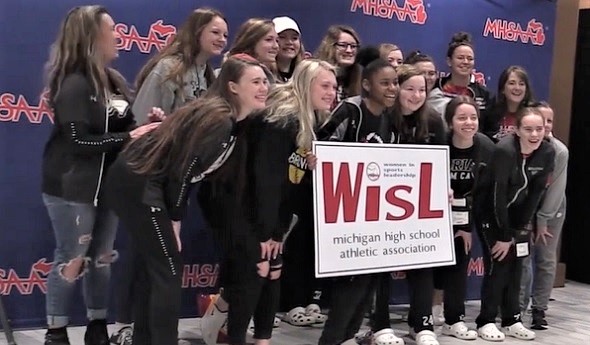
24th WISL Conference Draws 700 Leaders
February 7, 2020
By Geoff Kimmerly
Second Half editor
More than 700 high school students, coaches and administrators from across Michigan converged in Lansing this past Sunday and Monday for the 24th Women in Sports Leadership Conference.
This "MHSAA Minute" details some of the highlights.