


Rep Council Wrap-up: Fall 2012
December 7, 2012
A change in format for the Boys Basketball Finals highlighted actions taken by the Representative Council of the Michigan High School Athletic Association during its annual Fall Meeting, Nov. 30 in East Lansing.
Mirroring closely the format of the MHSAA Girls Basketball Finals, the Boys Finals will move this season from three to two sessions. The first session will tip off with the Class D Final at 10 a.m., followed by the Class A championship game. The second session will begin tentatively at 4:30 p.m. with the Class C Final and conclude with the Class B title game.
Previously, the Class A and B Finals were separate sessions, with the Class A Final tipping at 4 p.m. and Class B at 8 p.m. The change will make for a shorter day for spectators wishing to attend all four games, and also allow them to do so by purchasing tickets for two sessions instead of three.
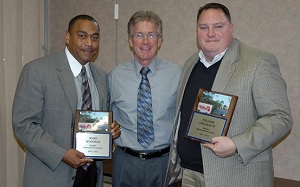 The Fall Meeting also saw the addition of two members to the 19-person council. Reese Public Schools athletic director Dave Derocher began a two-year term after being elected earlier this fall to represent Class C and D schools in the northern Lower Peninsula. Orlando Medina, who serves as athletic coordinator for Harrison Township L’Anse Creuse Public Schools, was appointed for a two-year term. He also previously served as athletic director at Detroit Cesar Chavez Academy. They fill positions formerly held by Beal City superintendent William Chilman IV and Romulus High School athletic director Mark Woodson, whose terms ended.
Also, Carmen Kennedy, principal at St. Clair Shores South Lake High School, was reappointed for a second two-year term. The Representative Council is the legislative body of the MHSAA. All but five members are elected by member schools. Four members are appointed by the Council to facilitate representation of females and minorities, and the 19th position is occupied by the Superintendent of Public Instruction or designee.
The most prominent points discussed at the Fall Meeting were risk minimization for athletes and possible strategies for making school sports safer. Among topics discussed were raising expectations for coaches’ participation in online safety courses and schools’ management of heat illness; the possible restructuring of practice policies in regards to hot weather; and game rules revisions to enhance safety especially in football, soccer and ice hockey.
The Council reviewed its previous actions on those topics, including discussions in December 2011 that led to the inclusion of health and safety content in online rules meetings. Council members considered a model policy for managing heat and humidity, and also a number of ideas collected during Fall Update meetings with administrators throughout the state.
No action was requested on those items at the Fall Meeting. Complete and vetted proposals are likely to be considered when the Council next meets in March and then May.
PHOTO: Outgoing Representative Council members Mark Woodson of Romulus (left) and William Chilman IV (right) are presented plaques for their service by MHSAA Executive Director Jack Roberts (middle) during the Fall Meeting.
Winter Rules Changes Focus on Safety
December 6, 2016
By Geoff Kimmerly
Second Half editor
Seasons are underway for teams participating in 12 winter sports for which the Michigan High School Athletic Association sponsors postseason tournaments, with a continuing focus on safety highlighting rules changes taking effect with the first days of competition.
Beginning with ice hockey’s first games Nov. 14, six sports started play during the final weeks of November, while the rest will be underway by the end of this week; Wrestling on Dec. 7 and Boys and Girls Skiing on Dec. 10 will be the final winter sports to begin competition.
Basketball, wrestling and ice hockey are among sports with noticeable changes to enhance safety this winter. In basketball, a change has been made to further protect the free-throw shooter from being displaced immediately after attempting a shot. Players occupying marked free-throw lane spaces may enter the lane on the release of the ball but may not touch or cross the free-throw line extended, into the semicircle, until the ball is released and touches the ring or backboard. Other players not occupying marked lane spaces may not have either foot beyond the vertical plane of the free-throw line extended and the 3-point line which is farther from the basket until the ball touches the ring or until the free throw ends. Both are designed to keep the free-throw shooter free from contact and alone in the semicircle directly following the shot attempt.
Also in basketball, non-playing personnel including cheerleaders, media and school supervisors must remain outside the playing area during a timeout 30 seconds or shorter. Non-playing personnel also must remain throughout the game in the areas between the free-throw lines extended and sidelines, to provide a safer environment free of possible collisions for both playing and non-playing personnel.
Officials will be on the lookout in wrestling for a hold that could lead to a competitor being dropped to the mat after a lift without the ability to use his or her arms to break the fall because they are trapped as part of the hold. If a wrestler, from a standing position, is placed in a body lock with one or both arms trapped, the offensive wrestler is required to safely return that defensive wrestler to the mat through a variety of legal moves. Officials will stop the match if a lift is coming or imminent that would result in the defensive wrestler being unable to break his or her fall because of an arm trap.
Hockey contact to the head or neck area will be penalized with multiple levels of severity in 2016-17, depending on the extent and intent of that contact. If contact to the head or neck area is deemed to be direct – that is, with the initial force of the contact occurring to the neck or head area – that contact will be considered a flagrant foul and result in a major penalty or game disqualification. If the contact is deemed indirect – with the initial force of the contact beginning below the neck and progressing upward to the head or neck area – the result will be a minor penalty unless the indirect contact is deemed by officials to be flagrant, which again will result in a major or game disqualification.
Also of note in hockey, all players (excluding goaltenders) must now take a stationary position on all faceoffs before the puck is dropped. By eliminating motion prior to faceoffs, this rule change is designed to also eliminate any possible advantage gained by players previously working for better position.
The 2016-17 Winter campaign culminates with postseason tournaments beginning with the Upper Peninsula Girls and Boys Swimming & Diving Finals on Feb. 18, and wraps up with the Boys Basketball Finals on March 25. Here is a complete list of winter tournament dates:
Boys Basketball
Districts – March 6, 8 & 10
Regionals – March 13 & 15
Quarterfinals – March 21
Semifinals – March 23-24
Finals – March 25
Girls Basketball
Districts – Feb. 27, March 1 & 3
Regionals – March 7 & 9
Quarterfinals – March 14
Semifinals – March 16-17
Finals – March 18
Girls & Boys Bowling
Team Regionals – Feb. 24
Singles Regionals – Feb. 25
Team Finals – March 3
Singles Finals – March 4
Girls Competitive Cheer
Districts – Feb. 17-18
Regionals – Feb. 25
Finals: March 3-4
Girls Gymnastics
Regionals – March 4
Team Finals – March 10
Individual Finals – March 11
Ice Hockey
Pre-Regionals – Feb. 27-March 3
Regional Finals – March 3-4
Quarterfinals – March 7-8
Semifinals – March 9-10
Finals – March 11
Girls & Boys Skiing
Regionals – Feb. 13-17
Finals – Feb. 27
Girls & Boys Swimming & Diving
U.P. Girls & Boys Finals – Feb. 18
L.P. Boys Diving Regionals – March 2
L.P. Boys Finals – March 10-11
Wrestling
Team Districts – Feb. 8-9
Individual Districts – Feb. 11
Team Regionals – Feb. 15
Individual Regionals – Feb. 18
Team Quarterfinals – Feb. 24
Team Semifinals & Finals – Feb. 25
Individual Finals – March 2-4