

Representative Council Approves Expansion of Personal Branding Activities for Student-Athletes
By
Geoff Kimmerly
MHSAA.com senior editor
January 27, 2026
The Representative Council of the Michigan High School Athletic Association has approved an expansion of personal branding activities (PBA) – also commonly referred to as Name-Image-Likeness (NIL) – allowing student-athletes at MHSAA member schools, effective immediately, to potentially benefit from such opportunities.
The MHSAA previously allowed some PBA opportunities, including the abilities for student-athletes to conducts camps, clinics and private lessons. The expanded policy allows student-athletes to capitalize on PBA through several more options as long as those activities are individual opportunities for individual students – while not disrupting competitive equity that would result from the creations of group activities including collectives and other pay-for-play opportunities now the norm at the collegiate level.
The topic of PBA/NIL had been discussed at length with membership over the last three years during MHSAA Update meetings and various other conferences with schools and their administrators. The Council had debated the possibility of these rule changes since the Michigan Legislature proposed amending state law to allow for student-athletes’ use of NIL in 2023, and also after closely monitoring similar developments in surrounding states.
“We have said from the start of this conversation that the MHSAA could be comfortable with a policy that provides individual branding opportunities for individual student-athletes, and this rule change provides those while excluding the possibility of collectives, and boosters and school people getting involved in those activities,” MHSAA Executive Director Mark Uyl said. “This is the essence of what NIL was supposed to allow in the first place, and we’re confident we’ve crafted language that allows true NIL opportunities without affecting competitive equity among our member schools.”
Additional activities allowed by the new PBA policy include social media endorsements and promotions, personal appearances, photo sessions or autograph signings; modeling, advertising, merchandise, sports cards or apparel sales; and the use of a student’s name, image or likeness in marketing materials.
PBA activities must be consistent with MHSAA rules and school policies. A student-athlete may not capitalize on PBA based on athletic performances, awards/recognition, team participation or competition outcomes. A student-athlete also may not involve school names, logos, mascots, trademarks or other obvious identifiers, uniforms or other intellectual property, and PBA activity may not occur during school attendance or any MHSAA event (including practice) and cannot take place on school property or be promoted on school media channels.
Schools, including coaches and other employees, are not allowed to solicit, arrange, negotiate or promote PBA activities on behalf of their student-athletes. Doing so may put that school’s MHSAA membership in jeopardy, in addition to rendering that student-athlete ineligible for MHSAA athletics.
“The MHSAA will guard the competitive equity we have promoted for more than 100 years, and take with the utmost seriousness any attempts to break or blur this rule,” Uyl said. “We have provided clear language and sufficient guidance on what is allowed to assist our schools as they navigate this ever-changing landscape.”
PBA associated with products, services, individuals, companies or industries deemed inappropriate, unsafe or inconsistent with the values and goals of interscholastic athletics, as determined by the MHSAA – for example gaming or gambling, alcoholic beverages and banned substances – are also prohibited.
All PBA activities must be disclosed to the MHSAA within seven days of an opportunity or contract for disclosure and approval. Schools may choose to have stricter rules regarding PBA if they choose to do so.
For more details on what is and what is not allowed, and frequently asked questions about PBA in regards to MHSAA regulations, visit the MHSAA Name, Image, Likeness page.
The Representative Council is the legislative body of the MHSAA. All but five members are elected by member schools. Four members are appointed by the Council to facilitate representation of females and minorities, and the 19th position is occupied by the Superintendent of Public Instruction or designee.
The MHSAA is a private, not-for-profit corporation of voluntary membership by more than 1,500 public and private senior high schools and junior high/middle schools which exists to develop common rules for athletic eligibility and competition. No government funds or tax dollars support the MHSAA, which was the first such association nationally to not accept membership dues or tournament entry fees from schools. Member schools which enforce these rules are permitted to participate in MHSAA tournaments, which attract more than 1.4 million spectators each year.
2023 Bush Award Honorees Groat, Albright, Show Dedication in Multiple Roles
By
Geoff Kimmerly
MHSAA.com senior editor
August 3, 2023
Battle Creek St. Philip’s Vicky Groat and Midland High’s Eric Albright both have devoted themselves to Michigan school sports for multiple decades – and both continue to lead as highly-successful coaches while also serving in multiple administrative roles within their schools and as important voices in statewide leadership as well.
To recognize their dedication and far-reaching contributions to educational athletics, Groat and Albright have been named recipients of the Michigan High School Athletic Association’s Allen W. Bush Award for 2023.
Al Bush served as executive director of the MHSAA for 10 years. The award honors individuals for past and continuing service to school athletics as a coach, administrator, official, trainer, doctor or member of the media. The award was developed to bring recognition to people who are giving and serving without a lot of attention. This is the 32nd year of the award.
Groat will enter this fall’s girls volleyball season with a career coaching record of 1,240-304-95, ranking seventh on the MHSAA coaching wins list for her sport. She took over for her mother, equally-legendary Sheila Guerra, for the 1997-98 winter season, stepped away briefly after her second year, and returned to lead the program again in 2000-01. Groat has guided the Tigers to 14 MHSAA Finals championships, including a record nine straight in Class D from Winter 2006-07 through Fall 2014 (volleyball moved to the fall with the 2007-08 school year), and most recently guided St. Philip to back-to-back Division 4 championships to cap the 2020 and 2021 seasons.
A 1985 graduate of the school, Groat is entering her 17th year as the athletic director and also took over as principal on an interim basis in December 2014 and then permanently to begin the 2016-17 school year. She previously had served as the school’s student services director and as an assistant principal. She also served on the MHSAA Representative Council from 2016-20 and is a longtime leader as part of the Michigan Interscholastic Volleyball Coaches Association (MIVCA).
Groat is a member of the Battle Creek St. Philip Athletic and MIVCA Halls of Fame. She was named Michigan High School Coaches Association volleyball Coach of the Year in 2009, and the national Coach of the Year for her sport by the National High School Athletic Coaches Association in 2021. She earned her bachelor's degree from Central Michigan University in 1989 and master’s from Fort Hays State University (Kan.) in 2019.
“Vicky Groat has established herself as one of the most accomplished volleyball coaches in the state and also wears multiple difficult hats so well as the athletic director and principal,” MHSAA Executive Director Mark Uyl said. “Her passion for St. Philip school and its students is evident at every turn, and her desire to help all students excel has been a great benefit to her school and throughout Michigan.”
Albright came to Michigan from Minnesota, graduating from Royalton High School in 1992 and then Hamline University with his bachelor’s degree in 1996. He began at Midland High as a teacher in 1997 and continued in the classroom through 2013-14, adding the varsity baseball coaching job in 2003 and building a 520-199 record over the last two decades while also leading the Chemics to seven league and four District titles and a Division 1 Semifinals appearance in 2018. He became the school’s athletic director in 2010 and serves as an assistant principal as well.
Midland has hosted various MHSAA postseason events under Albright’s direction, including Finals tennis, Semifinals in soccer and football and Quarterfinals for basketball, softball and volleyball. Albright has served on seven committees or task forces for the Association and as part of the Representative Council since 2019.
Albright also is beginning his tenure as president of the Michigan Interscholastic Athletic Administrators Association (MIAAA) and is a Leadership Training Course instructor for the National Interscholastic Athletic Administrators Association (NIAAA). He received a master’s degree from Central Michigan University in 2000 and earned a certified athletic administrator designation from the NIAAA in 2013. Albright also has been an MHSAA registered official in basketball and baseball over the last two decades, most recently in both sports since 2018-19. He worked as a professional baseball umpire in the Gulf Coast League during the 1997 season before beginning his tenure at Midland.
“Eric Albright is a leader in school-based athletics across Michigan with his work with the MIAAA and MHSAA, and he’s become a go-to person for other athletic directors statewide,” Uyl said. “He has worked tirelessly to provide a wealth of guidance and vision, continuously demonstrating his passion for educational athletics.”
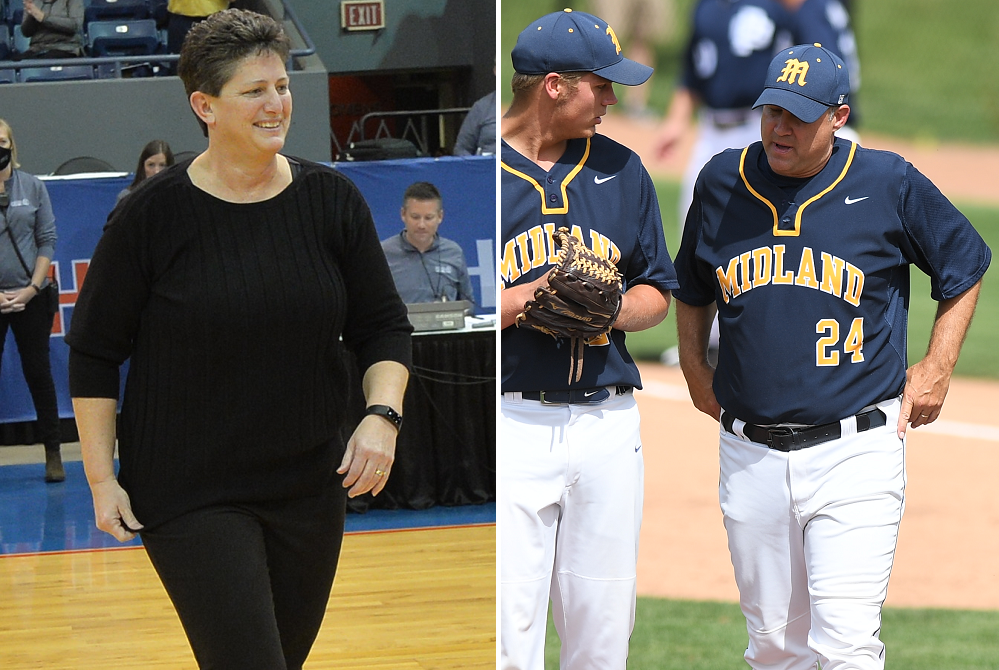
PHOTOS Battle Creek St. Philip volleyball coach Vicky Groat steps on the court to receive her team's Division 4 championship trophy in 2021, and Midland's Eric Albright (far right) confers with his pitcher during the 2018 Division 1 Baseball Semifinals.