


Tournament Attendance Nears 1.5 Million
October 5, 2012
The 2011-12 school year marked the fifth straight that attendance at Michigan High School Athletic Association postseason tournaments totaled more than 1.47 million fans – with records set for total attendance at tournaments for six sports.
Total attendance for 2011-12 was 1,479,421 fans, with 1,050,405 at boys tournaments and 429,016 spectators at girls tournaments. Attendance is kept for all sports except golf, skiing and tennis, for which admission typically is not charged.
The previous year, total attendance was 1,522,468 – a five-year high – with 1,090,040 fans at boys tournament events and 432,368 at girls events. The 2011-12 overall attendance figure was the lowest since 2006-07 and represents a 2.8 percent drop from 2010-11, with boys attendance down 3.6 percent but girls attendance down slightly less than one percent.
Twelve sports saw increased tournament attendance last school year from 2010-11: boys soccer (33,399), cross country (19,279) team wrestling (30,415), baseball (47,692), boys lacrosse (7,899), volleyball (99,295), competitive cheer (23,511), girls lacrosse (5,526), girls soccer (26,928) and softball (41,434). Two tournaments at which boys and girls compete simultaneously, bowling (12,346) and track and field (36,904), also saw increases during 2011-12.
Three girls sports set attendance records. Cheer and girls lacrosse each set all-time highs for the eighth consecutive year, with lacrosse’s annual increases dating back to its first year as an MHSAA-sponsored sport in 2005. Volleyball set a high for the fourth straight year despite a slight decrease in District attendance – totals at Regionals, Quarterfinals, Semifinals and the Finals all increased from 2010-11, the Finals total by 27 percent.
The combined bowling tournament also set a record, besting its figure of 12,099 fans in 2009-10, and the track and field tournament set a record for a second straight year, besting the 2010-11 attendance of 36,873. The combined boys and girls cross country tournament bested its 2010-11 record total by nearly 1,000 fans.
Eight more Finals joined volleyball with increases in attendance from 2010-11. Among the most notable, Girls Basketball Finals weekend saw an increase of 9.7 percent, while attendance at Team Wrestling Finals weekend and the Track and Field Finals both were up eight percent from the year before. Finals for cheer, girls soccer, bowling, boys soccer and individual wrestling also saw small increases in 2011-12.
Football again ranked as the most-attended MHSAA tournament, with 427,520 fans. Since playoff expansion occurred in 1999, the football playoffs have been the single most attended tournament series on 10 occasions. Boys basketball was second in 2011-12 attendance with 322,988 fans, and girls basketball was third with 158,481. All three of those sports saw attendance drops from the previous year – football by 4.7 percent, boys basketball by 3.6 percent and girls basketball by five percent. Boys basketball hit a record low for the second straight year. The 2011-12 football attendance, however, was still more than 24,000 fans better than in 2009-10, and girls basketball attendance was roughly 5,000 fans more than in 2008-09.
'Mentor' to Receive Forsythe Award
By
Geoff Kimmerly
MHSAA.com senior editor
March 14, 2017
Long before he became superintendent for multiple Oakland County school districts, George Heitsch was a young athletic director first at Westland Huron Valley and then West Bloomfield High School.
And thankfully, there were veterans like Auburn Hills Avondale’s Chuck Nurek to show him the ropes.
“Chuck was a gracious mentor taking the time to encourage, support and, at times, direct a ‘newbie,’” wrote Heitsch in recommending Nurek for the MHSAA’s Charles E. Forsythe Award. “Chuck has a passion and dedication for the Avondale interscholastic athletic program and high school sports in general. … Chuck had dedicated his life service to not only the students in Avondale but to bettering the student-athlete experience for everyone in Michigan.”
That career of service, and especially dedication to the training and educating of athletic directors and coaches throughout Michigan, has earned Nurek this year’s MHSAA annual honor for outstanding contributions to the interscholastic athletics community.
The Charles E. Forsythe Award is in its 40th year and named after the MHSAA’s first full-time and longest-serving chief executive. Forsythe Award recipients are selected each year by the MHSAA Representative Council. Nurek will receive his honor during the break after the first quarter of the MHSAA Class A Boys Basketball Final on March 25 at the Breslin Student Events Center in East Lansing.
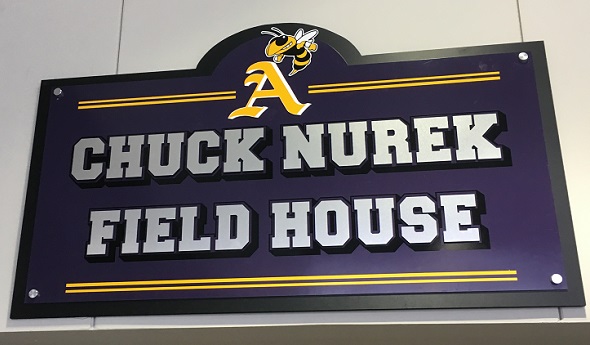
Nurek served as athletic director at Auburn Hills Avondale High School from 1978-1999 after previously serving as assistant athletic administrator beginning in 1968. In addition to his leadership at that school – Avondale named its fieldhouse after him in 2012 – Nurek also was active in county and league leadership and statewide as part of the Michigan Interscholastic Athletic Administrators Association (MIAAA).
In all three roles, Nurek helped to provide tools, training and mentoring for those charged with directing high school sports programs and teams. One of his far-reaching impacts came as a longtime member and chairperson of the MIAAA Convention Program Committee, growing and planning an event that regularly draws more than 500 athletic directors, secretaries and assistants. Nurek also served as an early steering committee member of the MHSAA coaches education program that has evolved to educate and certify thousands over the last 30 years.
“Chuck Nurek has dedicated decades to educational athletics and particularly to the training of those who in turn lead our programs in their daily pursuits,” MHSAA Executive Director John E. “Jack” Roberts said. “He has impacted multiple generations of school leaders in our state, both through his assistance in building up our coaches education and then his work in making the MIAAA conference one of the most valuable teaching tools of its kind. We’re pleased to present Chuck Nurek with the Charles E. Forsythe Award.”
Nurek coached varsity basketball, cross country and subvarsity football at points during his Avondale tenure, and also taught physical education for all but the final few years of his time as an athletic administrator.
It was during his time as athletic director that Nurek saw the need for education, both to combat heavy turnover among school athletic directors and also to provide framework for an influx of coaches who did not work fulltime in schools.
He first began in coaches education as part of a small group of athletic directors building a program for Oakland County. That group merged with another, and in 1987 Nurek contributed in the creation of what became known as the MHSAA’s Program of Athletic Coaches Education (PACE), the predecessor of the current Coaches Advancement Program (CAP).
 A frequent past speaker at MHSAA athletic director in-service programs, Nurek also served as part of an MHSAA mentoring program that paired veteran or retired athletic directors with new administrators. And he played a significant role in designing the MIAAA convention, which includes various training sessions for high school and middle school athletic directors, their assistants and secretaries while also serving as a significant source for networking and professional development.
“Just being able to work with all the great people over the years that I worked with, whether it be the leaders in Oakland County or leaders at the MIAAA,” Nurek said of his favorite memories over four decades, “and especially just the outstanding people on the conference committee, putting together one of the best conferences in the country.”
Nurek also served as part of the MIAAA’s State Sportsmanship Committee and Exemplary Athletic Programs Committee and as a representative to the 5 State Exchange Committee, chairing that group for a year.
At Avondale, Nurek co-sponsored a successful Substance Abuse Awareness Conference and organized a group of students to develop standards for sportsmanship both for the student body and the school’s parent group as well. At the league level, Nurek served as North Oakland Activities Conference president in 1980 and Metro Conference president from 1986-87, and later as president and secretary of the Macomb-Oakland Activities Conference. He also created a program to recognize academic excellence both for his league and all of Oakland County.
Nurek was named “Athletic Director of the Year” by the MIAAA for 1998-99 and his region’s award winner in 1991, and received the MIAAA’s George Lovich State Award of Merit in 2004. He also was named “Athletic Director of the Year” by the Oakland County Athletic Directors Association in 1996 and served as that body’s treasurer from 1983-99.
Nurek has been a member of the MIAAA since 1980 and National Interscholastic Athletic Administrators Association (NIAAA) since 1985. He also has been a member of the Michigan Association for Health, Physical Education, Recreation and Dance (MAHPERD) and American Alliance for Health, Physical Education, Recreation and Dance (AAHPERD).
He graduated from Avondale in 1958 and then earned his bachelor’s degree in education from Northwest Missouri State University in 1966. He also earned a master’s in education from Eastern Michigan University in 1971 and received Certified Athletic Administrator certification from the NIAAA in 1994. Nurek maintained a strong presence in the Avondale community, speaking at the district’s annual parent fairs and serving as a board member of Auburn Hills’ Boys Club for a decade. Nurek also was involved with the local Little League program for a number of years and worked as part of the Avondale football scholarship golf outing committee.
Past recipients of the Charles E. Forsythe Award
1978 - Brick Fowler, Port Huron; Paul Smarks, Warren
1979 - Earl Messner, Reed City; Howard Beatty, Saginaw
1980 - Max Carey, Freesoil
1981 - Steven Sluka, Grand Haven; Samuel Madden, Detroit
1982 - Ernest Buckholz, Mt. Clemens; T. Arthur Treloar, Petoskey
1983 - Leroy Dues, Detroit; Richard Maher, Sturgis
1984 - William Hart, Marquette; Donald Stamats, Caro
1985 - John Cotton, Farmington; Robert James, Warren
1986 - William Robinson, Detroit; Irving Soderland, Norway
1987 - Jack Streidl, Plainwell; Wayne Hellenga, Decatur
1988 - Jack Johnson, Dearborn; Alan Williams, North Adams
1989 - Walter Bazylewicz, Berkley; Dennis Kiley, Jackson
1990 - Webster Morrison, Pickford; Herbert Quade, Benton Harbor
1991 - Clifford Buckmaster, Petoskey; Donald Domke, Northville
1992 - William Maskill, Kalamazoo; Thomas G. McShannock, Muskegon
1993 - Roy A. Allen Jr., Detroit; John Duncan, Cedarville
1994 - Kermit Ambrose, Royal Oak
1995 - Bob Perry, Lowell
1996 - Charles H. Jones, Royal Oak
1997 - Michael A. Foster, Richland; Robert G. Grimes, Battle Creek
1998 - Lofton C. Greene, River Rouge; Joseph J. Todey, Essexville
1999 - Bernie Larson, Battle Creek
2000 - Blake Hagman, Kalamazoo; Jerry Cvengros, Escanaba
2001 - Norm Johnson, Bangor; George Lovich, Canton
2002 - John Fundukian, Novi
2003 - Ken Semelsberger, Port Huron
2004 - Marco Marcet, Frankenmuth
2005 - Jim Feldkamp, Troy
2006 - Dan McShannock, Midland; Dail Prucka, Monroe
2007 - Keith Eldred, Williamston; Tom Hickman, Spring Lake
2008 - Jamie Gent, Haslett; William Newkirk, Sanford-Meridian
2009 - Paul Ellinger, Cheboygan
2010 - Rudy Godefroidt, Hemlock; Mike Boyd, Waterford
2011 - Eric C. Federico, Trenton
2012 - Bill Mick, Midland
2013 - Jim Gilmore, Tecumseh; Dave Hutton, Grandville
2014 - Dan Flynn, Escanaba
2015 - Hugh Matson, Saginaw
2016 - Gary Hice, Petoskey; Gina Mazzolini, Lansing
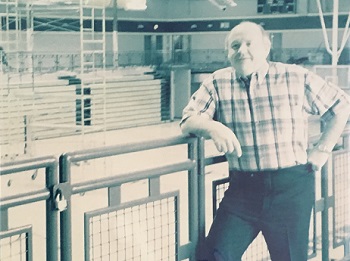
PHOTOS: (Top) A sign over the doors at Auburn Hills Avondale's gym announces the former athletic director for which it is named. (Middle) Chuck Nurek stands for a photo inside the building named after him. (Photos courtesy of Avondale High School.)