


Use of Participate Fees Falls in 2016-17
July 20, 2017
By Geoff Kimmerly
Second Half editor
Just under half of high schools responding to an annual Michigan High School Athletic Association survey assessed participation fees to help fund interscholastic athletics in 2016-17, making it the first school year since 2009-10 that fewer than 50 percent of respondents reported not charging student-athletes to play sports.
The survey, completed by 557 high schools – or 74 percent of the MHSAA membership – showed 49.7 percent charged participation fees, down from 51.5 percent in 2015-16.
There were 750 senior high schools in the MHSAA membership in 2016-17. This was the 13th survey of schools since the 2003-04 school year, when members reported fees were charged by 24 percent of schools. The percentage of member schools charging fees crossed 50 percent in 2010-11 and reached a high of 56.6 percent in 2013-14.
Class A schools remained the largest group charging fees, as 70 percent of respondents did so in 2016-17 and at least 70 percent have charged for the last five years. Class B schools ticked up to 52 percent charging fees, but Class C (42 down from 49 percent) and Class D (35 down from 38 percent) both reported lower percentages of schools charging fees.
Charging a standardized fee for each team on which a student-athlete participates – regardless of the number of teams – remains the most popular method among schools assessing fees, with that rate at 44 percent of schools that assessed fees for the second straight year. Schools charging a one-time standardized fee per student-athlete rose slightly, from 27 to 31 percent over the last year. Also for the second straight year, the survey showed a slight decrease in schools assessing fees based on tiers of the number of sports a student-athlete plays (for example, charging a larger fee for the first team and less for additional sports) and also a slight decrease in fees being assessed based on the specific sport being played.
The amounts of most fees also remained consistent from 2015-16 to 2016-17: the median annual maximum fee per student at $150, the median annual maximum family fee at $300 and the median per-team fee at $75 – all for at least the third straight year. The median fee assessed by schools that charge student-athletes once per year increased again, but only $5 to $125 after showing a $20 increase per student-athlete between 2014-15 and 2015-16.
The survey for 2016-17 and surveys from previous years can be found on the MHSAA Website by clicking here.
The MHSAA is a private, not-for-profit corporation of voluntary membership by more than 1,400 public and private senior high schools and junior high/middle schools which exists to develop common rules for athletic eligibility and competition. No government funds or tax dollars support the MHSAA, which was the first such association nationally to not accept membership dues or tournament entry fees from schools. Member schools which enforce these rules are permitted to participate in MHSAA tournaments, which attract more than 1.4 million spectators each year.
'Retired' Garvey Remains Eager to Give
By
Geoff Kimmerly
MHSAA.com senior editor
March 18, 2020
Earlier this week, Mike Garvey told his wife she can't let him quit all that he does to contribute to school sports across the state of Michigan, even if he is officially "retired."
But after 40 years serving in a variety of roles, he really doesn't have plans to stop. And she wasn't intending to make that request.
"I married the best girl in the world," Garvey said, "and she’s supportive and urges me to do the stuff that I enjoy."
And that has stretched over tenures at four Michigan high schools, serving as a teacher, coach and administrator, and continuing today in various roles at the local and statewide levels.
To celebrate his devotion and many contributions, Garvey has been named the 2020 recipient of the Michigan High School Athletic Association’s Charles E. Forsythe Award.
The annual award is in its 43rd year and named after former MHSAA Executive Director Charles E. Forsythe, the Association's first full-time and longest-serving chief executive. Forsythe Award recipients are selected each year by the MHSAA Representative Council, based on an individual's outstanding contributions to the interscholastic athletics community.
Garvey, who grew up mostly in Detroit, began his educational career in 1980 teaching at Marian Central Catholic in Woodstock, Ill., before returning to Michigan in 1985 to teach at Lawton High School. While at Lawton, he helped the Blue Devils’ wrestling program continue a dominating run as an assistant coach on Lower Peninsula Class D championship teams in 1986 and 1987 and runner-up teams in 1988 and 1989, and then as head coach of the 1990 Class D title winner. He also served as athletic director at Lawton from 1994-99 before leaving for the same position at Delton Kellogg, where he served from 1999-2006. Garvey then was athletic director at Otsego from 2006-10, and he then served as athletic director at Kalamazoo Hackett Catholic Prep from 2010-18.
He earned a number of accolades during his time as a coach and administrator, including the MHSAA’s Allen W. Bush Award in 2015 for his many contributions to educational athletics that often went unsung despite their great importance. Garvey also has been a registered MHSAA official for 35 years, in softball for all 35 and for a mix of seasons in baseball, basketball, volleyball, wrestling and track & field. He continues to instruct as part of the MHSAA’s Coaches Advancement Program (CAP) and has served as tournament manager for the MHSAA Team Wrestling Finals since their 2018 move to Wings Event Center in Kalamazoo.
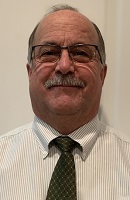 “I never looked at my jobs as jobs. I always looked at it as I had a mission and was trying to complete a mission,” said Garvey, who continues to reside in Lawton. “I think I can still help people, so maybe my mission isn’t complete.
“It’s a blast. I just feel like it’s a chance to give. Schools and athletics and everything have given so much to me. Plus the human interaction – working with kids and coaches and officials, it just fits me and I enjoy it.”
Among accolades at the state and national levels, Garvey received the National Interscholastic Athletic Administrators Association (NIAAA) 2016 Distinguished Service Award and the George Lovich State Award of Merit in 2009 from the Michigan Interscholastic Athletic Administrators Association (MIAAA).
Garvey remains an active member of both the MIAAA and NIAAA and the Michigan Wrestling Coaches Association. He remains on the faculty for the NIAAA’s Leadership Training Institute and has served as Michigan’s coordinator for the program. He’s been a long-serving member of the MHSAA’s Wrestling Committee and hosted more than 75 tournament events while an athletic director. He served as co-commissioner of the former Kalamazoo Valley Association and currently is the executive secretary of the Southwestern Michigan Athletic Conference.
He’s also rejoined the coaching ranks, taking over as head coach of Vicksburg High School’s girls and boys golf teams this school year.
“Even in ‘retirement,’ Mike Garvey continues to serve students, coaches and administrators with enthusiasm,” MHSAA Executive Director Mark Uyl said. “He continues to pass on to our current coaches the best practices he’s learned over decades, and he has played a sizable role in making the Team Wrestling Finals a record-setting event for attendance the last few seasons. His brings a genuine enjoyment to these activities, and we’re fortunate to have him continuing to take leading roles.”
Garvey began classes at Bloomfield Hills Brother Rice as a high school freshman, but after less than a month moved overseas as the family followed his father’s job with Chrysler. Garvey matriculated in Geneva, Switzerland, and then completed high school at The American School in London, England. Once back in the United States, Garvey earned bachelor’s and master’s degrees from Western Michigan University. He remains active in community service through his church and lake association.
Past recipients of the Charles E. Forsythe Award
1978 - Brick Fowler, Port Huron; Paul Smarks, Warren
1979 - Earl Messner, Reed City; Howard Beatty, Saginaw
1980 - Max Carey, Freesoil
1981 - Steven Sluka, Grand Haven; Samuel Madden, Detroit
1982 - Ernest Buckholz, Mt. Clemens; T. Arthur Treloar, Petoskey
1983 - Leroy Dues, Detroit; Richard Maher, Sturgis
1984 - William Hart, Marquette; Donald Stamats, Caro
1985 - John Cotton, Farmington; Robert James, Warren
1986 - William Robinson, Detroit; Irving Soderland, Norway
1987 - Jack Streidl, Plainwell; Wayne Hellenga, Decatur
1988 - Jack Johnson, Dearborn; Alan Williams, North Adams
1989 - Walter Bazylewicz, Berkley; Dennis Kiley, Jackson
1990 - Webster Morrison, Pickford; Herbert Quade, Benton Harbor
1991 - Clifford Buckmaster, Petoskey; Donald Domke, Northville
1992 - William Maskill, Kalamazoo; Thomas G. McShannock, Muskegon
1993 - Roy A. Allen Jr., Detroit; John Duncan, Cedarville
1994 - Kermit Ambrose, Royal Oak
1995 - Bob Perry, Lowell
1996 - Charles H. Jones, Royal Oak
1997 - Michael A. Foster, Richland; Robert G. Grimes, Battle Creek
1998 - Lofton C. Greene, River Rouge; Joseph J. Todey, Essexville
1999 - Bernie Larson, Battle Creek
2000 - Blake Hagman, Kalamazoo; Jerry Cvengros, Escanaba
2001 - Norm Johnson, Bangor; George Lovich, Canton
2002 - John Fundukian, Novi
2003 - Ken Semelsberger, Port Huron
2004 - Marco Marcet, Frankenmuth
2005 - Jim Feldkamp, Troy
2006 - Dan McShannock, Midland; Dail Prucka, Monroe
2007 - Keith Eldred, Williamston; Tom Hickman, Spring Lake
2008 - Jamie Gent, Haslett; William Newkirk, Sanford Meridian
2009 - Paul Ellinger, Cheboygan
2010 - Rudy Godefroidt, Hemlock; Mike Boyd, Waterford
2011 - Eric C. Federico, Trenton
2018 - Gary Ellis, Allegan
2019 – Jim Derocher, Negaunee; Fredrick J. Smith, Stevensville
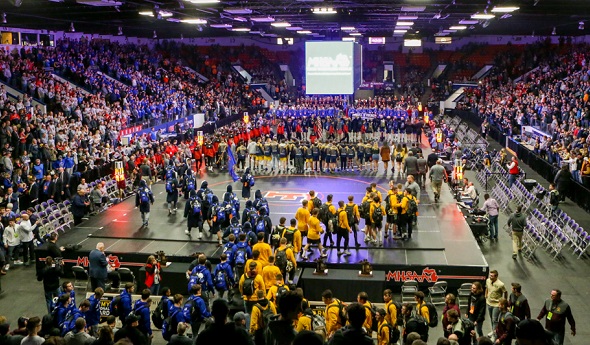
PHOTO: Teams take the mat for this season's MHSAA Team Wrestling Finals at Wings Event Center, again managed this winter by Mike Garvey. (Click for more from HighSchoolSportsScene.com.)