


Winter Rules Changes Focus on Safety
December 6, 2016
By Geoff Kimmerly
Second Half editor
Seasons are underway for teams participating in 12 winter sports for which the Michigan High School Athletic Association sponsors postseason tournaments, with a continuing focus on safety highlighting rules changes taking effect with the first days of competition.
Beginning with ice hockey’s first games Nov. 14, six sports started play during the final weeks of November, while the rest will be underway by the end of this week; Wrestling on Dec. 7 and Boys and Girls Skiing on Dec. 10 will be the final winter sports to begin competition.
Basketball, wrestling and ice hockey are among sports with noticeable changes to enhance safety this winter. In basketball, a change has been made to further protect the free-throw shooter from being displaced immediately after attempting a shot. Players occupying marked free-throw lane spaces may enter the lane on the release of the ball but may not touch or cross the free-throw line extended, into the semicircle, until the ball is released and touches the ring or backboard. Other players not occupying marked lane spaces may not have either foot beyond the vertical plane of the free-throw line extended and the 3-point line which is farther from the basket until the ball touches the ring or until the free throw ends. Both are designed to keep the free-throw shooter free from contact and alone in the semicircle directly following the shot attempt.
Also in basketball, non-playing personnel including cheerleaders, media and school supervisors must remain outside the playing area during a timeout 30 seconds or shorter. Non-playing personnel also must remain throughout the game in the areas between the free-throw lines extended and sidelines, to provide a safer environment free of possible collisions for both playing and non-playing personnel.
Officials will be on the lookout in wrestling for a hold that could lead to a competitor being dropped to the mat after a lift without the ability to use his or her arms to break the fall because they are trapped as part of the hold. If a wrestler, from a standing position, is placed in a body lock with one or both arms trapped, the offensive wrestler is required to safely return that defensive wrestler to the mat through a variety of legal moves. Officials will stop the match if a lift is coming or imminent that would result in the defensive wrestler being unable to break his or her fall because of an arm trap.
Hockey contact to the head or neck area will be penalized with multiple levels of severity in 2016-17, depending on the extent and intent of that contact. If contact to the head or neck area is deemed to be direct – that is, with the initial force of the contact occurring to the neck or head area – that contact will be considered a flagrant foul and result in a major penalty or game disqualification. If the contact is deemed indirect – with the initial force of the contact beginning below the neck and progressing upward to the head or neck area – the result will be a minor penalty unless the indirect contact is deemed by officials to be flagrant, which again will result in a major or game disqualification.
Also of note in hockey, all players (excluding goaltenders) must now take a stationary position on all faceoffs before the puck is dropped. By eliminating motion prior to faceoffs, this rule change is designed to also eliminate any possible advantage gained by players previously working for better position.
The 2016-17 Winter campaign culminates with postseason tournaments beginning with the Upper Peninsula Girls and Boys Swimming & Diving Finals on Feb. 18, and wraps up with the Boys Basketball Finals on March 25. Here is a complete list of winter tournament dates:
Boys Basketball
Districts – March 6, 8 & 10
Regionals – March 13 & 15
Quarterfinals – March 21
Semifinals – March 23-24
Finals – March 25
Girls Basketball
Districts – Feb. 27, March 1 & 3
Regionals – March 7 & 9
Quarterfinals – March 14
Semifinals – March 16-17
Finals – March 18
Girls & Boys Bowling
Team Regionals – Feb. 24
Singles Regionals – Feb. 25
Team Finals – March 3
Singles Finals – March 4
Girls Competitive Cheer
Districts – Feb. 17-18
Regionals – Feb. 25
Finals: March 3-4
Girls Gymnastics
Regionals – March 4
Team Finals – March 10
Individual Finals – March 11
Ice Hockey
Pre-Regionals – Feb. 27-March 3
Regional Finals – March 3-4
Quarterfinals – March 7-8
Semifinals – March 9-10
Finals – March 11
Girls & Boys Skiing
Regionals – Feb. 13-17
Finals – Feb. 27
Girls & Boys Swimming & Diving
U.P. Girls & Boys Finals – Feb. 18
L.P. Boys Diving Regionals – March 2
L.P. Boys Finals – March 10-11
Wrestling
Team Districts – Feb. 8-9
Individual Districts – Feb. 11
Team Regionals – Feb. 15
Individual Regionals – Feb. 18
Team Quarterfinals – Feb. 24
Team Semifinals & Finals – Feb. 25
Individual Finals – March 2-4
Several 1st-Time Winners Highlight 2025-26 MHSAA Parade of Champions
By
Geoff Kimmerly
MHSAA.com senior editor
June 18, 2026
Three schools celebrated their first Michigan High School Athletic Association Finals championships in any sport during the 2025-26 school year as 39 teams total won first Finals titles in their respective sports.
Holland Calvary, in boys cross country, Durand in boys bowling and Walled Lake Northern in softball won their schools’ first Finals championships in any sport, as 88 schools total won at least one of the 132 MHSAA team titles awarded over the three seasons.
A total of 23 schools won two or more championships this school year, paced again by Marquette with eight earned in girls and boys cross country, boys golf, girls skiing, girls and boys swimming & diving, boys tennis and boys track & field. Detroit Country Day was next with seven Finals championships, followed by Detroit Catholic Central with six and Ann Arbor Pioneer with four.
Bloomfield Hills Cranbrook Kingswood, Negaunee, Northville and Rockford all won three titles in 2025-26. Winning two were Birmingham Seaholm, Charlevoix, Farmington Hills Mercy, Flint Kearsley, Flint Powers Catholic, Grand Rapids West Catholic, Jackson Lumen Christi, Lake Linden-Hubbell, Lowell, Newberry, Orchard Lake St. Mary’s, Pewamo-Westphalia, Ravenna, Rudyard and West Iron County.
A total of 48 champions were repeat winners from 2025-26. A total of 31 teams won championships for at least the third-straight season, while 22 teams extended title streaks to at least four consecutive seasons. The Lowell wrestling program owns the longest title streak at 13 seasons, followed by Dundee wrestling’s nine consecutive titles and runs of seven straight Finals victories by the Detroit Catholic Central ice hockey team and Marquette’s boys cross country and boys swimming & diving programs.
This school year saw the addition of field hockey and boys volleyball to the MHSAA’s postseason tournament offerings. Eighteen of the MHSAA's 30 team championship tournaments are unified, involving teams from the Upper and Lower Peninsulas, while separate competition to determine title winners in both peninsulas is conducted in remaining sports.
For a sport-by-sport listing of MHSAA champions for 2025-26, click here (PDF).
The MHSAA is a private, not-for-profit corporation of voluntary membership by more than 1,500 public and private senior high schools and junior high/middle schools which exists to develop common rules for athletic eligibility and competition. No government funds or tax dollars support the MHSAA, which was the first such association nationally to not accept membership dues or tournament entry fees from schools. Member schools which enforce these rules are permitted to participate in MHSAA tournaments, which attract more than 1.4 million spectators each year.
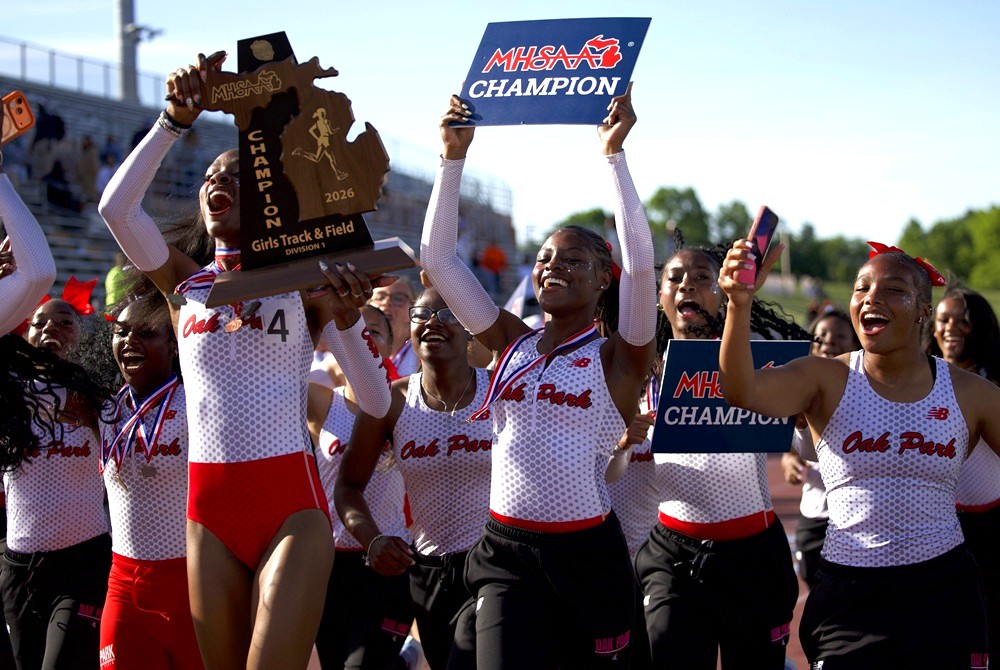
PHOTO The Oak Park girls track & field team hoist their championship trophy and sign May 30 at Rockford High School. (Click for more from RunMichigan.com.)