

New Math: Division & Multiplication Problems
July 25, 2017
By Jack Roberts
MHSAA Executive Director
This is the second part in a series on MHSAA tournament classification, past and present, that will be published over the next two weeks. This series originally ran in this spring's edition of MHSAA benchmarks.
High school tournament classifications went viral before there was social media and most of us knew what “viral” meant.
Much as a virus infects computers today or has created epidemics of disease around the world for centuries, high school tournament classification – once introduced – tends to spread uncontrollably. Once started, it tends to keep expanding and rarely contracts.
While we are still some distance from providing every team a trophy as a result of expanding high school tournament classification across the country, there is criticism nevertheless that we are headed in that direction – a philosophy which is supposed to exist only in local youth sports for our youngest children.
Michigan could be blamed for all this. Michigan is generally accepted as the first state to provide different classifications for season-ending tournaments for different sized schools. It started a century ago. Today, every state has various classifications for its tournaments in most if not all sports. And it is a bit ironic that Michigan – creator of the classification chaos – more than most other states has kept the number of tournament classes or divisions under control.
Yes, there is evidence that tournament classifications have expanded over the years in Michigan, especially with the relatively recent introduction of tournaments in football and the late 1990s’ move from classes to divisions in most MHSAA tournaments. But the MHSAA Representative Council has held true to its word when it expanded the playoffs for football from four classes to eight divisions: this is needed because of unique factors of football, factors that exist in no other sport; and all other sports should be capped at a maximum of four classes or divisions.
Kentucky is the preeminent defender of single-class basketball. All of its 276 high schools compete for the single state championship for each gender. In Indiana, there are still open wounds from its move in 1998 from one to four classes for its 400 schools in basketball.
Multi-class tournaments have tended to increase the number of non-public school champions, which some states are trying to lower through enrollment “multipliers,” and also tend to increase the number of repeat champions, which some states are trying to affect with “success factors” which lift smaller schools into classifications for larger schools if they take home too many trophies.
While there is considerable evidence that state tournaments do as much bad as good for educational athletics, state associations persist in providing postseason tournaments because, on balance, the experiences are supposed to be good for student-athletes. And once we reach that conclusion it is just a small leap to believe that if the tournaments are good for a few, they must be better for more – which leads to creating more and more tournament classifications. One becomes two classes, then three, then four and so forth.
While the argument is that more classifications or divisions provides more students with opportunities to compete and win, it is undeniable that the experience changes as the number of tournament classifications expands. It is not possible for state associations to provide the same level of support when tournament classifications expand to multiple venues playing simultaneously. For example, there is less audio and video broadcast potential at each venue, and less media coverage to each venue. Focus is diluted and fans diminished at each championship.
No one can argue reasonably that today's two-day MHSAA Football Finals of eight championship games has the same pizazz as the one-day, four-games event conducted prior to 1990.
In some states the number of divisions has grown so much that it is difficult to see much difference between the many season-ending state championship games and a regular-season event in the same sport.
It is a balancing act. And Michigan has been studying that balance longer than any other state, and charting a steadier course than most.
Addition by Division
The shift to Divisions for MHSAA Tournament play in numerous sports has added up to a greater number of champions for teams and individuals across the state. Following are the sports currently employing a divisional format, and the procedures for determining enrollment and classification.
In 23 statewide or Lower Peninsula tournaments, schools which sponsor the sport are currently divided into nearly equal divisions. They are:
- Baseball - 4 Divisions
- Boys Bowling - 4 Divisions
- Girls Bowling - 4 Divisions
- Girls Competitive Cheer - 4 Divisions
- LP Boys Cross Country - 4 Divisions
- LP Girls Cross Country - 4 Divisions
- LP Boys Golf - 4 Divisions
- LP Girls Golf - 4 Divisions
- Ice Hockey - 3 Divisions
- Boys Lacrosse - 2 Divisions
- Girls Lacrosse - 2 Divisions
- Boys Skiing - 2 Divisions
- Girls Skiing - 2 Divisions
- LP Boys Soccer - 4 Divisions LP
- Girls Soccer - 4 Divisions
- Girls Softball - 4 Divisions
- LP Boys Swimming & Diving - 3 Divisions
- LP Girls Swimming & Diving - 3 Divisions
- LP Boys Tennis - 4 Divisions
- LP Girls Tennis - 4 Divisions
- LP Boys Track & Field - 4 Divisions
- LP Girls Track & Field - 4 Divisions
- Wrestling - 4 Divisions
Lists of schools for each division of these 23 tournaments are posted on MHSAA.com approximately April 1. Listings of schools in Upper Peninsula tournaments for their sports are also posted on MHSAA.com. The lists are based on school memberships and sports sponsorships in effect or anticipated for the following school year, as known to the MHSAA office as of a date in early March.
In football, the 256 schools which qualify for MHSAA 11-player playoffs are placed in eight equal divisions annually on Selection Sunday. Beginning in 2017, the 8-player divisions will be determined in a like manner on Selection Sunday as well, with 32 qualifying schools placed in two divisions.
Schools have the option to play in any higher division in one or more sports for a minimum of two years.
The deadlines for "opt-ups" are as follows:
- Applications for fall sports must be submitted by April 15
- Applications for winter sports must be submitted by Aug. 15
- Applications for spring sports must be submitted by Oct. 15
Subsequent to the date of these postings for these tournaments, no school will have its division raised or lowered by schools opening or closing, schools adding or dropping sports, schools exercising the option to play in a higher division, or approval or dissolution of cooperative programs.
When the same sport is conducted for boys and girls in the same season (e.g., track & field and cross country), the gender that has the most sponsoring schools controls the division breaks for both genders.
1st & Goal: 2024 Playoffs Week 1 Preview
By
Geoff Kimmerly
MHSAA.com senior editor
November 1, 2024
Tonight, the 50th MHSAA Football Playoffs begin. And while we’ll always focus on how they finish, how the stage is set at the start makes them perhaps most meaningful to the thousands who have earned this experience over the last half-century.
 Football is the only MHSAA-sponsored head-to-head sport for which teams must qualify for the opportunity to continue into the postseason. Making the playoffs for many can rank right up there with winning a league championship, and potentially higher when schools reach them for the first time, or first time in a long time.
No teams accomplished that feat this fall after Perry and Hart made their playoff debuts in 2023. But of the 601 varsities that took the field during the regular season, only seven haven’t made the MHSAA Playoffs at least once. At the same time, 682 schools have made at least one postseason appearance, including several which have since shut their doors or merged with other schools. When Beal City and Crystal Falls Forest Park take the field this weekend, they’ll do so after qualifying for the playoffs for an MHSAA-record 39th time, not counting COVID-shortened 2020 when all but a few teams made the field.
Tournaments begin with District Semifinals in 11-player and Regional Semifinals in 8-player. Tickets to both cost $7, and nearly 120 of the 144 games to be played will be streamed live on the NFHS Network. See below for some of the matchups that most pop off the page this first round, and come back to MHSAA.com all weekend for scores and updated pairings.
11-Player Division 1
Oxford (6-3) at Davison (7-2)
Oxford is coming off winning arguably the most powerful league in the state – the Oakland Activities Association Red, which includes Clarkston, Lake Orion, Rochester Adams and West Bloomfield – and a District title claimed over the next two weeks would be the program’s first since 2001. But in terms of depth of talent, the Saginaw Valley Red may not be far behind its OAA counterpart, and Davison’s only losses this season were by six points two weeks ago to champion Grand Blanc and in a season opener to Division 2 contender Warren De La Salle Collegiate.
Keep an eye on these FRIDAY East Kentwood (5-4) at Hudsonville (8-1), Clarkston (6-3) at Lake Orion (6-3), Saline (6-3) at Northville (6-3), Romeo (4-5) at Utica Eisenhower (7-2).
11-Player Division 2
Grand Rapids Northview (9-0) at Byron Center (8-1)
Northview packing up the bus for a road game explains plenty of what Byron Center has seen on its schedule this season, with its only loss by two points in Week 4 to quite possibly the Division 2 favorite Muskegon Mona Shores. But Northview has seen its share of competition as well in finishing a regular season undefeated for the first time since 1970 (according to Michigan-Football.com). The Wildcats will find out how all of that transfers as they pursue more program history – their first playoff win.
Keep an eye on these FRIDAY Portage Northern (5-4) at Portage Central (6-3), Milford (7-2) at East Lansing (6-3), Warren Mott (7-2) at Birmingham Seaholm (6-3), Roseville (7-2) at Grosse Pointe South (9-0).
11-Player Division 3
Riverview (8-1) at Trenton (6-3)
Trenton has to be one of the most intriguing three-losses teams in the state. The Trojans opened this season with losses to Brownstown Woodhaven and Southgate Anderson – the latter would end up second in the Downriver League – but Trenton went on to defeat eventual league champion Gibraltar Carlson in Week 6 and another co-runner-up Allen Park in Week 7 before suffering a one-point loss to Southeastern Conference White champ Chelsea in Week 8. Riverview, meanwhile, hits the road with its only loss to Huron League champion Monroe St. Mary Catholic Central, potentially the favorite in Division 7 this month. That defeat also was the only game over the last seven in which the Pirates didn’t score at least 43 points.
Keep an eye on these FRIDAY Cedar Springs (7-2) at Lowell (7-2), Zeeland East (5-4) at Zeeland West (8-1), Linden (4-5) at Fenton (7-2), Garden City (7-2) at Walled Lake Western (9-0).
11-Player Division 4
Paw Paw (8-1) at Niles (8-1)
This is a rare repeat from a Week 9 regular-season game, won by Niles 21-0 to take the Wolverine Conference championship outright. The shutout was the Vikings’ second in a row and fifth this season and lowered their points allowed average this fall to 6.3 per game. But all is not lost for Paw Paw; prior to the shutout the Red Wolves were averaging 38.1 points per game, and they no doubt would savor an opportunity to avenge such a recent disappointment.
Keep an eye on these FRIDAY Edwardsburg (6-3) at Battle Creek Harper Creek (8-1), Ortonville Brandon (6-3) at Goodrich (8-1), Harper Woods (6-3) at Redford Union (8-1), Croswell-Lexington (6-3) at Marysville (8-1).
11-Player Division 5
Clare (7-2) at Ogemaw Heights (8-1)
These two shared the Jack Pine Conference Division 1 championship thanks to Ogemaw Heights’ 41-34 win over the Pioneers in Week 5 (and also Ogemaw’s 27-25 loss to Standish-Sterling in Week 7). In their first meeting, Ogemaw led by 15 at the end of the third quarter, Clare tied it up with 3:57 to play and Ogemaw scored the final go-ahead points on a fourth-down touchdowns with 1:08 left on the clock. Clare’s only loss since came last week to undefeated Petoskey, while the Falcons rebounded from their lone defeat with wins over playoff teams Harrison and Croswell-Lexington.
Keep an eye on these FRIDAY Dowagiac (6-3) at Berrien Springs (6-3), Flint Hamady (5-3) at Corunna (7-2), Whitmore Lake (7-2) at Ann Arbor Father Gabriel Richard (5-4), Detroit Denby (6-3) at Flat Rock (7-2).
11-Player Division 6
Ovid-Elsie (7-2) at Almont (9-0)
These two have met in the playoffs three of the last four seasons, with Almont winning last year’s Semifinal matchup 45-21. The Raiders have had only one game closer than 14 points this fall – a 29-28 win over rival Armada in Week 6 – and last week’s 41-22 victory over Detroit Edison was especially notable as a potential spark for another run. Ovid-Elsie started this fall powerfully before running into still-undefeated Chesaning in Week 7 and then falling to Standish-Sterling last week, but the Marauders are playing for their third-straight eight-win season and between those defeats avenged a 2023 loss to New Lothrop.
Keep an eye on these FRIDAY Negaunee (6-3) at Boyne City (7-2), Constantine (6-3) at Parchment (7-2), Detroit Central (6-3) at Detroit Edison (6-3), Detroit Old Redford (8-1) at Detroit Pershing (7-2).
11-Player Division 7
Union City (8-1) at Hanover-Horton (8-1)
Union City not only won a third-straight Big 8 Conference title this season but also has its most wins since 2014, and despite falling to Buchanan 17-7 a week ago. Hanover-Horton is coming off a loss as well, 35-14 to Leslie in the Cascades Conference championship game, but also is at eight wins for the first time since 2014 and after winning the Cascades West championship. Both teams’ offenses were stopped last week, but Union City averaged nearly 39 points per game coming into Week 9 and the Comets were at just over 41.
Keep an eye on these FRIDAY Charlevoix (6-3) at Traverse City St. Francis (6-3), Harrison (7-2) at McBain (8-1), Napoleon (6-3) at Hudson (8-1), Ottawa Lake Whiteford (5-4) at Clinton (6-3).
11-Player Division 8
Ubly (6-3) at Harbor Beach (9-0)
On paper this might not seem too intriguing, but the storylines stack up nicely. Ubly is the reigning Division 8 champion but lost its first three games this fall including 45-6 to Harbor Beach in Week 3. However, the Bearcats have not lost again or even come close, winning their last six games by nearly 29 points per. That said, Harbor Beach has yet to cool down after escaping an opener with Cass City with a two-point victory. The Pirates are allowing just six points per game and scoring 46 as they passed 60 last year week for the second time this fall.
Keep an eye on these FRIDAY Frankfort (7-2) at Beal City (7-2), Saugatuck (6-3) at White Pigeon (8-1), Manchester (7-2) at Petersburg Summerfield (8-1), Bark River-Harris (5-4) at East Jordan (7-2).
8-Player Division 1
Martin (7-1) at Gobles (9-0)
Their Oct. 11 meeting was among the games of the year for all of 8-player football this regular season and decided a league title, and the magnitude of this rematch may eclipse it. Gobles won that Week 7 matchup 20-14, holding on to hand the two-time reigning Division 1 champion Clippers their only loss this fall. But surely Martin has noted a few times over the last three weeks that Gobles won last year’s regular-season game as well, 53-16, before Martin won the rematch 28-6 on the way to that repeat Finals championship.
Keep an eye on these FRIDAY Mendon (8-1) at Climax-Scotts (8-1), Fulton (8-1) at Kingston (7-2), Munising (6-3) at Pickford (9-0). SATURDAY Norway (7-2) at Ishpeming (6-2).
8-Player Division 2
Portland St. Patrick (8-1) at Morrice (8-1)
St. Patrick has won their last two meetings including 29-12 in Week 4 this fall, with that victory keyed in part by quarterback Brady Leonard – who has continued to put up big numbers. Morrice will attempt to slow him down with a defensive group that has given up only 26 points over five games since that loss to the Shamrocks, including a Week 5 shutout of Fulton – the lone team to defeat St. Patrick as all three shared the Mid-State Activities Conference Red title.
Keep an eye on these FRIDAY Marion (8-1) at Onekama (8-1), Burr Oak (7-2) at Pittsford (7-2), Mio (7-2) at Au Gres-Sims (8-1). SATURDAY Gaylord St. Mary (7-2) at Powers North Central (8-1).
MHSAA.com's weekly “1st & Goal” previews and reviews are powered by MI Student Aid, a division within the Department of Lifelong Education, Advancement, and Potential (MiLEAP). MI Student Aid encourages students to pursue postsecondary education by providing access to student financial resources and information. MI Student Aid administers the state’s scholarship and grant programs that help make college Accessible, Affordable and Attainable for you. Click to connect with MI Student Aid and find more information on Facebook and Twitter @mistudentaid.
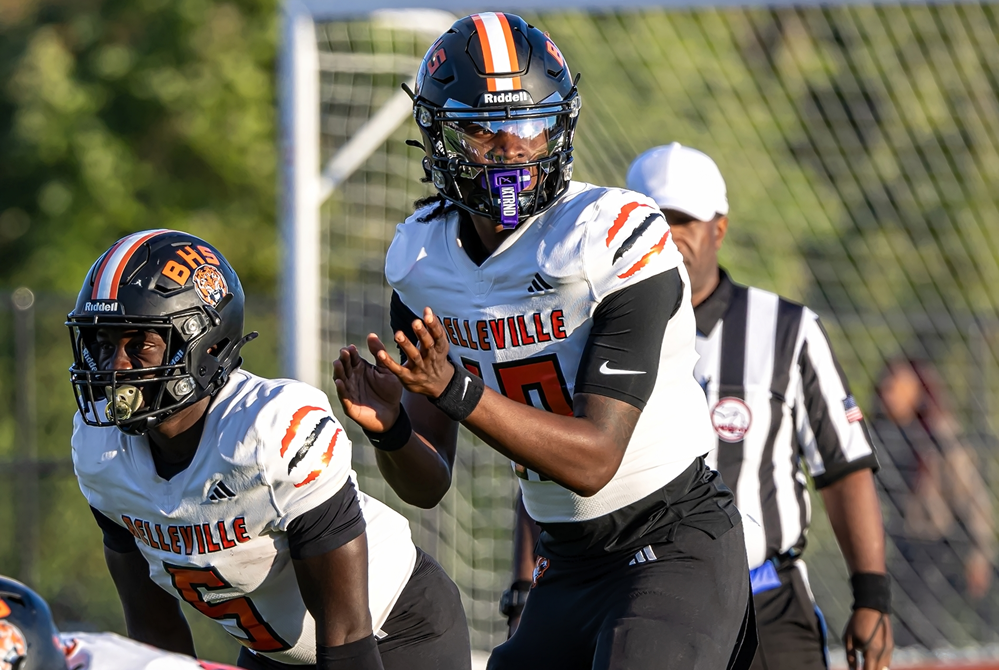
PHOTO Belleville's Bryce Underwood (19) prepares to take a snap during his team's regular-season win over Livonia Stevenson. (Photo by Douglas Bargerstock.)