

New Math: Division & Multiplication Problems
July 25, 2017
By Jack Roberts
MHSAA Executive Director
This is the second part in a series on MHSAA tournament classification, past and present, that will be published over the next two weeks. This series originally ran in this spring's edition of MHSAA benchmarks.
High school tournament classifications went viral before there was social media and most of us knew what “viral” meant.
Much as a virus infects computers today or has created epidemics of disease around the world for centuries, high school tournament classification – once introduced – tends to spread uncontrollably. Once started, it tends to keep expanding and rarely contracts.
While we are still some distance from providing every team a trophy as a result of expanding high school tournament classification across the country, there is criticism nevertheless that we are headed in that direction – a philosophy which is supposed to exist only in local youth sports for our youngest children.
Michigan could be blamed for all this. Michigan is generally accepted as the first state to provide different classifications for season-ending tournaments for different sized schools. It started a century ago. Today, every state has various classifications for its tournaments in most if not all sports. And it is a bit ironic that Michigan – creator of the classification chaos – more than most other states has kept the number of tournament classes or divisions under control.
Yes, there is evidence that tournament classifications have expanded over the years in Michigan, especially with the relatively recent introduction of tournaments in football and the late 1990s’ move from classes to divisions in most MHSAA tournaments. But the MHSAA Representative Council has held true to its word when it expanded the playoffs for football from four classes to eight divisions: this is needed because of unique factors of football, factors that exist in no other sport; and all other sports should be capped at a maximum of four classes or divisions.
Kentucky is the preeminent defender of single-class basketball. All of its 276 high schools compete for the single state championship for each gender. In Indiana, there are still open wounds from its move in 1998 from one to four classes for its 400 schools in basketball.
Multi-class tournaments have tended to increase the number of non-public school champions, which some states are trying to lower through enrollment “multipliers,” and also tend to increase the number of repeat champions, which some states are trying to affect with “success factors” which lift smaller schools into classifications for larger schools if they take home too many trophies.
While there is considerable evidence that state tournaments do as much bad as good for educational athletics, state associations persist in providing postseason tournaments because, on balance, the experiences are supposed to be good for student-athletes. And once we reach that conclusion it is just a small leap to believe that if the tournaments are good for a few, they must be better for more – which leads to creating more and more tournament classifications. One becomes two classes, then three, then four and so forth.
While the argument is that more classifications or divisions provides more students with opportunities to compete and win, it is undeniable that the experience changes as the number of tournament classifications expands. It is not possible for state associations to provide the same level of support when tournament classifications expand to multiple venues playing simultaneously. For example, there is less audio and video broadcast potential at each venue, and less media coverage to each venue. Focus is diluted and fans diminished at each championship.
No one can argue reasonably that today's two-day MHSAA Football Finals of eight championship games has the same pizazz as the one-day, four-games event conducted prior to 1990.
In some states the number of divisions has grown so much that it is difficult to see much difference between the many season-ending state championship games and a regular-season event in the same sport.
It is a balancing act. And Michigan has been studying that balance longer than any other state, and charting a steadier course than most.
Addition by Division
The shift to Divisions for MHSAA Tournament play in numerous sports has added up to a greater number of champions for teams and individuals across the state. Following are the sports currently employing a divisional format, and the procedures for determining enrollment and classification.
In 23 statewide or Lower Peninsula tournaments, schools which sponsor the sport are currently divided into nearly equal divisions. They are:
- Baseball - 4 Divisions
- Boys Bowling - 4 Divisions
- Girls Bowling - 4 Divisions
- Girls Competitive Cheer - 4 Divisions
- LP Boys Cross Country - 4 Divisions
- LP Girls Cross Country - 4 Divisions
- LP Boys Golf - 4 Divisions
- LP Girls Golf - 4 Divisions
- Ice Hockey - 3 Divisions
- Boys Lacrosse - 2 Divisions
- Girls Lacrosse - 2 Divisions
- Boys Skiing - 2 Divisions
- Girls Skiing - 2 Divisions
- LP Boys Soccer - 4 Divisions LP
- Girls Soccer - 4 Divisions
- Girls Softball - 4 Divisions
- LP Boys Swimming & Diving - 3 Divisions
- LP Girls Swimming & Diving - 3 Divisions
- LP Boys Tennis - 4 Divisions
- LP Girls Tennis - 4 Divisions
- LP Boys Track & Field - 4 Divisions
- LP Girls Track & Field - 4 Divisions
- Wrestling - 4 Divisions
Lists of schools for each division of these 23 tournaments are posted on MHSAA.com approximately April 1. Listings of schools in Upper Peninsula tournaments for their sports are also posted on MHSAA.com. The lists are based on school memberships and sports sponsorships in effect or anticipated for the following school year, as known to the MHSAA office as of a date in early March.
In football, the 256 schools which qualify for MHSAA 11-player playoffs are placed in eight equal divisions annually on Selection Sunday. Beginning in 2017, the 8-player divisions will be determined in a like manner on Selection Sunday as well, with 32 qualifying schools placed in two divisions.
Schools have the option to play in any higher division in one or more sports for a minimum of two years.
The deadlines for "opt-ups" are as follows:
- Applications for fall sports must be submitted by April 15
- Applications for winter sports must be submitted by Aug. 15
- Applications for spring sports must be submitted by Oct. 15
Subsequent to the date of these postings for these tournaments, no school will have its division raised or lowered by schools opening or closing, schools adding or dropping sports, schools exercising the option to play in a higher division, or approval or dissolution of cooperative programs.
When the same sport is conducted for boys and girls in the same season (e.g., track & field and cross country), the gender that has the most sponsoring schools controls the division breaks for both genders.
Fearful Start Behind Her, Abnet Continuing to Amaze for Undefeated Vicksburg
By
Pam Shebest
Special for MHSAA.com
February 7, 2023
VICKSBURG – It is not often that a mother calls her child’s concussion a blessing, but it certainly was for Vicksburg senior Tristin Abnet.
 The concussion, sustained her freshman year during a volleyball game, led to tests which led to the discovery of a brain tumor.
Luckily, the tumor was benign and, after the surgery and a long recovery, Abnet is one of two seniors on the undefeated girls basketball team that has set a program record this winter for most wins in a season at 16 and counting, eclipsing the previous mark of 15.
And when it comes to Abnet’s journey over the last three years, Bulldogs coach Tim Kirby said it’s been nothing short of amazing.
After taking a hit during a volleyball game, “I actually got a concussion and I ended up with a headache for about a month or so,” Abnet said.
“I didn’t think too much of it because I always got injuries and always got over them. But this one scared me a little bit.”
It was not until she was playing in a college exposure softball tournament that November that she realized something more was going on.
“Tristin was an up-and-coming softball athlete throughout the country,” her dad, Cheyenne, said. “She won many national championships up to her freshman year (in travel softball).
“We were playing at a college exposure tournament, and she was the youngest on the team. The third day (of the tournament) she started crying because her headache was so bad. She asked me if I would take her out.”
Her mother, Kristina, added, “That was so unlike T. She would battle through anything.”
At that moment, they knew something was terribly wrong.
“She was only making it through maybe two days of school every week because of headaches,” Kristina said. “We took her to her family doctor (in November), and they weren’t comfortable with everything.
“Her doctor (Rosa Maira) said she felt it necessary to do further imaging. Had she not, we’d still never know.”
 The wait during the imaging dragged on, causing a bit of concern for her parents.
“They kept her for so long, and I said there’s something wrong – Mother’s intuition,” Kristina said.
“Then they came out and took us back and showed us what they found and asked to do further testing. Everything snowballed after that.”
Finding out about the tumor, “My world crashed,” Kristina said, with tears in her eyes. “(In 2011) I had a lot of tumors, desmoid tumors, and to think of the battle I went through and the fact that it was on her brain, it was tough.”
In March, doctors performed a biopsy, finding Tristin’s tumor was a low-grade glioma, which is benign.
“We all lost it that day,” Kristina said. “We had our entire family there for her first surgery in March. We left (the hospital) three days later, and then COVID hit.”
With classes online, “She ended up not having to go back to school that year, so that was a blessing too.”
The surgery to remove the tumor was scheduled for August 2020, and during the months between the biopsy and surgery, Tristin said, “I didn’t want to freak myself out because I knew it was coming, I knew what was going to happen and there was nothing I could do about it.”
Her dad said Tristin “never cried in front of me from the day at the tournament all the way to the day of her surgery.
“She was so, so strong, and she was just a little girl. I never saw a tear until they were ready to wheel her away for the surgery.”
One worry for Tristin was the chance of losing her hair to facilitate the craniotomy.
“First they told me they were going to shave my head halfway back and then, as I was getting wheeled back, there were two girl nurses talking about what they were going to do with my hair, so I knew they weren’t going to completely shave my head,” Abnet said.
 The surgery lasted 13 hours at Helen DeVos Children’s Hospital in Grand Rapids, and three days later she was headed home to her bedroom decorated by friends and family.
At first, Tristin was allowed no competition for six months after the surgery. But after a CT scan, doctors added another two months before giving her the OK to play.
“There are (three) metal plates there, that’s why she could not go back to sports for such a long time because that plate had to heal,” her dad said.
Although she could not play basketball her sophomore year, she found a way to stay involved: She became the varsity team manager.
“As a sophomore she literally was here for every practice and every game, even though she wasn’t allowed to participate,” Kirby said.
“At the end of the season, her team unanimously voted her “best teammate” on the entire team, and she couldn’t play. I think that’s a testament to the kind of person she is and the impact she had on the team.”
After taking a year off and after major surgery, Abnet had a lot of catching up to do, both physically and mentally, during her junior year, her coach said.
“Last year, you just wanted to make sure you kept her safe,” Kirby noted. “This year, I haven’t worried about it as much because she’s been through it and we’re all more comfortable with it.
“She knows what her limitations are. Last year, I was a little more leery about it.”
Tristin worked her way back into shape.
 “She goes to the gym four days a week,” her mom said. “She’s literally built up about 10 pounds of muscle.
“She lost 35 pounds after her brain surgery. She went from being a fit athlete to being very tiny, very fragile.”
Those first few games back last year were also nail-biters.
“I was absolutely terrified,” her mom said. “One hit to her head and her forehead could concave.”
They were a bit daunting for Tristin as well.
“I was super, super nervous because I didn’t want to get hit in the head and have to go through that surgery again,” she said.
Her dad added that the surgery changed her.
“She’s not the athlete she was four years ago; she’s not, and that’s fine,” Cheyenne said. “It took me a while as Dad, as (softball) coach, to understand that. I’m proud of her.”
Through it all, she never let her grades suffer and carries a 4.13 GPA.
She is also called the team “mom,” taking snacks to road games and putting out reminders every day in the team’s group chat.
“She inspires me every single day,” Kirby said. “When you’re a young team, you have to have that leadership. She’s a great leader for us. She bonds everybody together.”
That bonding is one thing that is so special about the Bulldogs, Kirby said.
“They work hard every day and they share the basketball like nobody I’ve ever seen before,” he explained. “Every night, someone else leads us in scoring.
“I’ve had seven different girls lead us in scoring this year, and I don’t have anyone averaging 10 points a game right now.”
Amanda Laugher joins Abnet as the team’s seniors. The young roster also includes juniors Brooklynn Ringler, Emma Steele and Maddison Diekman and sophomores Scarlett Hosner, Kendra Cooley, Emily Zemitans, Makayla Allen and Hannah Devries.
As for the school record, that was not the team’s goal at the beginning of the season.
“Our goal this year is to win the (Wolverine) Conference championship,” Kirby said. “Vicksburg has never won a conference championship in girls basketball. That was our No. 1 goal this year.
“We host our District this year, so we’re hoping maybe to follow up a conference championship with a District championship. You get to that point, and it’s all gravy.”
 Pam Shebest served as a sportswriter at the Kalamazoo Gazette from 1985-2009 after 11 years part-time with the Gazette while teaching French and English at White Pigeon High School. She can be reached at [email protected] with story ideas for Calhoun, Kalamazoo and Van Buren counties.
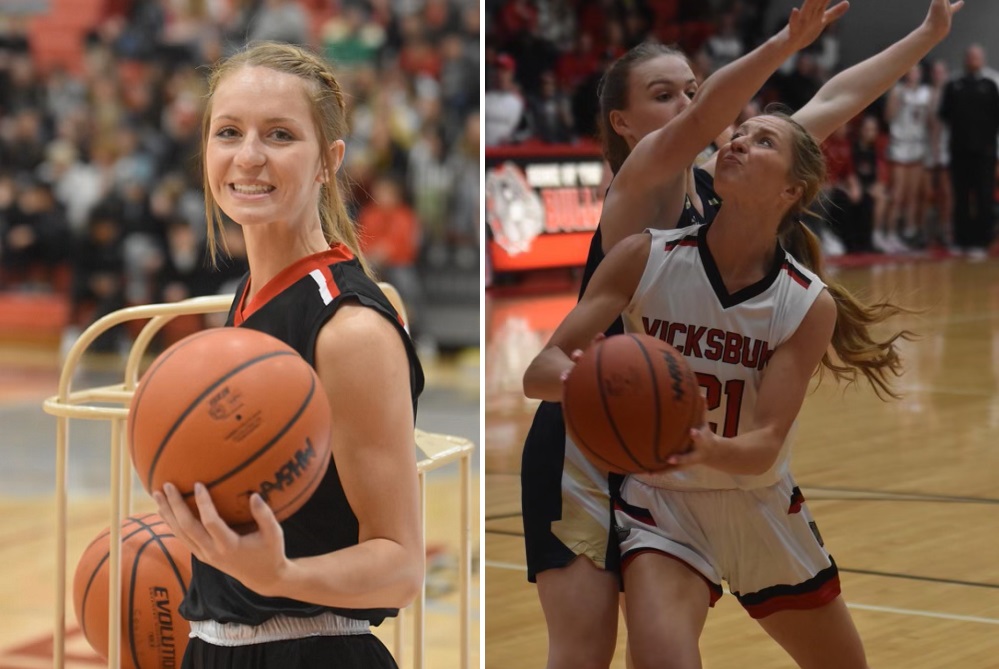
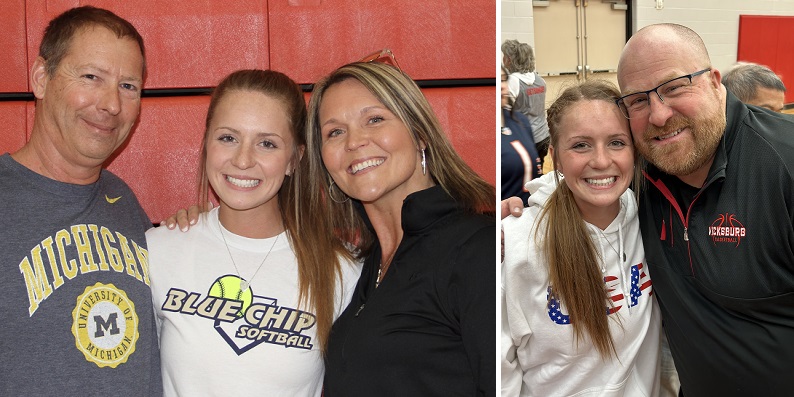
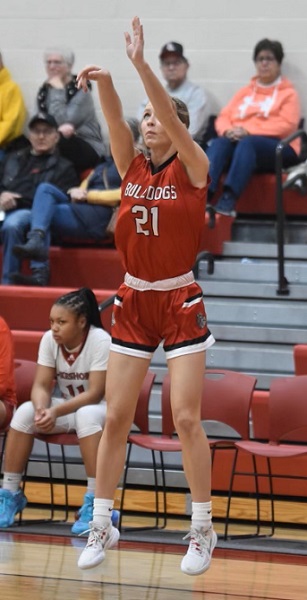
PHOTOS (Top) Vicksburg’s Tristin Abnet is glad to be back on the court, and intense going to the basket. (2) Stitches stretched across Abnet’s scalp as three metal plates and a hinge were applied to her skull. (3) Abnet is surrounded by support including parents Cheyenne, left, and Kristina, and coach Tim Kirby. (4) Abnet launches a jumper during a game with Stevensville Lakeshore. (Photos courtesy of the Abnet family.)