

New Math: Division & Multiplication Problems
July 25, 2017
By Jack Roberts
MHSAA Executive Director
This is the second part in a series on MHSAA tournament classification, past and present, that will be published over the next two weeks. This series originally ran in this spring's edition of MHSAA benchmarks.
High school tournament classifications went viral before there was social media and most of us knew what “viral” meant.
Much as a virus infects computers today or has created epidemics of disease around the world for centuries, high school tournament classification – once introduced – tends to spread uncontrollably. Once started, it tends to keep expanding and rarely contracts.
While we are still some distance from providing every team a trophy as a result of expanding high school tournament classification across the country, there is criticism nevertheless that we are headed in that direction – a philosophy which is supposed to exist only in local youth sports for our youngest children.
Michigan could be blamed for all this. Michigan is generally accepted as the first state to provide different classifications for season-ending tournaments for different sized schools. It started a century ago. Today, every state has various classifications for its tournaments in most if not all sports. And it is a bit ironic that Michigan – creator of the classification chaos – more than most other states has kept the number of tournament classes or divisions under control.
Yes, there is evidence that tournament classifications have expanded over the years in Michigan, especially with the relatively recent introduction of tournaments in football and the late 1990s’ move from classes to divisions in most MHSAA tournaments. But the MHSAA Representative Council has held true to its word when it expanded the playoffs for football from four classes to eight divisions: this is needed because of unique factors of football, factors that exist in no other sport; and all other sports should be capped at a maximum of four classes or divisions.
Kentucky is the preeminent defender of single-class basketball. All of its 276 high schools compete for the single state championship for each gender. In Indiana, there are still open wounds from its move in 1998 from one to four classes for its 400 schools in basketball.
Multi-class tournaments have tended to increase the number of non-public school champions, which some states are trying to lower through enrollment “multipliers,” and also tend to increase the number of repeat champions, which some states are trying to affect with “success factors” which lift smaller schools into classifications for larger schools if they take home too many trophies.
While there is considerable evidence that state tournaments do as much bad as good for educational athletics, state associations persist in providing postseason tournaments because, on balance, the experiences are supposed to be good for student-athletes. And once we reach that conclusion it is just a small leap to believe that if the tournaments are good for a few, they must be better for more – which leads to creating more and more tournament classifications. One becomes two classes, then three, then four and so forth.
While the argument is that more classifications or divisions provides more students with opportunities to compete and win, it is undeniable that the experience changes as the number of tournament classifications expands. It is not possible for state associations to provide the same level of support when tournament classifications expand to multiple venues playing simultaneously. For example, there is less audio and video broadcast potential at each venue, and less media coverage to each venue. Focus is diluted and fans diminished at each championship.
No one can argue reasonably that today's two-day MHSAA Football Finals of eight championship games has the same pizazz as the one-day, four-games event conducted prior to 1990.
In some states the number of divisions has grown so much that it is difficult to see much difference between the many season-ending state championship games and a regular-season event in the same sport.
It is a balancing act. And Michigan has been studying that balance longer than any other state, and charting a steadier course than most.
Addition by Division
The shift to Divisions for MHSAA Tournament play in numerous sports has added up to a greater number of champions for teams and individuals across the state. Following are the sports currently employing a divisional format, and the procedures for determining enrollment and classification.
In 23 statewide or Lower Peninsula tournaments, schools which sponsor the sport are currently divided into nearly equal divisions. They are:
- Baseball - 4 Divisions
- Boys Bowling - 4 Divisions
- Girls Bowling - 4 Divisions
- Girls Competitive Cheer - 4 Divisions
- LP Boys Cross Country - 4 Divisions
- LP Girls Cross Country - 4 Divisions
- LP Boys Golf - 4 Divisions
- LP Girls Golf - 4 Divisions
- Ice Hockey - 3 Divisions
- Boys Lacrosse - 2 Divisions
- Girls Lacrosse - 2 Divisions
- Boys Skiing - 2 Divisions
- Girls Skiing - 2 Divisions
- LP Boys Soccer - 4 Divisions LP
- Girls Soccer - 4 Divisions
- Girls Softball - 4 Divisions
- LP Boys Swimming & Diving - 3 Divisions
- LP Girls Swimming & Diving - 3 Divisions
- LP Boys Tennis - 4 Divisions
- LP Girls Tennis - 4 Divisions
- LP Boys Track & Field - 4 Divisions
- LP Girls Track & Field - 4 Divisions
- Wrestling - 4 Divisions
Lists of schools for each division of these 23 tournaments are posted on MHSAA.com approximately April 1. Listings of schools in Upper Peninsula tournaments for their sports are also posted on MHSAA.com. The lists are based on school memberships and sports sponsorships in effect or anticipated for the following school year, as known to the MHSAA office as of a date in early March.
In football, the 256 schools which qualify for MHSAA 11-player playoffs are placed in eight equal divisions annually on Selection Sunday. Beginning in 2017, the 8-player divisions will be determined in a like manner on Selection Sunday as well, with 32 qualifying schools placed in two divisions.
Schools have the option to play in any higher division in one or more sports for a minimum of two years.
The deadlines for "opt-ups" are as follows:
- Applications for fall sports must be submitted by April 15
- Applications for winter sports must be submitted by Aug. 15
- Applications for spring sports must be submitted by Oct. 15
Subsequent to the date of these postings for these tournaments, no school will have its division raised or lowered by schools opening or closing, schools adding or dropping sports, schools exercising the option to play in a higher division, or approval or dissolution of cooperative programs.
When the same sport is conducted for boys and girls in the same season (e.g., track & field and cross country), the gender that has the most sponsoring schools controls the division breaks for both genders.
Owosso Ace's Strikeout Total Stacks Up with State's All-Time Best
By
Geoff Kimmerly
MHSAA.com senior editor
January 4, 2023
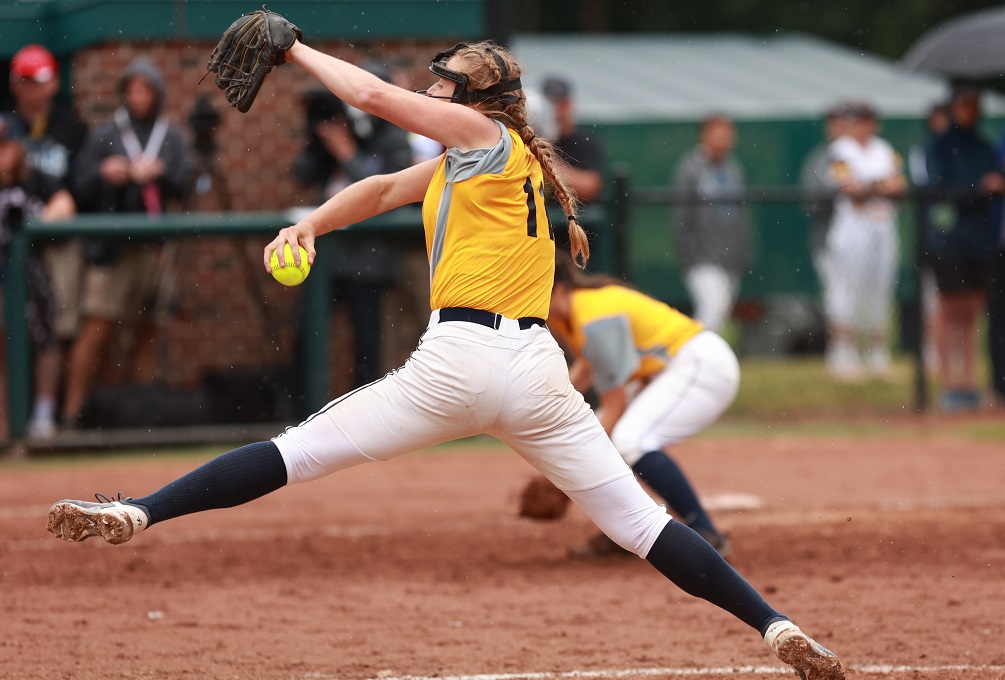
Owosso’s Macy Irelan earned 11 entries in the MHSAA record book over her three-year varsity career that came to a close last spring, most notably with her 1,157 strikeouts despite the 2020 season being canceled due to COVID-19.
Irelan’s career strikeouts were the second-most in the state since the pitching distance was lengthened three feet in 2011. She finished 31-7 last spring with a 1.43 ERA and 414 strikeouts in 229 2/3 innings in earning the Miss Softball Award for pitching.
She also hit .551 with 21 doubles last season, and her 55 career doubles over 117 games and three seasons made that category career list. She’s continuing her career at Kent State.
See below for more recent additions to the softball record book:
Softball
Unionville-Sebewaing’s dominating run to the 2021 Division 4 championship was filled with seven record book-worthy highlights, including many near the top of all-time lists. In going 40-3, the Patriots tied their season record for wins for the second time. Their 502 runs scored ranked third all-time, with their 493 hits tied for ninth, their 114 doubles second, their 49 home runs also tied for ninth, their 431 RBI also second and their 503 strikeouts thrown ranking third. Senior Brynn Polega completed her career with 13 record book entries despite her junior season being canceled because of COVID-19; she added listings for 71 runs, 79 hits, a third-best 28 doubles, 11 homers, 70 RBI, four perfect games pitching and 365 strikeouts, among others. Then-junior Laci Harris made lists with 77 runs, 83 hits, 22 doubles, 14 homers and 78 RBI, while then-junior Macy Reinhardt was added for 78 runs and then-freshman Gabriella Crumm was added for 16 doubles. Polega, Harris and Reinhardt also posted entries for single-game accomplishments. Polega is playing at Northwood and Harris at Madonna.
Big Rapids set a school record for wins in 2021 in finishing 34-7, a run which included a number of accomplishments that reached the record book. The Cardinals scored 439 runs – tied for 12th on that list – and also as a team were added for 428 hits, 82 doubles and 363 RBI, which tied for 10th all-time. Marissa Warren made the individual hits list with 71, while Hanna Smith earned an entry with 20 doubles and Rylie Haist followed with 19. Josie Cornell was added with 40 walks drawn. Warren, Smith and Haist were added for single-game accomplishments as well, as was Madison Affer from a 2019 game. Haist, Smith and Cornell are seniors this school year, and Warren is a junior. Smith has signed with Ferris State.
A pair of Bad Axe standouts earned record book entries in 2021 with their work at the plate. Haley Newland made the single-season doubles list with 19, and Brooke Messing was added for seven RBI in a game that saw her hit a grand slam and three-run homer. Newland graduated last spring and Messing is a senior this school year.
Montrose then-freshman Lainey Cannon made two record book lists with her performance April 25 against Montrose. She hit three home runs to make the single-game list in that category, and also made the single-game RBI list with eight.
Capac then-sophomore Madalyn Roberson made the record book three times with her performance May 9 against Brown City. She hit two home runs in back-to-back at bats, both during the fifth inning, and also drove in six runs for the game.
Spring Lake standouts now fill the record book after the addition of 55 individual and 23 team entries dating back to the 2000 season. Among listings ranking highest in their respective categories were Madelyn Nelson’s 81 runs in 2018, which tied for seventh all-time; Nelson’s 250 career runs from 2015-18) that rank seventh and Lauren Hellman’s 249 career runs also from 2015-18 that rank eighth on that list; Nelson’s 84 hits in 2018 that are tied for 12th-most all-time and her 264 career hits that rank 11th, Leah Vaughan’s 26 doubles in 2019 that rank seventh, Evie Lorimer’s 16 triples in 2011 that are tied for eighth and her 37 career triples from 2010-12 that are ranked fourth, Vaughan’s 23 career times being hit by pitch from 2016-19 which rank second, and Lorimer’s 92 stolen bases in 2012 that rank second (with all 92 coming consecutively to tie for fifth on that list) and 183 career steals that rank 11th. As a team, Spring Lake in 2017 ranked seventh all-time with 501 hits over 42 games, fourth with 109 doubles and eighth with 34 triples. The 2018 team ranks 11th with 441 runs scored over 41 games, 10th with 497 hits and tied for ninth with 100 doubles. Valerie Alter, Linsey Paggeot, Jenna Core, Molly Poole, Alicia Mumby, Leah Anton, Ann Marie Galloway and Rachael Adams also earned individual entries. Nelson went on to play at Grand Valley State, Vaughan plays at Aquinas College, Lorimer played at Central Michigan, Alter played at Jacksonville University (Fla.), Poole plays at Cornerstone University and Mumby played at Lansing Community College. Core plays volleyball at Hope College.
Freeland’s offense earned five record book entries during the team’s 26-12 season in 2022, including for 412 runs scored, 442 hits, 78 doubles, 336 RBI and a .400 team batting average. Three individuals also earned entries – sophomore Addie Steffen for a 20-game hitting streak and seven RBI in a game, junior Evelynn Rybicki for six RBI in a game and freshman Brynn Jaime for getting hit by a pitch twice in the same inning.
Chloe Parker hit .604 last spring and made the records with 20 doubles over 33 games for Niles Brandywine. She’s a junior this school year.
A series of record book entries were added for past and present Zeeland West standouts. Carly Sleeman was added for 73 runs, 75 hits, 27 doubles and 12 home runs in 2021 as a sophomore, while Lily Brower was added for 72 runs, 17 triples and 11 homers, plus 38 doubles and 29 triples over a four-year varsity career. Sleeman’s 27 doubles are tied for fifth-most in one season, and Brower’s 17 triples are tied for fourth on that list. Haley Hoogenraad was added for 70 hits and 17 doubles as a junior in 2015, 19 doubles as a senior, and 49 doubles and 24 triples over her four-year career from 2013-16. Kenzie Siersma was added for 17 doubles in 2017 and 54 over her career from 2016-19, while Courtney Sleeman made the season home runs list with 15 in 2015 and Sarah VanValkenburg made the career RBI list with 152 from 2014-17. Emily Brands was added for hitting consecutive home runs in the same inning, May 7 against Reese; she graduated this spring. Hoogenraad went on to play at University of Michigan, Courtney Sleeman played at Western Michigan, Siersma plays at West Virginia Tech, Brower played last season at Kalamazoo Valley Community College, and Carly Sleeman has signed with Central Michigan.
PHOTO Owosso’s Macy Irelan unloads a pitch during the 2021 Division 2 Final.