

New Math: Division & Multiplication Problems
July 25, 2017
By Jack Roberts
MHSAA Executive Director
This is the second part in a series on MHSAA tournament classification, past and present, that will be published over the next two weeks. This series originally ran in this spring's edition of MHSAA benchmarks.
High school tournament classifications went viral before there was social media and most of us knew what “viral” meant.
Much as a virus infects computers today or has created epidemics of disease around the world for centuries, high school tournament classification – once introduced – tends to spread uncontrollably. Once started, it tends to keep expanding and rarely contracts.
While we are still some distance from providing every team a trophy as a result of expanding high school tournament classification across the country, there is criticism nevertheless that we are headed in that direction – a philosophy which is supposed to exist only in local youth sports for our youngest children.
Michigan could be blamed for all this. Michigan is generally accepted as the first state to provide different classifications for season-ending tournaments for different sized schools. It started a century ago. Today, every state has various classifications for its tournaments in most if not all sports. And it is a bit ironic that Michigan – creator of the classification chaos – more than most other states has kept the number of tournament classes or divisions under control.
Yes, there is evidence that tournament classifications have expanded over the years in Michigan, especially with the relatively recent introduction of tournaments in football and the late 1990s’ move from classes to divisions in most MHSAA tournaments. But the MHSAA Representative Council has held true to its word when it expanded the playoffs for football from four classes to eight divisions: this is needed because of unique factors of football, factors that exist in no other sport; and all other sports should be capped at a maximum of four classes or divisions.
Kentucky is the preeminent defender of single-class basketball. All of its 276 high schools compete for the single state championship for each gender. In Indiana, there are still open wounds from its move in 1998 from one to four classes for its 400 schools in basketball.
Multi-class tournaments have tended to increase the number of non-public school champions, which some states are trying to lower through enrollment “multipliers,” and also tend to increase the number of repeat champions, which some states are trying to affect with “success factors” which lift smaller schools into classifications for larger schools if they take home too many trophies.
While there is considerable evidence that state tournaments do as much bad as good for educational athletics, state associations persist in providing postseason tournaments because, on balance, the experiences are supposed to be good for student-athletes. And once we reach that conclusion it is just a small leap to believe that if the tournaments are good for a few, they must be better for more – which leads to creating more and more tournament classifications. One becomes two classes, then three, then four and so forth.
While the argument is that more classifications or divisions provides more students with opportunities to compete and win, it is undeniable that the experience changes as the number of tournament classifications expands. It is not possible for state associations to provide the same level of support when tournament classifications expand to multiple venues playing simultaneously. For example, there is less audio and video broadcast potential at each venue, and less media coverage to each venue. Focus is diluted and fans diminished at each championship.
No one can argue reasonably that today's two-day MHSAA Football Finals of eight championship games has the same pizazz as the one-day, four-games event conducted prior to 1990.
In some states the number of divisions has grown so much that it is difficult to see much difference between the many season-ending state championship games and a regular-season event in the same sport.
It is a balancing act. And Michigan has been studying that balance longer than any other state, and charting a steadier course than most.
Addition by Division
The shift to Divisions for MHSAA Tournament play in numerous sports has added up to a greater number of champions for teams and individuals across the state. Following are the sports currently employing a divisional format, and the procedures for determining enrollment and classification.
In 23 statewide or Lower Peninsula tournaments, schools which sponsor the sport are currently divided into nearly equal divisions. They are:
- Baseball - 4 Divisions
- Boys Bowling - 4 Divisions
- Girls Bowling - 4 Divisions
- Girls Competitive Cheer - 4 Divisions
- LP Boys Cross Country - 4 Divisions
- LP Girls Cross Country - 4 Divisions
- LP Boys Golf - 4 Divisions
- LP Girls Golf - 4 Divisions
- Ice Hockey - 3 Divisions
- Boys Lacrosse - 2 Divisions
- Girls Lacrosse - 2 Divisions
- Boys Skiing - 2 Divisions
- Girls Skiing - 2 Divisions
- LP Boys Soccer - 4 Divisions LP
- Girls Soccer - 4 Divisions
- Girls Softball - 4 Divisions
- LP Boys Swimming & Diving - 3 Divisions
- LP Girls Swimming & Diving - 3 Divisions
- LP Boys Tennis - 4 Divisions
- LP Girls Tennis - 4 Divisions
- LP Boys Track & Field - 4 Divisions
- LP Girls Track & Field - 4 Divisions
- Wrestling - 4 Divisions
Lists of schools for each division of these 23 tournaments are posted on MHSAA.com approximately April 1. Listings of schools in Upper Peninsula tournaments for their sports are also posted on MHSAA.com. The lists are based on school memberships and sports sponsorships in effect or anticipated for the following school year, as known to the MHSAA office as of a date in early March.
In football, the 256 schools which qualify for MHSAA 11-player playoffs are placed in eight equal divisions annually on Selection Sunday. Beginning in 2017, the 8-player divisions will be determined in a like manner on Selection Sunday as well, with 32 qualifying schools placed in two divisions.
Schools have the option to play in any higher division in one or more sports for a minimum of two years.
The deadlines for "opt-ups" are as follows:
- Applications for fall sports must be submitted by April 15
- Applications for winter sports must be submitted by Aug. 15
- Applications for spring sports must be submitted by Oct. 15
Subsequent to the date of these postings for these tournaments, no school will have its division raised or lowered by schools opening or closing, schools adding or dropping sports, schools exercising the option to play in a higher division, or approval or dissolution of cooperative programs.
When the same sport is conducted for boys and girls in the same season (e.g., track & field and cross country), the gender that has the most sponsoring schools controls the division breaks for both genders.
Powerful Hitters Set Pace for Grand Rapids Christian's Annual Title Chase
By
Geoff Kimmerly
MHSAA.com senior editor
April 29, 2022
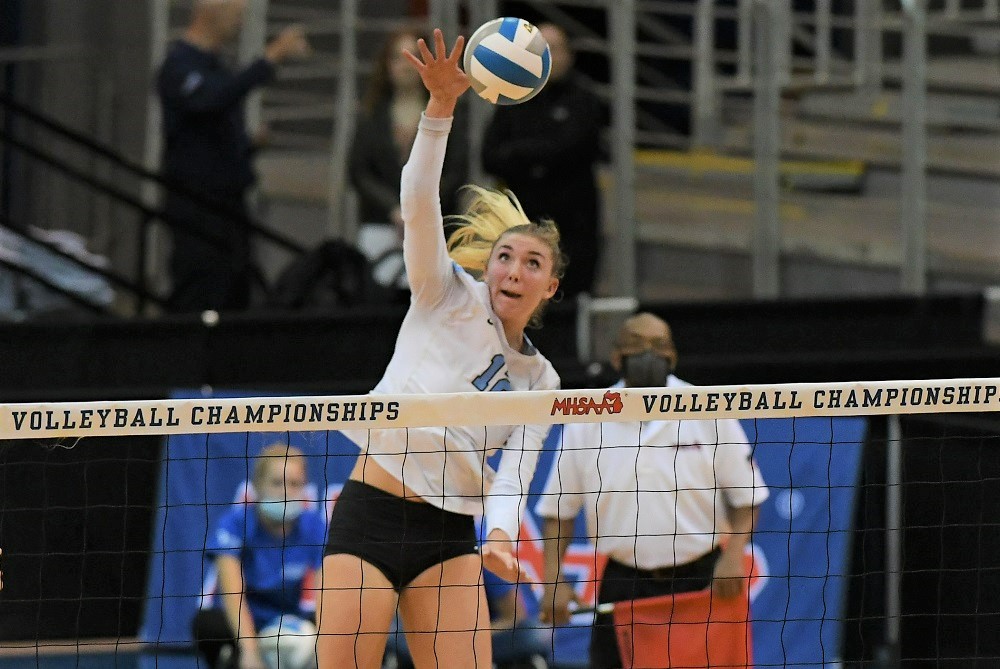
A number of standouts drove Grand Rapids Christian to three straight Division 2 titles from 2018-20 and its Semifinal appearance this past season, including a pair of hitters now among the MHSAA single-season and career leaders in kills.
Current senior Evie Doezema was added to the record book for her 748 kills in the fall and 1,603 over 466 games and four seasons. Addie VanderWeide, who graduated in 2021, was added for 592 kills over 103 games her senior season and 2,110 over 477 games and four seasons. Doezema and senior setter Alyssa DeVries also were added for their contributions in a 3-1 Regional Final win over Hudsonville Unity Christian on Nov. 11 – Doezema for 42 kills and DeVries for 53 assists.
VanderWeide plays at Iowa, and Doezema has signed with Michigan State.
See below for more recent record book entries for volleyball, girls soccer, boys tennis and wrestling.
Girls Soccer
Paul Stenglein retired as Frankenmuth’s girls soccer coach with a 400-95-44 record from 1996-2019. His 400 wins remain fourth on the all-time list.
Volleyball
A total of 26 record book entries covering the recent history of Kingsley as a state power were added, with a number of single-season and career highlights for players over the last two decades. Among those added for single-season kills were Katie Travis, Jill Walton, Jessica Lefler, Hannah Bach and Lilly Travis, with Lefler (2,205 from 2015-18), Walton (1,682 from 2004-06) and Brittany Bowman (1,562 from 2016-19) making the career kills list. Maddie Bies, Erica Berridge, Dakota Deweese and Leah Hall made the single-season assists list, with Hall ranking 17th on the career assists list with 3,881 from 2011-14 and Brittany Denter (2,983 from 2005-Fall 2007) and Bies (2,617 from 2017-19) joining her. Austyn Deweese was added for 407 blocks from 2017-19, and Emily Fasel, Bowman, Sam Zubalik, Walton and Hillary Hoeflin made the aces single-season list during the current rally scoring era. Holly Nickerson was added to the single-season aces list from the pre-rally scoring era for her 130 in 2002-03. Austyn DeWeese is playing at Central Michigan, Lefler has gone on to play at Ferris State, with Hall at Lawrence Tech, and Denter went at Caldwell (N.J.). Walton played basketball at Lake Superior State, and Bowman was a redshirt freshman on that team this season.
After an injury kept her from playing as a junior, Whitehall’s Rayne Thompson stormed back this past fall – and her 45 kills in a five-set match Oct. 16 against Muskegon Western Michigan Christian rank fifth all-time in the rally scoring era. She also made the single-match kills list with 32 against Fruitport in a sweep Nov. 4. She signed with Northern Michigan University.
Emma Mirabelli finished a massive hitting career for Traverse City Christian in the fall, posting 922 kills to finish with 2,089 from grades 9-12 (and with 89 more as an eighth grader on varsity in 2017). Her single-season total ranked eighth on that list. She had 44 kills in a four-set match against Traverse City St. Francis on Sept. 16 of last season that rank sixth-most since the start of rally scoring. Teammate Julianna Brower made the single-season assists list with 1,230. Brower will continue her career at Cornerstone University, and Mirabelli has committed to Purdue-Fort Wayne.
Johannesburg-Lewiston’s Autumn Vermilya capped her career in the fall by earning three record book entries. She set a personal high of 54 assists Nov. 4 vs. Charlevoix and also had 48 against Pellston on Oct. 25. She also made the single-season assists list with 1,207.
Emiley Bender also earned a memorable senior-year accomplishment, making the record book with 29 kills for Sandusky during a five-set match against Harbor Beach on Oct. 12.
A number of standouts from Flushing’s recent history also were added. Current senior Kendyl Andrews made career lists with 4,075 assists (ranking 10th) and 304 aces and the single-season assists list twice with matches both of 46. Whitney Heeres was added for 1,731 kills over her four seasons finishing in 2009, and also for her 645 over 150 games as a junior in 2008. Carson Rutherford was added for 598 kills as a senior in 2014 and 1,545 over her four-season career. Rachel Hamblin made the single-season aces list with 116 over 139 games during the winter 2006-07 season. Karen Fox had 130 aces as a junior in 2005-06 and also was added for 315 for her career. Lexi Kiefer was added to the career assists list with 3,282 from 2011-14, Lauren Fenton made the list with 2,601 from 2008-11 and Ashley Hurand was added for 2,618 from 2006-08. Kari Carnell made the career assists list with 2,797 despite playing only her senior season, 2004-05, with rally scoring. Andrews has signed to continue her career at Wayne State. Heeres played at Ball State and then Tennessee, while Rutherford, Hamblin and Kiefer all played at Northwood. Carnell played at Aquinas College and is Corunna’s coach, and Fenton went on to play at Mott Community College. Fox played softball at Michigan State.
Boys Tennis
Midland Dow’s run at the Lower Peninsula Division 2 championship in the fall ended with a tie for third, thanks in part to another group of standouts. Sophomore Logan Yu finished 34-2 to make the singles wins list, while sophomore Vishagen Karthikeyan (30 wins), senior Michael McGaugh (29), sophomore Jonathan Song (28) and junior Shubhan Nagarkar (28) all made the single-season doubles wins list.
Wrestling
On Dec. 22, for the second time in five seasons, Otisville LakeVille Memorial tied the most meet points scored in a 14-weight dual. The Falcons defeated Essexville Garber 84-0 with pins at every weight.
PHOTO Grand Rapids Christian’s Evie Doezema unloads on a kill attempt during the Division 2 Semifinals in November. (Click for more from Hockey Weekly Action Photos.)