


New Math: Division & Multiplication Problems
July 25, 2017
By Jack Roberts
MHSAA Executive Director
This is the second part in a series on MHSAA tournament classification, past and present, that will be published over the next two weeks. This series originally ran in this spring's edition of MHSAA benchmarks.
High school tournament classifications went viral before there was social media and most of us knew what “viral” meant.
Much as a virus infects computers today or has created epidemics of disease around the world for centuries, high school tournament classification – once introduced – tends to spread uncontrollably. Once started, it tends to keep expanding and rarely contracts.
While we are still some distance from providing every team a trophy as a result of expanding high school tournament classification across the country, there is criticism nevertheless that we are headed in that direction – a philosophy which is supposed to exist only in local youth sports for our youngest children.
Michigan could be blamed for all this. Michigan is generally accepted as the first state to provide different classifications for season-ending tournaments for different sized schools. It started a century ago. Today, every state has various classifications for its tournaments in most if not all sports. And it is a bit ironic that Michigan – creator of the classification chaos – more than most other states has kept the number of tournament classes or divisions under control.
Yes, there is evidence that tournament classifications have expanded over the years in Michigan, especially with the relatively recent introduction of tournaments in football and the late 1990s’ move from classes to divisions in most MHSAA tournaments. But the MHSAA Representative Council has held true to its word when it expanded the playoffs for football from four classes to eight divisions: this is needed because of unique factors of football, factors that exist in no other sport; and all other sports should be capped at a maximum of four classes or divisions.
Kentucky is the preeminent defender of single-class basketball. All of its 276 high schools compete for the single state championship for each gender. In Indiana, there are still open wounds from its move in 1998 from one to four classes for its 400 schools in basketball.
Multi-class tournaments have tended to increase the number of non-public school champions, which some states are trying to lower through enrollment “multipliers,” and also tend to increase the number of repeat champions, which some states are trying to affect with “success factors” which lift smaller schools into classifications for larger schools if they take home too many trophies.
While there is considerable evidence that state tournaments do as much bad as good for educational athletics, state associations persist in providing postseason tournaments because, on balance, the experiences are supposed to be good for student-athletes. And once we reach that conclusion it is just a small leap to believe that if the tournaments are good for a few, they must be better for more – which leads to creating more and more tournament classifications. One becomes two classes, then three, then four and so forth.
While the argument is that more classifications or divisions provides more students with opportunities to compete and win, it is undeniable that the experience changes as the number of tournament classifications expands. It is not possible for state associations to provide the same level of support when tournament classifications expand to multiple venues playing simultaneously. For example, there is less audio and video broadcast potential at each venue, and less media coverage to each venue. Focus is diluted and fans diminished at each championship.
No one can argue reasonably that today's two-day MHSAA Football Finals of eight championship games has the same pizazz as the one-day, four-games event conducted prior to 1990.
In some states the number of divisions has grown so much that it is difficult to see much difference between the many season-ending state championship games and a regular-season event in the same sport.
It is a balancing act. And Michigan has been studying that balance longer than any other state, and charting a steadier course than most.
Addition by Division
The shift to Divisions for MHSAA Tournament play in numerous sports has added up to a greater number of champions for teams and individuals across the state. Following are the sports currently employing a divisional format, and the procedures for determining enrollment and classification.
In 23 statewide or Lower Peninsula tournaments, schools which sponsor the sport are currently divided into nearly equal divisions. They are:
- Baseball - 4 Divisions
- Boys Bowling - 4 Divisions
- Girls Bowling - 4 Divisions
- Girls Competitive Cheer - 4 Divisions
- LP Boys Cross Country - 4 Divisions
- LP Girls Cross Country - 4 Divisions
- LP Boys Golf - 4 Divisions
- LP Girls Golf - 4 Divisions
- Ice Hockey - 3 Divisions
- Boys Lacrosse - 2 Divisions
- Girls Lacrosse - 2 Divisions
- Boys Skiing - 2 Divisions
- Girls Skiing - 2 Divisions
- LP Boys Soccer - 4 Divisions LP
- Girls Soccer - 4 Divisions
- Girls Softball - 4 Divisions
- LP Boys Swimming & Diving - 3 Divisions
- LP Girls Swimming & Diving - 3 Divisions
- LP Boys Tennis - 4 Divisions
- LP Girls Tennis - 4 Divisions
- LP Boys Track & Field - 4 Divisions
- LP Girls Track & Field - 4 Divisions
- Wrestling - 4 Divisions
Lists of schools for each division of these 23 tournaments are posted on MHSAA.com approximately April 1. Listings of schools in Upper Peninsula tournaments for their sports are also posted on MHSAA.com. The lists are based on school memberships and sports sponsorships in effect or anticipated for the following school year, as known to the MHSAA office as of a date in early March.
In football, the 256 schools which qualify for MHSAA 11-player playoffs are placed in eight equal divisions annually on Selection Sunday. Beginning in 2017, the 8-player divisions will be determined in a like manner on Selection Sunday as well, with 32 qualifying schools placed in two divisions.
Schools have the option to play in any higher division in one or more sports for a minimum of two years.
The deadlines for "opt-ups" are as follows:
- Applications for fall sports must be submitted by April 15
- Applications for winter sports must be submitted by Aug. 15
- Applications for spring sports must be submitted by Oct. 15
Subsequent to the date of these postings for these tournaments, no school will have its division raised or lowered by schools opening or closing, schools adding or dropping sports, schools exercising the option to play in a higher division, or approval or dissolution of cooperative programs.
When the same sport is conducted for boys and girls in the same season (e.g., track & field and cross country), the gender that has the most sponsoring schools controls the division breaks for both genders.
BOTF X: Buchanan's 'Herd' Begins New Era with Same Bucks Energy
By
Geoff Kimmerly
MHSAA.com senior editor
February 8, 2022
They knew each other, but weren’t really friends at that point. Six months later, McKean just remembers thinking it would be fun. But the magnitude of the opportunity sank into Tucker’s recollection much more heavily.
“He grabbed me,” Tucker recalled last week,” and changed my senior year.”
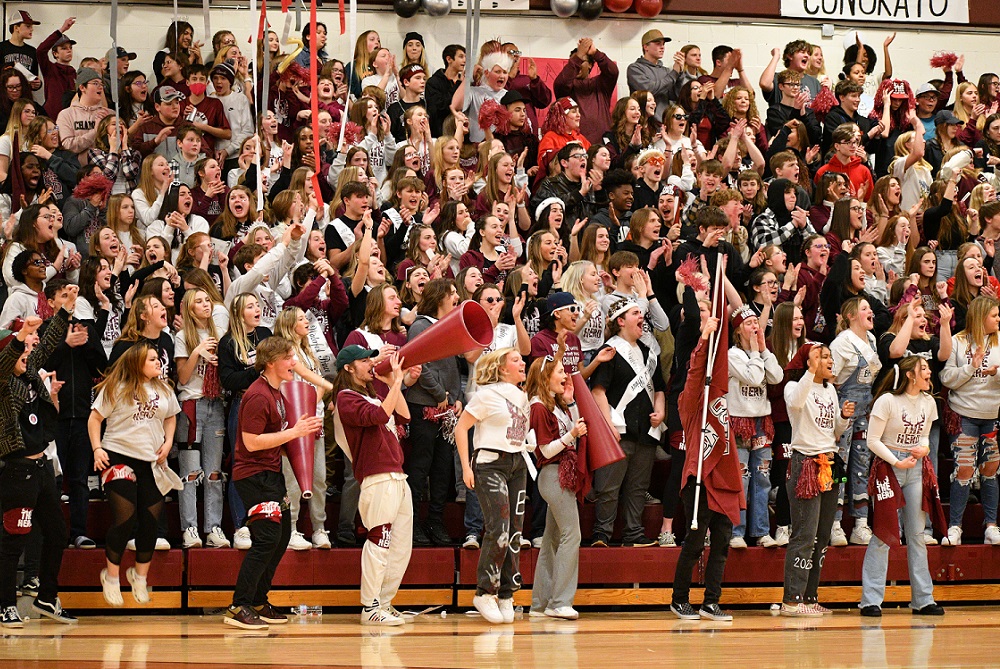
Over the last decade, Buchanan High School’s “Herd” has established itself statewide as an example of prime student section culture. The Bucks have won the MHSAA’s Battle of the Fans three times, and Buchanan’s appearance in this year’s BOTF X Finals is its fourth-straight and seventh overall in the championship round. The Herd has served as a teaching example for how student sections can organize, grow and transform a school – and Tucker’s experience has been among the latest examples of the good that results from that work.
“This year was just completely different for me,” Tucker said. “It’s so much fun; it’s hard to explain. Getting to help lead the chants, being up front at games, it’s an experience you can’t recreate in a different way.”
We caught up with The Herd for Friday’s home boys basketball game against South Haven, the MHSAA’s second of three visits as part of this year’s BOTF finalists tour. Midland Dow hosted the first Jan. 28, and the final visit will be at Traverse City West on Feb. 8.
Below is our highlight reel and 10 “X Factors” from our trip to Buchanan.
1. Battle Plan
Friday’s visit coincided with the culmination of Buchanan’s “Winterfest” week. Activities included the crowning of class representatives between the girls and boys varsity games and a collection taken up to assist with medical bills for a student suffering through a tough bout with COVID-19. This also would be the seventh win of a current eight-game streak for the boys basketball team.
2. Honoring Tradition
Anyone who has witnessed a Buchanan basketball game over the last decade would have recognized the “Welcome to the Woods” and “B-U-C-K-S Bucks” chants and the dance mashup among familiar Herd activities. With seven BOTF finalists appearances, there’s a lot of Herd video out there – and current leaders have watched for ideas that while old are new to them.
3. Hitting Reset – Sort Of
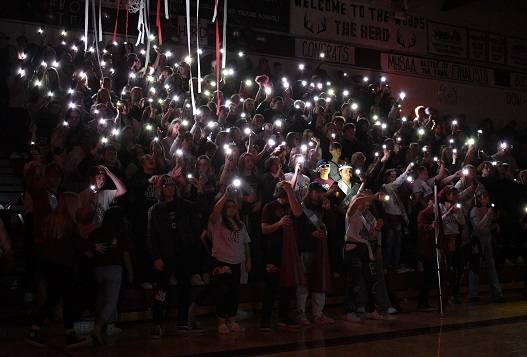
Two years of COVID-19 – and especially 2020-21 with spectator limits – forced current leaders (almost exclusively seniors) immediately up front, without the usual buffer junior year to watch how everything works. But there was some benefit: “We started new and we’re growing different this time,” senior Brennen Weaver said. “We’ve always had The Herd, it’s here, but it’s like we cleared the white board and we’re now redrawing a new thing that’s starting.”
4. Why it Works
Current leaders were raised in this culture, which makes things easier to continue – but other schools can follow the same plan. The section is basically a “spirit team” that brings enthusiastic students together for regular planning meetings. There’s an upperclassmen-driven leadership structure, but input is supplied by students from all classes. The Herd from its start has made a priority of visiting Buchanan’s elementary and middle schools, teaching those students how to cheer and cultivating the next leaders. They work closely with three teacher advisors and the blessing of administration, and have made a point of becoming active in the community as well. All of it is mostly in the name of fun, and that keeps interest up – clearly, as about 170 students from a school of 380 filled the stands Friday.
5. So What’s New?
The Herd always has taken pride is attending a variety of sports. But this year’s football cheering section surpassed all previous renditions. The Bucks also cheered on their classmates during a competitive cheer meet. They supported at cross country, wrestling, and even at a marching band competition in Detroit. And of course there are new themes to go with the ones that always get the rowdies excited.
6. Nicest Place in America
Reader’s Digest named Buchanan exactly that for 2020, and while The Herd wasn’t mentioned in the feature on the community, there’s no doubt that strand is woven through the student section as well. Example: A “Mean Stinks” anti-bullying campaign incorporated into the 2014 Bucks section still is part of its message today. “I can’t imagine living or going anywhere else,” senior Macy Orphanidis said. “Buchanan is such a tight-knit community, and I love every single person here and I know everybody. It’s like my family now.”
7. “Which Way? This Way”
The chant is basketball related, but the message is a way of cheering life. It’s all positive. And can be pretty simple: Earlier this season an opposing student section was cheering “air ball” and trying to get a Herd response, but instead was ignored. And the negativity from the other side stopped. “They have the energy,” senior Joy Kaltenbach said. “In sports a lot of times we naturally just get mad when something bad happens instead of being happy when something good happens. So I feel like they just need to redirect their energy.”
 8. Come Join Us
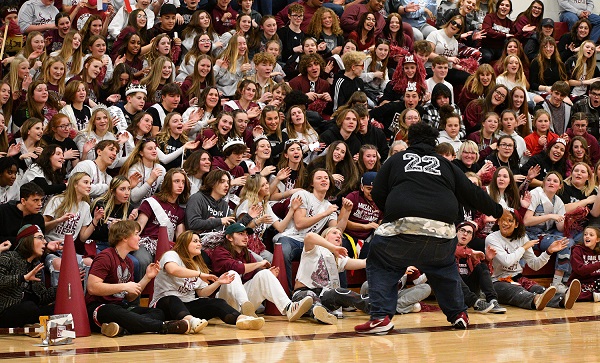
Another Herd tradition brought back this year is a halftime conga line, and on this night the Bucks got at least a handful of South Haven students to join in. During football season, McKean went across the field to the Niles student section and unsolicited led those students in a chant. It in part comes down to confidence. “Even if you’re not confident, you have to portray yourself as confident, because if you’re nervous they won’t listen to you,” McKean advised. “If you walk around with a lot of swagger holding that megaphone like a boss, they’ll listen to you.”
9. Pro Tip: Work with What You Have – It’s Plenty
Every student section has the ingredients, starting with a leadership group filled with different personalities – some will want to focus on creating cheers, others themes or how to make the most noise. Involving variety also includes bringing in leaders from different sports, extracurricular activities and friend circles. Those representatives in turn will get more from their groups to take part.
10. The Herd Will Continue to Roam
That’s the end game. “I just want to teach (younger students) to stand out in their crowd and try to be their own leaders, so maybe that can be the ones who can be in the position we are,” Weaver said. “So they can give their energy and be the one providing all the loudness and fun cheers. (We want to) find those people who really embrace it and want to do more.”
The Battle of the Fans X finalists tour will conclude Tuesday at Traverse City West, with public voting on the MHSAA’s social media channels starting Feb. 15 and the champion announced Feb. 18.
PHOTOS (Top) Buchanan's "Herd" cheers during Friday's boys basketball win over South Haven. (Middle) Students shine their phone lights during pregame introductions. (Below) The Bucks follow their leader on a rollercoaster ride during a break in the game. (Photos by Jessica Elliott.)