

New Math: Division & Multiplication Problems
July 25, 2017
By Jack Roberts
MHSAA Executive Director
This is the second part in a series on MHSAA tournament classification, past and present, that will be published over the next two weeks. This series originally ran in this spring's edition of MHSAA benchmarks.
High school tournament classifications went viral before there was social media and most of us knew what “viral” meant.
Much as a virus infects computers today or has created epidemics of disease around the world for centuries, high school tournament classification – once introduced – tends to spread uncontrollably. Once started, it tends to keep expanding and rarely contracts.
While we are still some distance from providing every team a trophy as a result of expanding high school tournament classification across the country, there is criticism nevertheless that we are headed in that direction – a philosophy which is supposed to exist only in local youth sports for our youngest children.
Michigan could be blamed for all this. Michigan is generally accepted as the first state to provide different classifications for season-ending tournaments for different sized schools. It started a century ago. Today, every state has various classifications for its tournaments in most if not all sports. And it is a bit ironic that Michigan – creator of the classification chaos – more than most other states has kept the number of tournament classes or divisions under control.
Yes, there is evidence that tournament classifications have expanded over the years in Michigan, especially with the relatively recent introduction of tournaments in football and the late 1990s’ move from classes to divisions in most MHSAA tournaments. But the MHSAA Representative Council has held true to its word when it expanded the playoffs for football from four classes to eight divisions: this is needed because of unique factors of football, factors that exist in no other sport; and all other sports should be capped at a maximum of four classes or divisions.
Kentucky is the preeminent defender of single-class basketball. All of its 276 high schools compete for the single state championship for each gender. In Indiana, there are still open wounds from its move in 1998 from one to four classes for its 400 schools in basketball.
Multi-class tournaments have tended to increase the number of non-public school champions, which some states are trying to lower through enrollment “multipliers,” and also tend to increase the number of repeat champions, which some states are trying to affect with “success factors” which lift smaller schools into classifications for larger schools if they take home too many trophies.
While there is considerable evidence that state tournaments do as much bad as good for educational athletics, state associations persist in providing postseason tournaments because, on balance, the experiences are supposed to be good for student-athletes. And once we reach that conclusion it is just a small leap to believe that if the tournaments are good for a few, they must be better for more – which leads to creating more and more tournament classifications. One becomes two classes, then three, then four and so forth.
While the argument is that more classifications or divisions provides more students with opportunities to compete and win, it is undeniable that the experience changes as the number of tournament classifications expands. It is not possible for state associations to provide the same level of support when tournament classifications expand to multiple venues playing simultaneously. For example, there is less audio and video broadcast potential at each venue, and less media coverage to each venue. Focus is diluted and fans diminished at each championship.
No one can argue reasonably that today's two-day MHSAA Football Finals of eight championship games has the same pizazz as the one-day, four-games event conducted prior to 1990.
In some states the number of divisions has grown so much that it is difficult to see much difference between the many season-ending state championship games and a regular-season event in the same sport.
It is a balancing act. And Michigan has been studying that balance longer than any other state, and charting a steadier course than most.
Addition by Division
The shift to Divisions for MHSAA Tournament play in numerous sports has added up to a greater number of champions for teams and individuals across the state. Following are the sports currently employing a divisional format, and the procedures for determining enrollment and classification.
In 23 statewide or Lower Peninsula tournaments, schools which sponsor the sport are currently divided into nearly equal divisions. They are:
- Baseball - 4 Divisions
- Boys Bowling - 4 Divisions
- Girls Bowling - 4 Divisions
- Girls Competitive Cheer - 4 Divisions
- LP Boys Cross Country - 4 Divisions
- LP Girls Cross Country - 4 Divisions
- LP Boys Golf - 4 Divisions
- LP Girls Golf - 4 Divisions
- Ice Hockey - 3 Divisions
- Boys Lacrosse - 2 Divisions
- Girls Lacrosse - 2 Divisions
- Boys Skiing - 2 Divisions
- Girls Skiing - 2 Divisions
- LP Boys Soccer - 4 Divisions LP
- Girls Soccer - 4 Divisions
- Girls Softball - 4 Divisions
- LP Boys Swimming & Diving - 3 Divisions
- LP Girls Swimming & Diving - 3 Divisions
- LP Boys Tennis - 4 Divisions
- LP Girls Tennis - 4 Divisions
- LP Boys Track & Field - 4 Divisions
- LP Girls Track & Field - 4 Divisions
- Wrestling - 4 Divisions
Lists of schools for each division of these 23 tournaments are posted on MHSAA.com approximately April 1. Listings of schools in Upper Peninsula tournaments for their sports are also posted on MHSAA.com. The lists are based on school memberships and sports sponsorships in effect or anticipated for the following school year, as known to the MHSAA office as of a date in early March.
In football, the 256 schools which qualify for MHSAA 11-player playoffs are placed in eight equal divisions annually on Selection Sunday. Beginning in 2017, the 8-player divisions will be determined in a like manner on Selection Sunday as well, with 32 qualifying schools placed in two divisions.
Schools have the option to play in any higher division in one or more sports for a minimum of two years.
The deadlines for "opt-ups" are as follows:
- Applications for fall sports must be submitted by April 15
- Applications for winter sports must be submitted by Aug. 15
- Applications for spring sports must be submitted by Oct. 15
Subsequent to the date of these postings for these tournaments, no school will have its division raised or lowered by schools opening or closing, schools adding or dropping sports, schools exercising the option to play in a higher division, or approval or dissolution of cooperative programs.
When the same sport is conducted for boys and girls in the same season (e.g., track & field and cross country), the gender that has the most sponsoring schools controls the division breaks for both genders.
BOTF X: Dow Aims to Give Teams Advantage with Charger Spirit
By
Geoff Kimmerly
MHSAA.com senior editor
February 1, 2022
MIDLAND – The 10th MHSAA “Battle of the Fans” – and first after a COVID-induced pause for 2021 – appropriately started Friday with a never-seen-before experience.
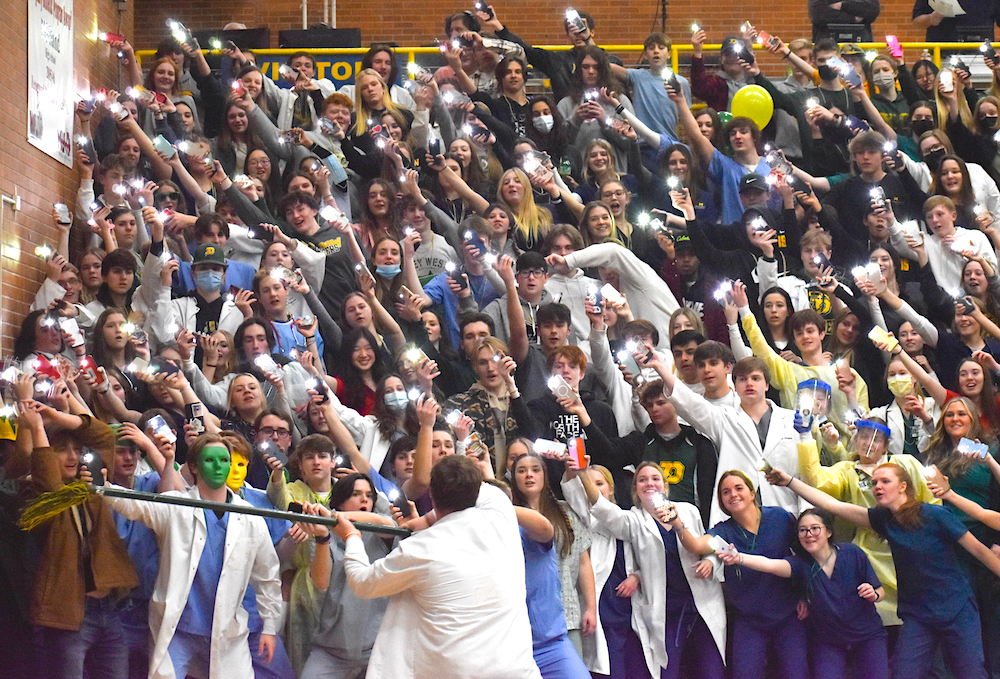
Midland Dow’s student section mostly makes its presence known at “Herb’s House” – the unofficial name of the Chargers’ gymnasium. But Dow hit the road, traveling four miles southeast to rival Midland High for the first of this year’s three finalists visits – the first time a section has ever hosted the MHSAA staff and Student Advisory Council at an away game.
Challenge? Chargers accepted it.
“We want to show up and be the best student section at their school,” Dow senior Daniel Watkins said. “That’s always the best thing ever.
“We bring the same energy. If nothing else, (the road game) almost feeds it more. Not only is it against our rival, but we’re at their place.”
This year’s BOTF X finalists tour also will include visits to Buchanan and Traverse City West.
Below is our highlight reel and 10 “X Factors” from our first stop with Dow’s student section.
1. Battle Plan
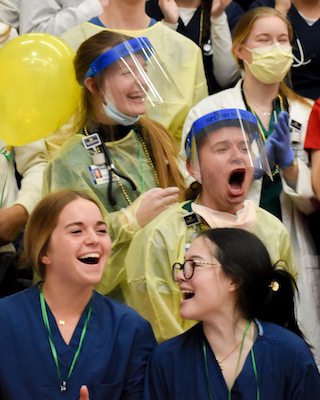
As noted, Dow’s section traveled to rival Midland High, which packed its own student cheering section to match. Dow students dressed in scrubs and lab coats for a “Doctors & Nurses” theme and collected money during halftime to buy snacks for the local hospital emergency room staff.
2. This is the Year of Dow
While a Dow student section has existed for years, a number of factors lined up well for this to be the section’s first applying for Battle of the Fans – and making the championship round. A focused group of leaders was eager to get to work after spectator limits kept crowds small during 2020-21.
3. Follow the Leaders
Every year four seniors – two girls and two boys – take over leadership. Those four leaders then select the next year’s leaders, to be announced at an assembly at the end of the school year. This year’s are Watkins, Kourtney Fischer, Abby Rey and Nolan Sanders. “We know the qualities a section leader needs to have, and we’re picking someone we know can handle the job and go the extra mile,” Rey said. “We make sure they’re driven, because it’s not an easy job – sometimes you just want to go to the game, but you have a bigger responsibility. And obviously someone who can communicate, especially with administrators.”
 4. Believe in the Spirit Stick
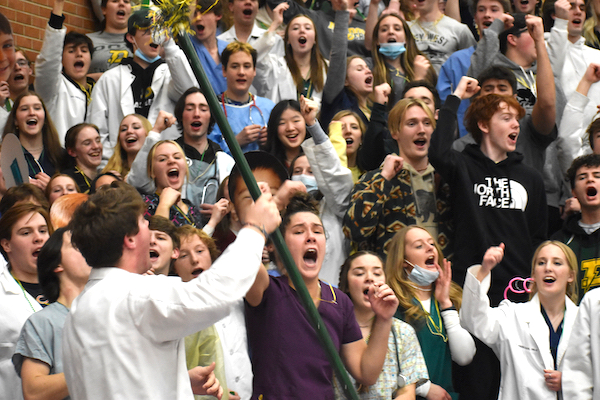
At least since 2014 – when it started appearing in yearbook photos – a Spirit Stick has been the instrument used by leaders to direct the section. The stick is green – and recently repainted – and also recently busted after one end broke off during that hockey game. But section leaders claim it’s still got plenty of magic – when a ball falls out of bounds their way, they make sure the pompom end of the stick sprinkles a little Charger spirit on it before putting it back in play. “It’s powerful, really,” Watkins said. “It changes games.”
5. Strength in Numbers
With an enrollment of nearly 1,300 students, getting a couple hundred to big games is a goal. Section leaders knew there was potential when the section showed in force for the football season opener at University of Michigan – which kicked off at noon on the first Friday of the school year. Despite being on the road this past Friday, nearly 150 students showed for the boys basketball game against the Chemics.
6. Get Social
Without argument, the biggest driver of Dow’s student section strength this year has been the addition of dedicated social media channels. Putting out announcements and themes on Instagram spreads the word, as those posts become part of students’ stories and get passed along quickly. Senior Kimberly Douglas puts together video and the section started a TikTok as well.
7. Making the Difference
Dow’s goal is to affect the game’s outcome – it’s that simple. All four leaders are athletes and know the confidence boost the section can provide. “We just want to be the turning point,” said Sanders, who plays hockey, baseball and runs track. “To allow our sports teams to get the closest to a win as possible … like a sixth man on the court, to help get those extra points. It’s important to understand that we’re not on the court, but we can have a say (in the result).”
8. They’re Everywhere
Dow is part of the Saginaw Valley League, which stretches from Lapeer to Mount Pleasant and makes rallying the section for frequent two-hour road trips difficult. So the section focuses on home events – and not just football and basketball. Watkins would rush from football practice to lead the section during volleyball matches, and the section supported its boys soccer team in the fall and is big at hockey.
 9. Coming Attractions
The section drives attendance by taking sporting events up a level in terms of fan participation. That has included some significant setup for football games; before the game against Midland this fall, Fischer and Rey built enough shakers – two solo cups taped together with corn inside – to fill six garbage bags. “Toga” and “Grandma & Grandpa” have been among popular themes, and they expect a big turnout for tonight’s boys basketball game “Teddy Bear Toss” with stuffed animals to be donated to a children’s hospital.
10. Keep it Classy
Behavior can go south during a rivalry game. Friday’s was a perfect example of how it doesn’t have to do so. While there was plenty of responding to each other’s cheers, it was basically some friendly back and forth and there wasn’t a hint of negativity coming from either side. For Dow’s leaders, cheering is more about giving their teams confidence – they don’t like booing, they don’t do the “who cares” during pregame introductions and they don’t tear opponents down. “That’s the way we do things,” Rey said. “It’s always positive. (Our students) respect that; they know that. They should be cheering out there for our team, and nothing else.”
The Battle of the Fans X finalists tour will resume Friday at Buchanan and conclude Feb. 8 at Traverse City West, with the champion announced Feb. 18.
PHOTOS (Top) Senior Daniel Watkins leads Dow’s cheering section with the Spirit Stick during Friday’s boys basketball game at Midland. (Middle) Students cheer on their classmates during a "Doctors & Nurses" theme night. (Below) Senior Abby Rey, front in purple, helps lead the section after scoring a team-high 16 points in the girls basketball team’s win over the Chemics to begin the evening. (Photos by Kaylee Emrick/Midland Dow Yearbook staff.)