

New Math: Division & Multiplication Problems
July 25, 2017
By Jack Roberts
MHSAA Executive Director
This is the second part in a series on MHSAA tournament classification, past and present, that will be published over the next two weeks. This series originally ran in this spring's edition of MHSAA benchmarks.
High school tournament classifications went viral before there was social media and most of us knew what “viral” meant.
Much as a virus infects computers today or has created epidemics of disease around the world for centuries, high school tournament classification – once introduced – tends to spread uncontrollably. Once started, it tends to keep expanding and rarely contracts.
While we are still some distance from providing every team a trophy as a result of expanding high school tournament classification across the country, there is criticism nevertheless that we are headed in that direction – a philosophy which is supposed to exist only in local youth sports for our youngest children.
Michigan could be blamed for all this. Michigan is generally accepted as the first state to provide different classifications for season-ending tournaments for different sized schools. It started a century ago. Today, every state has various classifications for its tournaments in most if not all sports. And it is a bit ironic that Michigan – creator of the classification chaos – more than most other states has kept the number of tournament classes or divisions under control.
Yes, there is evidence that tournament classifications have expanded over the years in Michigan, especially with the relatively recent introduction of tournaments in football and the late 1990s’ move from classes to divisions in most MHSAA tournaments. But the MHSAA Representative Council has held true to its word when it expanded the playoffs for football from four classes to eight divisions: this is needed because of unique factors of football, factors that exist in no other sport; and all other sports should be capped at a maximum of four classes or divisions.
Kentucky is the preeminent defender of single-class basketball. All of its 276 high schools compete for the single state championship for each gender. In Indiana, there are still open wounds from its move in 1998 from one to four classes for its 400 schools in basketball.
Multi-class tournaments have tended to increase the number of non-public school champions, which some states are trying to lower through enrollment “multipliers,” and also tend to increase the number of repeat champions, which some states are trying to affect with “success factors” which lift smaller schools into classifications for larger schools if they take home too many trophies.
While there is considerable evidence that state tournaments do as much bad as good for educational athletics, state associations persist in providing postseason tournaments because, on balance, the experiences are supposed to be good for student-athletes. And once we reach that conclusion it is just a small leap to believe that if the tournaments are good for a few, they must be better for more – which leads to creating more and more tournament classifications. One becomes two classes, then three, then four and so forth.
While the argument is that more classifications or divisions provides more students with opportunities to compete and win, it is undeniable that the experience changes as the number of tournament classifications expands. It is not possible for state associations to provide the same level of support when tournament classifications expand to multiple venues playing simultaneously. For example, there is less audio and video broadcast potential at each venue, and less media coverage to each venue. Focus is diluted and fans diminished at each championship.
No one can argue reasonably that today's two-day MHSAA Football Finals of eight championship games has the same pizazz as the one-day, four-games event conducted prior to 1990.
In some states the number of divisions has grown so much that it is difficult to see much difference between the many season-ending state championship games and a regular-season event in the same sport.
It is a balancing act. And Michigan has been studying that balance longer than any other state, and charting a steadier course than most.
Addition by Division
The shift to Divisions for MHSAA Tournament play in numerous sports has added up to a greater number of champions for teams and individuals across the state. Following are the sports currently employing a divisional format, and the procedures for determining enrollment and classification.
In 23 statewide or Lower Peninsula tournaments, schools which sponsor the sport are currently divided into nearly equal divisions. They are:
- Baseball - 4 Divisions
- Boys Bowling - 4 Divisions
- Girls Bowling - 4 Divisions
- Girls Competitive Cheer - 4 Divisions
- LP Boys Cross Country - 4 Divisions
- LP Girls Cross Country - 4 Divisions
- LP Boys Golf - 4 Divisions
- LP Girls Golf - 4 Divisions
- Ice Hockey - 3 Divisions
- Boys Lacrosse - 2 Divisions
- Girls Lacrosse - 2 Divisions
- Boys Skiing - 2 Divisions
- Girls Skiing - 2 Divisions
- LP Boys Soccer - 4 Divisions LP
- Girls Soccer - 4 Divisions
- Girls Softball - 4 Divisions
- LP Boys Swimming & Diving - 3 Divisions
- LP Girls Swimming & Diving - 3 Divisions
- LP Boys Tennis - 4 Divisions
- LP Girls Tennis - 4 Divisions
- LP Boys Track & Field - 4 Divisions
- LP Girls Track & Field - 4 Divisions
- Wrestling - 4 Divisions
Lists of schools for each division of these 23 tournaments are posted on MHSAA.com approximately April 1. Listings of schools in Upper Peninsula tournaments for their sports are also posted on MHSAA.com. The lists are based on school memberships and sports sponsorships in effect or anticipated for the following school year, as known to the MHSAA office as of a date in early March.
In football, the 256 schools which qualify for MHSAA 11-player playoffs are placed in eight equal divisions annually on Selection Sunday. Beginning in 2017, the 8-player divisions will be determined in a like manner on Selection Sunday as well, with 32 qualifying schools placed in two divisions.
Schools have the option to play in any higher division in one or more sports for a minimum of two years.
The deadlines for "opt-ups" are as follows:
- Applications for fall sports must be submitted by April 15
- Applications for winter sports must be submitted by Aug. 15
- Applications for spring sports must be submitted by Oct. 15
Subsequent to the date of these postings for these tournaments, no school will have its division raised or lowered by schools opening or closing, schools adding or dropping sports, schools exercising the option to play in a higher division, or approval or dissolution of cooperative programs.
When the same sport is conducted for boys and girls in the same season (e.g., track & field and cross country), the gender that has the most sponsoring schools controls the division breaks for both genders.
1st & Goal: 2025 Playoffs Week 2 Preview
By
Geoff Kimmerly
MHSAA.com senior editor
November 7, 2025
The term “rivalry week” doesn’t really pop up much during the playoffs, as generally those rivalry games take place during the regular season with maybe a few rematches as we get into November.
 This second weekend of the 2025 MHSAA Playoffs might be the exception.
We have several rivalries reigniting – most rematches from the regular season but others with longer histories of seeing each other this time of year, with seasons on the line.
Tickets this weekend are $7 for 11-Player District Finals and $9 for 8-Player Regional Finals and can be purchased at GoFan.co. A total of 63 games also will be broadcast and available to watch with subscription on the NFHS Network.
Games listed below are tonight unless noted.
11-Player Division 1
Rockford (8-2) at Hudsonville (10-0) WATCH
The Eagles are a combined 22-2 over the last two seasons with two wins Rockford, including 35-28 in Week 6 this fall. But finishing a season sweep of the rival Rams would be another major accomplishment. Rockford has won their past four playoff meetings, going back a decade, and the Eagles didn’t have to go through Rockford last year on the way to finishing Division 1 runner-up.
Keep an eye on these FRIDAY Grand Blanc (10-0) at Clarkston (9-1) WATCH, Rochester Hills Stoney Creek (7-3) at Rochester Adams (8-2) WATCH, Macomb Dakota (7-3) at Romeo (7-3) WATCH.
11-Player Division 2
St. Clair Shores Lakeview (8-2) at Grosse Pointe South (9-1), Saturday WATCH
South’s only loss this season – and only Macomb Area Conference White loss over the last four years – came 25-22 to Lakeview on Oct. 10 and resulted in a shared league title between the Blue Devils and Utica. If South avenges this weekend, it will win a District title for the first time since 2016. If Lakeview wins, the Huskies will celebrate their first District title, ever – and after going 3-6 only a year ago.
Keep an eye on these FRIDAY Byron Center (7-3) at Portage Central (10-0) WATCH, Bloomfield Hills Brother Rice (6-4) at Orchard Lake St. Mary’s (7-2) WATCH, Dexter (9-1) at South Lyon (10-0) WATCH.
11-Player Division 3
Gaylord (10-0) at Mount Pleasant (10-0) WATCH
These teams have taken distinctly different paths to reach perfection this deep into the season. Mount Pleasant hasn’t played a single-digit game and impressed primarily by giving up more than 17 points only once – when it outscored Midland Dow 63-39. Gaylord has won seven games by seven points or fewer, showing some serious moxie in outlasting those opponents – an intangible skill that tends to become important with trophies on the line.
Keep an eye on these FRIDAY Zeeland West (7-3) at St. Joseph (6-4) WATCH, Middleville Thornapple Kellogg (7-3) at Lowell (8-2) WATCH, Fenton (7-3) at Adrian (9-1) WATCH.
11-Player Division 4
Chelsea (9-1) at Goodrich (10-0) WATCH
The reigning Division 4 champion Martians have won 23 straight games, including close ones this fall over Frankenmuth, Lapeer and Fenton. They’ll take on a Chelsea team that’s lost only to Division 2 Dexter and otherwise played one single-digit game, defeating Linden 35-28 two weeks ago. Goodrich’s power running game has long been its catalyst, and Chelsea must either stop it – or match it – to win its first District title since its 2021 Finals championship season.
Keep an eye on these FRIDAY Haslett (8-2) at Williamston (10-0) WATCH, Harper Woods Chandler Park (8-2) at Harper Woods (10-0) WATCH. SATURDAY Big Rapids (9-1) at Escanaba (9-1) WATCH.
11-Player Division 5
Grand Rapids West Catholic (9-1) at Grand Rapids Catholic Central (10-0) WATCH
This will be the fourth playoff meeting over the last five seasons between these rivals, and Grand Rapids Catholic Central has won the first three of that series – including by two points two years ago and three last season. The Cougars have avenged three losses from last fall – when they reached the Division 5 Semifinals – and haven’t allowed more than 17 points in a game. West Catholic opened this fall with its lone loss, to Grand Rapids Northview, but has been on a roll since and finished the regular season with a 28-16 win over reigning Division 3 champion Zeeland West.
Keep an eye on these FRIDAY Michigan Center (9-1) at Ann Arbor Father Gabriel Richard (10-0) WATCH, Monroe Jeffers (9-1) at Romulus Summit Academy North (8-1) WATCH, Richmond (9-1) at Frankenmuth (9-1) WATCH.
11-Player Division 6
Traverse City St. Francis (7-2) at Kingsley (8-2) WATCH
St. Francis won these rivals’ Week 5 matchup 21-20 with a stop on a 2-point conversion try. This will be their first playoff rematch since 2018, and Kingsley retained homefield advantage thanks to a schedule that also included a loss to undefeated Division 3 Gaylord and a big Week 9 win over previously-unbeaten Charlevoix. That said, this will be St. Francis’ eighth game against a team with a winning record – with its losses to reigning Division 6 champion Jackson Lumen Christi and last year’s Division 5 title winner Pontiac Notre Dame Prep.
Keep an eye on these FRIDAY Kent City (10-0) at Belding (9-1) WATCH, Warren Michigan Collegiate (6-4) vs. Detroit Edison (8-2) at The Corner Ballpark, Marine City (7-3) at Almont (10-0) WATCH.
11-Player Division 7
Clinton (8-2) at Monroe St. Mary Catholic Central (8-2)
This is a rematch from Week 1 and a repeat of last season – and actually the third year in a row these two will meet in the playoffs. St. Mary, last year’s Division 7 runner-up, opened this fall with a 42-6 win over Clinton and obviously won last year’s District Final matchup as well. Clinton’s only other loss this fall was to still-undefeated Hudson, while SMCC closed the regular season with defeats to Riverview and Detroit Country Day over a three-week span before bouncing back with a 27-2 win over Leslie to open the playoffs.
Keep an eye on these FRIDAY Bronson (8-2) at Hanover-Horton (8-2) WATCH, Lawton (8-2) at Schoolcraft (8-2) WATCH. SATURDAY Ithaca (7-3) at Elkton-Pigeon-Bay Port Laker (8-2).
11-Player Division 8
New Lothrop (7-3) at Springport (10-0) WATCH
Springport is pursuing its first District championship in this sport and after falling in last year’s District Final against Reading by just a point. The Spartans closed this regular season with a pair of close calls, defeating Union City by a point and Bronson by seven, but opened the playoffs by downing Manchester 47-8. New Lothrop is back in the mix after missing the playoffs last season for the first time since 1999, and the Hornets bounced back from a pair of late league losses to win close in Week 9 over Cheboygan and then 19-14 last week over Fowler – which missed Ford Field with a one-point Semifinal defeat a year ago.
Keep an eye on these FRIDAY Iron Mountain (6-3) at Bark River-Harris (8-1) WATCH, Saginaw Nouvel Catholic Central (8-2) at Beal City (10-0) WATCH, Riverview Gabriel Richard (5-5) at Allen Park Cabrini (9-1) WATCH.
8-Player Division 1
Climax-Scotts (8-2) at Martin (10-0) WATCH
Climax-Scotts is playing to win a first Regional title since 2019 and has put up 72 points – and given up at least 62 – in both of its last two games, last week avenging a Week 1 defeat against Gobles. The Panthers are averaging 54 points per game but likely will run up against their toughest challenge yet in the Clippers, who have allowed 87 points total this season – and more than 14 only twice. Martin won the Division 1 championship back-to-back in 2022 and 2023 before falling in this round last season. The Clippers also have a win over Gobles from Week 4.
Other Regional Finals FRIDAY Pickford (8-1) at Norway (10-0) WATCH, Merrill (8-2) at Blanchard Montabella (9-1) WATCH, Capac (8-2) at Kingston (9-1) WATCH.
8-Player Division 2
Mendon (10-0) at Portland St. Patrick (10-0) WATCH
Mendon has reached at least the Regional Finals four of its five seasons in 8-player football, and this will be the first time doing so undefeated. The Hornets have the highest-scoring player in MHSAA 8-player history in running back Owen Gorham, and they’ll run up against a defense giving up only 8.5 points per game. The Shamrocks can score too, topping 40 points in all but one of their wins on the field (one win was by forfeit). But the Hornets also have shown they can slow down top offenses – they held Climax-Scotts, noted above, to just 20 points three weeks ago.
Other Regional Finals FRIDAY Gaylord St. Mary (8-2) at Onekama (10-0) WATCH. SATURDAY Lake Linden-Hubbell (8-2) at Felch North Dickinson (10-0), Deckerville (9-1) at Britton Deerfield (9-1) WATCH.
MHSAA.com's weekly “1st & Goal” previews and reviews are powered by MI Student Aid, a division within the Department of Lifelong Education, Advancement, and Potential (MiLEAP). MI Student Aid encourages students to pursue postsecondary education by providing access to student financial resources and information. MI Student Aid administers the state’s scholarship and grant programs that help make college Accessible, Affordable and Attainable for you. Click to connect with MI Student Aid and find more information on Facebook and Twitter @mistudentaid.
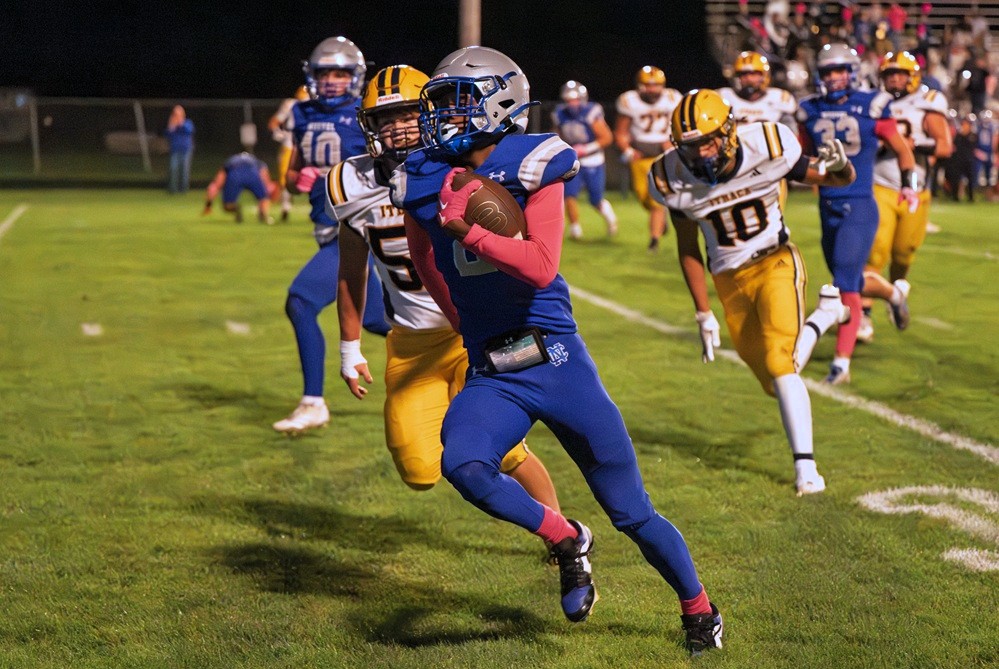
PHOTO Saginaw Nouvel Catholic Central's Sean Foley (2) breaks down the sideline during a Week 7 game against Ithaca. (Click for more from High School Sports Scene.)