

New Math: Division & Multiplication Problems
July 25, 2017
By Jack Roberts
MHSAA Executive Director
This is the second part in a series on MHSAA tournament classification, past and present, that will be published over the next two weeks. This series originally ran in this spring's edition of MHSAA benchmarks.
High school tournament classifications went viral before there was social media and most of us knew what “viral” meant.
Much as a virus infects computers today or has created epidemics of disease around the world for centuries, high school tournament classification – once introduced – tends to spread uncontrollably. Once started, it tends to keep expanding and rarely contracts.
While we are still some distance from providing every team a trophy as a result of expanding high school tournament classification across the country, there is criticism nevertheless that we are headed in that direction – a philosophy which is supposed to exist only in local youth sports for our youngest children.
Michigan could be blamed for all this. Michigan is generally accepted as the first state to provide different classifications for season-ending tournaments for different sized schools. It started a century ago. Today, every state has various classifications for its tournaments in most if not all sports. And it is a bit ironic that Michigan – creator of the classification chaos – more than most other states has kept the number of tournament classes or divisions under control.
Yes, there is evidence that tournament classifications have expanded over the years in Michigan, especially with the relatively recent introduction of tournaments in football and the late 1990s’ move from classes to divisions in most MHSAA tournaments. But the MHSAA Representative Council has held true to its word when it expanded the playoffs for football from four classes to eight divisions: this is needed because of unique factors of football, factors that exist in no other sport; and all other sports should be capped at a maximum of four classes or divisions.
Kentucky is the preeminent defender of single-class basketball. All of its 276 high schools compete for the single state championship for each gender. In Indiana, there are still open wounds from its move in 1998 from one to four classes for its 400 schools in basketball.
Multi-class tournaments have tended to increase the number of non-public school champions, which some states are trying to lower through enrollment “multipliers,” and also tend to increase the number of repeat champions, which some states are trying to affect with “success factors” which lift smaller schools into classifications for larger schools if they take home too many trophies.
While there is considerable evidence that state tournaments do as much bad as good for educational athletics, state associations persist in providing postseason tournaments because, on balance, the experiences are supposed to be good for student-athletes. And once we reach that conclusion it is just a small leap to believe that if the tournaments are good for a few, they must be better for more – which leads to creating more and more tournament classifications. One becomes two classes, then three, then four and so forth.
While the argument is that more classifications or divisions provides more students with opportunities to compete and win, it is undeniable that the experience changes as the number of tournament classifications expands. It is not possible for state associations to provide the same level of support when tournament classifications expand to multiple venues playing simultaneously. For example, there is less audio and video broadcast potential at each venue, and less media coverage to each venue. Focus is diluted and fans diminished at each championship.
No one can argue reasonably that today's two-day MHSAA Football Finals of eight championship games has the same pizazz as the one-day, four-games event conducted prior to 1990.
In some states the number of divisions has grown so much that it is difficult to see much difference between the many season-ending state championship games and a regular-season event in the same sport.
It is a balancing act. And Michigan has been studying that balance longer than any other state, and charting a steadier course than most.
Addition by Division
The shift to Divisions for MHSAA Tournament play in numerous sports has added up to a greater number of champions for teams and individuals across the state. Following are the sports currently employing a divisional format, and the procedures for determining enrollment and classification.
In 23 statewide or Lower Peninsula tournaments, schools which sponsor the sport are currently divided into nearly equal divisions. They are:
- Baseball - 4 Divisions
- Boys Bowling - 4 Divisions
- Girls Bowling - 4 Divisions
- Girls Competitive Cheer - 4 Divisions
- LP Boys Cross Country - 4 Divisions
- LP Girls Cross Country - 4 Divisions
- LP Boys Golf - 4 Divisions
- LP Girls Golf - 4 Divisions
- Ice Hockey - 3 Divisions
- Boys Lacrosse - 2 Divisions
- Girls Lacrosse - 2 Divisions
- Boys Skiing - 2 Divisions
- Girls Skiing - 2 Divisions
- LP Boys Soccer - 4 Divisions LP
- Girls Soccer - 4 Divisions
- Girls Softball - 4 Divisions
- LP Boys Swimming & Diving - 3 Divisions
- LP Girls Swimming & Diving - 3 Divisions
- LP Boys Tennis - 4 Divisions
- LP Girls Tennis - 4 Divisions
- LP Boys Track & Field - 4 Divisions
- LP Girls Track & Field - 4 Divisions
- Wrestling - 4 Divisions
Lists of schools for each division of these 23 tournaments are posted on MHSAA.com approximately April 1. Listings of schools in Upper Peninsula tournaments for their sports are also posted on MHSAA.com. The lists are based on school memberships and sports sponsorships in effect or anticipated for the following school year, as known to the MHSAA office as of a date in early March.
In football, the 256 schools which qualify for MHSAA 11-player playoffs are placed in eight equal divisions annually on Selection Sunday. Beginning in 2017, the 8-player divisions will be determined in a like manner on Selection Sunday as well, with 32 qualifying schools placed in two divisions.
Schools have the option to play in any higher division in one or more sports for a minimum of two years.
The deadlines for "opt-ups" are as follows:
- Applications for fall sports must be submitted by April 15
- Applications for winter sports must be submitted by Aug. 15
- Applications for spring sports must be submitted by Oct. 15
Subsequent to the date of these postings for these tournaments, no school will have its division raised or lowered by schools opening or closing, schools adding or dropping sports, schools exercising the option to play in a higher division, or approval or dissolution of cooperative programs.
When the same sport is conducted for boys and girls in the same season (e.g., track & field and cross country), the gender that has the most sponsoring schools controls the division breaks for both genders.
1st & Goal: 2025 Playoffs Week 1 Review
By
Geoff Kimmerly
MHSAA.com senior editor
November 4, 2025
The phrase is “survive and advance” for a reason.
 For high school football teams this time of year, the next game always is earned. And that was especially evident as the 51st MHSAA Playoffs began over the weekend.
A total of 32 games – out of 143 total – were decided by seven points of fewer. Nine of those matchups were decided by a single point.
We glance at several of those below as we move on this week to District Finals in 11-player and 8-player Regional championship games.
11-Player Division 1
HEADLINER Brownstown Woodhaven 30, Belleville 29 Marquez McAdoo ran for two touchdowns and Woodhaven (8-2) blocked a late extra-point try to secure the program’s first playoff win since 2021 – and after missing the postseason the last two years. The Tigers’ run ended at 7-3.
🚨 UPSET ALERT! 🚨 Woodhaven stuns Belleville in the Division 1 @MHSAA District Semifinal, 30-29!
Senior Andrew Pridemore came up clutch, blocking the potential game-tying extra point late in the 4th quarter to seal the win. The victory marks Woodhaven’s first playoff win since… pic.twitter.com/pWsyGaxA4v— STATE CHAMPS! Michigan (@statechampsmich) November 1, 2025
District Digest East Kentwood 49, Grand Ledge 15 The Falcons (8-2) earned their first playoff win since 2019, slowing down a Comets attack that had scored 30 or more points seven times in finishing 7-3. Clarkston 52, Davison 14 The Wolves (9-1) opened the playoffs with arguably their most impressive win of a season with several, as Davison (8-2) was averaging nearly 44 points per game the night. Macomb Dakota 6, Utica 3 The Cougars (7-3) bounced back from a 26-17 loss to Utica (7-3) from Week 8.
11-Player Division 2
HEADLINER Traverse City Central 15, Traverse City West 13 Just a week after West won their Patriot Game rivalry game 21-20, these two returned to the same field but with Central (6-4) advancing with its first win over the Titans (5-5) since 2022 – and first playoff victory over any opponent since 2021. Click for more from the Traverse City Record-Eagle.
District Digest Grosse Pointe South 28, Roseville 27 These Macomb Area Conference White rivals met for a second time after South (9-1) won the first 47-25 in Week 5 – and after the Blue Devils also defeated Roseville (4-6) by just a point to open the 2024 playoffs. East Lansing 26, White Lake Lakeland 20 The Trojans (5-5) made the playoffs in part because of an incredible strength of schedule, and they showed they belong in extending their winning streak to four while ending the Eagles’ season at 7-3. Warren Cousino 28, Birmingham Seaholm 7 The Patriots (7-3) – after missing the postseason a year ago – claimed their first playoff win since 2007, ending the Maples’ run at 5-5.
11-Player Division 3
HEADLINER Zeeland West 30, Niles 21 The reigning champion Dux (7-3) sent a wave through the Division 3 bracket, handing Niles (9-1) its only loss of the season as the Vikings also aspired to get back to Ford Field after finishing Division 4 runners-up a year ago. West’s 30 points were the most Niles gave up in a game all fall. Click for more from the South Bend Tribune.
District Digest Middleville Thornapple Kellogg 28, Hastings 20 The Trojans (7-3) earned their first playoff win since 2020 and continued to impress after winning a combined eight games over the last four seasons – and opening this one with a 31-29 loss to Hastings (7-3). Warren De La Salle Collegiate 56, Warren Fitzgerald 34 De La Salle (4-6) was another qualifier that played a powerful schedule this fall, and the Pilots added to it with this win over the MAC Gold champion Spartans (8-2). Gaylord 38, Marquette 34 The Blue Devils’ 10-0 season has included now seven wins by seven points or fewer, and they kept it alive with the go-ahead score during the final minute to get past the Sentinels (6-4).

11-Player Division 4
HEADLINER Big Rapids 32, Ludington 31 Big Rapids opened the playoffs with a win over Ludington for the second-straight postseason, but this time handed the Orioles (9-1) their lone defeat as well – also with a go-ahead touchdown coming during the final minute. The Cardinals (9-1) additionally reached nine wins for the third straight season. Click for more from the Big Rapids Pioneer.
District Digest Portland 42, Grand Rapids South Christian 41 (OT) The Raiders (10-0) hadn’t had a game closer than 24 points all season, but emerged from this first matchup with South Christian since falling to the Sailors (4-6) in a 2023 Semifinal. Madison Heights Lamphere 7, Redford Union 6 Another one-pointer saw Lamphere (7-3) earn its first playoff win since 2022 and set up a rematch with Dearborn Divine Child, which eliminated the Rams a year ago. Impressive sidenote: After allowing 40 in its opener this fall, Union (7-3) gave up only 41 total over its final nine games. Three Rivers 21, Paw Paw 14 Just two weeks prior, Paw Paw (6-4) had defeated Three Rivers (6-4) in league play 43-0. The Wildcats are in the playoffs for the first time since 2022.
11-Player Division 5
HEADLINER Ogemaw Heights 29, Negaunee 28 (OT) The Falcons (9-1) advanced to a District Final for the third-straight season, advancing from their toughest challenge since a Week 2 loss to Traverse City St. Francis. The Miners ended their run at 6-4. Click for more from the Bay City Times.
District Digest Berrien Springs 34, Dowagiac 20 These Lakeland Conference rivals met for a second time for the second season in a row, and this time after sharing the league title. Berrien Springs (7-2) had won the first matchup as well. Dowagiac finished 5-4. Detroit Denby 18, Detroit Southeastern 16 Denby (8-2) ran its winning streak to eight with its first playoff victory since 2020, ending Southeastern’s season at 6-4. Richmond 14, Armada 10 These Blue Water Area Conference rivals met for the second time this season and it was nearly as close as the first, as Richmond (9-1) held on after also claiming the Week 4 matchup 24-17 – and after Armada (6-4) won regular-season and playoff games over the Blue Devils a year ago.
11-Player Division 6
HEADINER Kent City 28, Olivet 22 Kent City added its first playoff victory since 2019 to its first 10-0 start since 2017 as it went on the road to defeat the Eagles (8-2). Olivet’s only losses this season came to teams still undefeated. Click for more from Local Sports Journal.
District Digest Traverse City St. Francis 55, Boyne City 35 The Gladiators (7-2) added a second win this season over Boyne City (6-4) after winning the first 20-13, and with this one earned another rematch this week, against rival Kingsley. Durand 32, Flint Hamady 22 The Railroaders (8-2) will play in a District Final for the first time since 2009, and after missing the playoffs the last two years. Hamady finished 6-4. Napoleon 26, Buchanan 20 The Pirates (7-3) advanced with this win over Lakeland Conference co-champion Buchanan (6-4).
11-Player Division 7
HEADLINER Ithaca 24, Saginaw Valley Lutheran 12 A signature win during Saginaw Valley Lutheran’s historic fall was a 23-22 Week 6 victory over the Yellowjackets as the Chargers (9-1) went on to complete a perfect regular season. But Ithaca (7-3) got its revenge to open its 17th-straight playoff run. Click for more from the Saginaw News.
District Digest McBain 28, Charlevoix 27 The Ramblers (8-2) stopped a 2-point conversion attempt for the win after Charlevoix (8-2) scored with less than a minute to play. Clinton 36, Ottawa Lake Whiteford 20 Clinton (8-2) has lost only once more since falling opening night to Monroe St. Mary Catholic Central, and earned a rematch this week with the Falcons by defeating Whiteford (8-2) in a playoff opener for the second-straight season. Shelby 20, LeRoy Pine River 2 Shelby qualified for the playoffs for the first time since 2013 (not counting COVID-shortened 2020, when nearly all teams made the field), and followed that by winning a playoff game for the first time since reaching the Division 6 Semifinals 12 years ago.
11-Player Division 8
HEADLINER White Pigeon 22, Decatur 20 (OT) White Pigeon’s Week 8 loss to Decatur was its first to the Raiders since 2022, but the Chiefs (8-2) held on in overtime to avenge and earn a District title opportunity against undefeated Hudson this week. Decatur finished 7-3. Click for more from the Sturgis Journal.
District Digest Saginaw Nouvel Catholic Central 34, Saginaw Michigan Lutheran Seminary 28 These rivals met a second time in the playoffs for the second-straight season, but this time Nouvel (8-2) finished the sweep after MLS (6-4) won by a point in their 2024 playoff matchup. Riverview Gabriel Richard 34, Melvindale Academy for Business & Tech 6 Gabriel Richard started this season 1-3 after finishing Division 8 runner-up a year ago, but that early tough competition may have paid off again as the Pioneers (5-5) handed ABT (9-1) the lone defeat of its winningest season all-time. New Lothrop 19, Fowler 14 After a rare playoff miss a year ago, the Hornets (7-3) got off to the right start by getting past an Eagles team (6-4) that made last season’s Semifinals.
8-Player Division 1
HEADLINER Pickford 30, Indian River Inland Lakes 26 Reigning Division 1 runner-up Pickford (8-1) opened these playoffs on the road, but came home with one of the weekend’s most notable wins after handing Inland Lakes (9-1) its only loss this fall. The pair had split Semifinals matchups the last two seasons. Click for more from the Cheboygan Daily Tribune.
Regional Roundup Climax-Scotts 72, Gobles 62 These two produced not only for one of the highest-scoring games this season, but their combined 134 points will rank high on the all-time MHSAA 8-player list. Gobles (7-3) had won their opening-night meeting 54-32, but Climax-Scotts (8-2) has lost only once more. Capac 40, Brown City 38 Capac (8-2) kicked off its first playoffs since 2011 by avenging a 61-22 Week 3 loss to the Green Devils (7-3). Kingston 22, Bay City All Saints 14 Kingston (9-1) navigated its closest win this season to earn a rematch with Capac. All Saints finished 7-3, its defeats by a combined 15 points to teams that are a combined 28-2.
8-Player Division 2
HEADLINER Deckerville 27, Morrice 26 This looked incredible on paper, but might have been even better than advertised as Deckerville emerged from a matchup of teams that both reached championship games a year ago. The reigning Division 1 champion Eagles (9-1) opened a 20-point lead by halftime but had to hold off the Orioles (8-2), last year’s Division 2 runner-up. Click for more from the Huron Daily Tribune.
Regional Roundup Gaylord St. Mary 84, Mio 48 This will also make the all-time single-game scoring list, St. Mary’s 84 points its most since the 2020 playoffs as the Snowbirds moved to 8-2. Mio finished 8-2 as well, its best record since 2019. Lake Linden-Hubbell 50, Powers North Central 28 The Lakes (8-2) made this nearly a repeat of their 52-34 win over the Jets (7-3) in Week 6. North Central’s only other loss this fall came to undefeated Norway. Felch North Dickinson 40, St. Ignace 22 The Nordics (10-0) opened their first playoffs since 2016 by adding to their perfect run, downing the Saints (6-4) to earn a rematch with opening-night opponent Lake Linden-Hubbell – which gave North Dickinson its only single-digit game this fall.
MHSAA.com's weekly “1st & Goal” previews and reviews are powered by MI Student Aid, a division within the Department of Lifelong Education, Advancement, and Potential (MiLEAP). MI Student Aid encourages students to pursue postsecondary education by providing access to student financial resources and information. MI Student Aid administers the state’s scholarship and grant programs that help make college Accessible, Affordable and Attainable for you. Click to connect with MI Student Aid and find more information on Facebook and Twitter @mistudentaid.
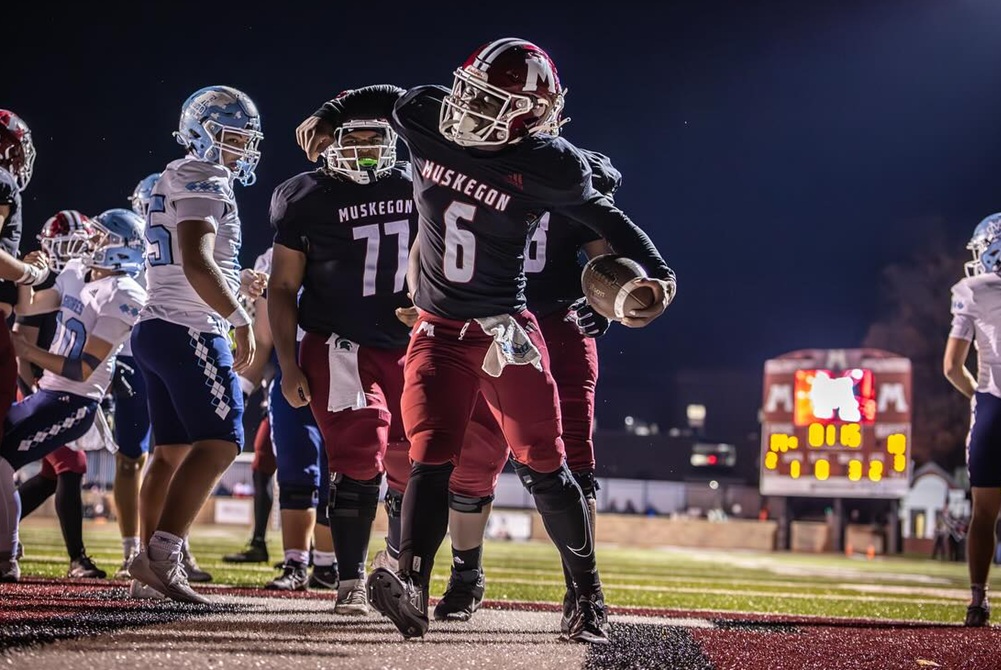
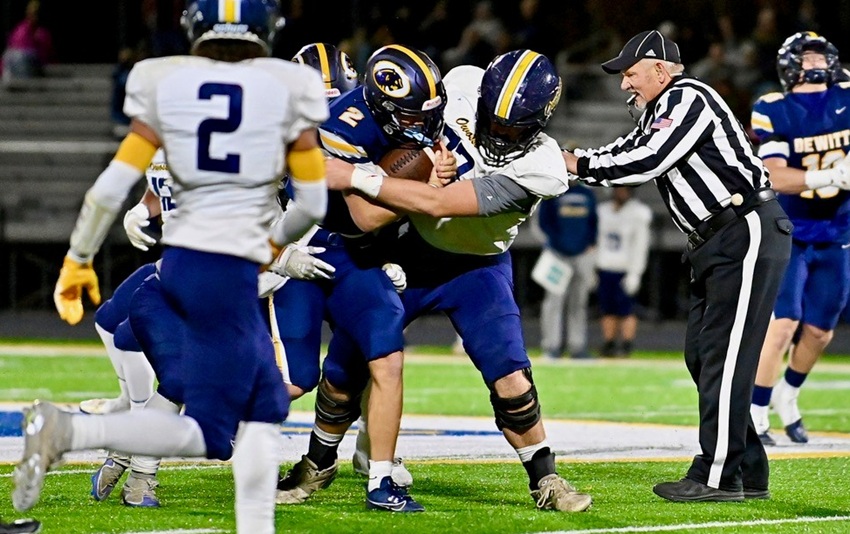
PHOTOS (Top) Muskegon's Lamar Bradford celebrates his touchdown run during the Big Reds' 39-34 win over Mona Shores on Friday. (Middle) East Grand Rapids' Tyler Blake (1) reaches the end zone as a Cedar Springs defender pursues during the Pioneers' 23-21 victory. (Below) An Owosso defender wraps up DeWitt's Trav Moore (2) during the Panthers' 70-13 win. (Muskegon/Mona Shores photo by Tim Reilly. EGR/Cedar Springs photo by Michigan Sports Photo. DeWitt/Owosso photo by Terry Lyons.)