

New Math: Division & Multiplication Problems
July 25, 2017
By Jack Roberts
MHSAA Executive Director
This is the second part in a series on MHSAA tournament classification, past and present, that will be published over the next two weeks. This series originally ran in this spring's edition of MHSAA benchmarks.
High school tournament classifications went viral before there was social media and most of us knew what “viral” meant.
Much as a virus infects computers today or has created epidemics of disease around the world for centuries, high school tournament classification – once introduced – tends to spread uncontrollably. Once started, it tends to keep expanding and rarely contracts.
While we are still some distance from providing every team a trophy as a result of expanding high school tournament classification across the country, there is criticism nevertheless that we are headed in that direction – a philosophy which is supposed to exist only in local youth sports for our youngest children.
Michigan could be blamed for all this. Michigan is generally accepted as the first state to provide different classifications for season-ending tournaments for different sized schools. It started a century ago. Today, every state has various classifications for its tournaments in most if not all sports. And it is a bit ironic that Michigan – creator of the classification chaos – more than most other states has kept the number of tournament classes or divisions under control.
Yes, there is evidence that tournament classifications have expanded over the years in Michigan, especially with the relatively recent introduction of tournaments in football and the late 1990s’ move from classes to divisions in most MHSAA tournaments. But the MHSAA Representative Council has held true to its word when it expanded the playoffs for football from four classes to eight divisions: this is needed because of unique factors of football, factors that exist in no other sport; and all other sports should be capped at a maximum of four classes or divisions.
Kentucky is the preeminent defender of single-class basketball. All of its 276 high schools compete for the single state championship for each gender. In Indiana, there are still open wounds from its move in 1998 from one to four classes for its 400 schools in basketball.
Multi-class tournaments have tended to increase the number of non-public school champions, which some states are trying to lower through enrollment “multipliers,” and also tend to increase the number of repeat champions, which some states are trying to affect with “success factors” which lift smaller schools into classifications for larger schools if they take home too many trophies.
While there is considerable evidence that state tournaments do as much bad as good for educational athletics, state associations persist in providing postseason tournaments because, on balance, the experiences are supposed to be good for student-athletes. And once we reach that conclusion it is just a small leap to believe that if the tournaments are good for a few, they must be better for more – which leads to creating more and more tournament classifications. One becomes two classes, then three, then four and so forth.
While the argument is that more classifications or divisions provides more students with opportunities to compete and win, it is undeniable that the experience changes as the number of tournament classifications expands. It is not possible for state associations to provide the same level of support when tournament classifications expand to multiple venues playing simultaneously. For example, there is less audio and video broadcast potential at each venue, and less media coverage to each venue. Focus is diluted and fans diminished at each championship.
No one can argue reasonably that today's two-day MHSAA Football Finals of eight championship games has the same pizazz as the one-day, four-games event conducted prior to 1990.
In some states the number of divisions has grown so much that it is difficult to see much difference between the many season-ending state championship games and a regular-season event in the same sport.
It is a balancing act. And Michigan has been studying that balance longer than any other state, and charting a steadier course than most.
Addition by Division
The shift to Divisions for MHSAA Tournament play in numerous sports has added up to a greater number of champions for teams and individuals across the state. Following are the sports currently employing a divisional format, and the procedures for determining enrollment and classification.
In 23 statewide or Lower Peninsula tournaments, schools which sponsor the sport are currently divided into nearly equal divisions. They are:
- Baseball - 4 Divisions
- Boys Bowling - 4 Divisions
- Girls Bowling - 4 Divisions
- Girls Competitive Cheer - 4 Divisions
- LP Boys Cross Country - 4 Divisions
- LP Girls Cross Country - 4 Divisions
- LP Boys Golf - 4 Divisions
- LP Girls Golf - 4 Divisions
- Ice Hockey - 3 Divisions
- Boys Lacrosse - 2 Divisions
- Girls Lacrosse - 2 Divisions
- Boys Skiing - 2 Divisions
- Girls Skiing - 2 Divisions
- LP Boys Soccer - 4 Divisions LP
- Girls Soccer - 4 Divisions
- Girls Softball - 4 Divisions
- LP Boys Swimming & Diving - 3 Divisions
- LP Girls Swimming & Diving - 3 Divisions
- LP Boys Tennis - 4 Divisions
- LP Girls Tennis - 4 Divisions
- LP Boys Track & Field - 4 Divisions
- LP Girls Track & Field - 4 Divisions
- Wrestling - 4 Divisions
Lists of schools for each division of these 23 tournaments are posted on MHSAA.com approximately April 1. Listings of schools in Upper Peninsula tournaments for their sports are also posted on MHSAA.com. The lists are based on school memberships and sports sponsorships in effect or anticipated for the following school year, as known to the MHSAA office as of a date in early March.
In football, the 256 schools which qualify for MHSAA 11-player playoffs are placed in eight equal divisions annually on Selection Sunday. Beginning in 2017, the 8-player divisions will be determined in a like manner on Selection Sunday as well, with 32 qualifying schools placed in two divisions.
Schools have the option to play in any higher division in one or more sports for a minimum of two years.
The deadlines for "opt-ups" are as follows:
- Applications for fall sports must be submitted by April 15
- Applications for winter sports must be submitted by Aug. 15
- Applications for spring sports must be submitted by Oct. 15
Subsequent to the date of these postings for these tournaments, no school will have its division raised or lowered by schools opening or closing, schools adding or dropping sports, schools exercising the option to play in a higher division, or approval or dissolution of cooperative programs.
When the same sport is conducted for boys and girls in the same season (e.g., track & field and cross country), the gender that has the most sponsoring schools controls the division breaks for both genders.
Preview: Boys Soccer Finals Guaranteed to Provide Unforgettable Finishes
By
Geoff Kimmerly
MHSAA.com senior editor
October 31, 2025
A first-time champion guaranteed in Division 1.
The possibility of two teams finishing this fall undefeated.
A Division 3 team making the MHSAA Boys Soccer Finals despite entering the tournament unranked.
A potential repeat champion, and another contender seeking its first title this century.
The program with the most Finals wins looking to add one more, and a contender coming off defeating the top-ranked team now seeking to finish No. 1.
Those are just a few storylines heading into Saturday’s season-concluding matches at Grand Ledge High School.
Saturday’s first Final will be Division 4 at 10 a.m., followed by Division 3 at 12:30 p.m., Division 2 at 3:30 and Division 1 at 6 p.m. Tickets cost $11 and may be purchased online only at GoFan. All four Finals also will be broadcast and available with subscription on the NFHS Network.
Division 1 | Division 2 | Division 3 | Division 4
Below is a glance at all eight contenders, with statistics through Regionals:
Division 1
ANN ARBOR HURON
Record/rank: 17-1-3, No. 2
Michigan Power Rating: No. 4
Coach: Luis Gomez-Dominguez, seventh season (66-44-16)
League finish: Second in Southeastern Conference Red
Championship history: Has never appeared in an MHSAA Final.
Players to watch: Kinley Poole, sr. F (12 goals, 10 assists); Malic Kasham, sr. F (13 goals, 4 assists); Philip Leucht, sr. M (7 goals, 3 assists); Matthew Pletcher, sr. GK (9 shutouts).
Outlook: Huron over the last two weeks has celebrated its first Regional championship and now first trip to the Finals, after navigating a tournament path that’s included wins over No. 13 Dearborn Edsel Ford and honorable mentions Troy Athens and Detroit U-D Jesuit. The River Rats have shut out their last three opponents and given up only seven goals all fall, with their lone loss 1-0 to Saline as the rivals split their season series. Pletcher made the all-state second team last season, and Poole and Leucht earned honorable mentions.
PORTAGE CENTRAL
Record/rank: 23-0-2, No. 1
Michigan Power Rating: No. 2
Coach: Tim Halloran, 12th season (175-57-28)
League finish: First in Southwestern Michigan Athletic Conference
Championship history: Has never appeared in an MHSAA Final.
Players to watch: Gunnar Thorhallsson, sr. GK (0.26 goals-against average, 17 shutouts); Max Bailey, sr. F (12 goals, 21 assists); Carter Seim, soph. M (11 goals, 11 assists); Marshall Neumann, sr. M (6 goals, 8 assists).
Outlook: Portage Central also won its first Regional title last week on the way to this first Finals appearance, and defeated No. 5 Clarkston in a Semifinal shootout to get here. But Halloran has plenty of experience coaching on the season’s last day, as he led Hackett Catholic Prep’s girls to three Division 4 titles and two runner-up finishes over a 14-year run ending in 2010. This is his second tenure with Central; he previously coached from 2008-14 and took over again in 2021. Thorhallsson has qualified for the MHSAA single-season shutouts list this fall and made the all-state third team last season. Bailey made the second team, and Neumann also made the third team in 2024. Seniors Gavan Sherman and Oliver Ruggiero also both had 10 goals entering the week.
Division 2
HUDSONVILLE UNITY CHRISTIAN
Record/rank: 19-0-4, No. 2
Michigan Power Rating: No. 5
Coach: Ian Billin, fourth season (67-9-12)
League finish: First in Ottawa-Kent Conference Black
Championship history: Six MHSAA titles (most recent 2023), four runner-up finishes.
Players to watch: Jackson Kamminga, sr. M/F (12 goals, 4 assists); Logan Lutke, sr. D/M (3 goals, 3 assists); Jack VanEyk, sr. M (15 goals, 12 assists); Alen Deppe, jr. GK (0.35 goals-against average).
Outlook: Unity is seeking its second Finals championship in three seasons and first in Division 2 since 2012 after most recently winning Division 3 in 2023. The Crusaders defeated honorable mentions Holland Christian and Holland High, No. 12 Mason, No. 6 Edwardsburg and then Cedar Springs to get here, and also downed No. 10 Grand Rapids South Christian during the regular season. Opponents have scored only eight goals against them. Kamminga made the all-state third team and Lutke earned an honorable mention last season.
WARREN DE LA SALLE COLLEGIATE
Record/rank: 20-4-2, No. 4
Michigan Power Rating: No. 15
Coach: Thaier Mukhtar, 37th season (616-147-99)
League finish: Third in Catholic High School League Central
Championship history: Six MHSAA titles (most recent 2024), one runner-up finish.
Players to watch: Dominic Baldarotta, jr. GK (0.65 goals-against average); Max Wyszczelski, sr. D (2 goals, 4 assists); Nikolai Zacharko, sr. M (10 goals, 15 assists); Andrew Corder, jr. F (38 goals, 15 assists).
Outlook: A year after winning their first championship since 2005, the Pilots are seeking their second in a row led by several players with big-game experience. Corder and Baldarotta made the all-state first team last season, Zacharko made the second team and Wyszczelski made the third. After finishing third in their league to Division 1 No. 11 Detroit Catholic Central and U-D Jesuit, De La Salle has outscored its six postseason opponents by a combined 31-2 – with shutouts of No. 9 Melvindale and No. 5 Bloomfield Hills Cranbrook Kingswood in its last two matches and a 6-1 win over No. 3 New Boston Huron in the Regional Semifinal.
Division 3
DETROIT COUNTRY DAY
Record/rank: 21-2-1, No. 2
Michigan Power Rating: No. 1
Coach: Steve Bossert, 11th season (165-54-24)
League finish: Does not compete in a league.
Championship history: 15 MHSAA titles (most recent 2018), two runner-up finishes.
Players to watch: Tino Haratsaris, sr. M (22 goals, 19 assists); Evan Stark, sr.; Micah Zacks, sr. F (15 goals, 14 assists); Mitchell Hamway, jr. GK (0.90 goals-against average).
Outlook: Country Day also most recently finished Division 3 runner-up two years ago and has its most wins in one season under Bossert, who now has led the team to three championship matches. The Yellowjackets’ only losses this season were to No. 4 Ann Arbor Greenhills and Division 2 top-ranked Grand Rapids Forest Hills Central, and they defeated Division 3 Flint Powers Catholic and No. 7 Alma during the regular season before a tournament run that’s included victories over top-ranked Pontiac Notre Dame Prep, No. 6 Grosse Ile and Greenhills among others. Haratsaris made the all-state first team last season, and Stark and Zacks made the second team.
SOUTH HAVEN
Record/rank: 18-4-4, unranked
Michigan Power Rating: No. 14
Coach: Randy Bautista, first season (18-4-4)
League finish: Second in Southwestern Athletic Conference Lakeshore
Championship history: Division 3 co-champion 2003, three runner-up finishes.
Players to watch: Noah Weaver, sr. F (17 goals, 8 assists); August Zoet, sr. F (24 goals, 4 assists); Levi DeLaRosa, sr. F/M (10 goals, 15 assists); Angel Barajas, jr. M (5 goals, 13 assists).
Outlook: South Haven has won 11 of its last 12 games on the way to making the Finals for the first time since finishing Division 3 runner-up in 2009. The path has been one of the toughest in any division. The Rams in the Semifinal handed No. 14 Fremont its only loss this season, and South Haven also defeated No. 15 Fennville, No. 8 Grand Rapids NorthPointe Christian, No. 11 Grand Rapids Catholic Central and No. 12 Paw Paw over its last five games – all decided by one goal. The Fennville win avenged a 2-1 league title-deciding loss. Weaver earned an all-state honorable mention last season.
Division 4
GROSSE POINTE WOODS UNIVERSITY LIGGETT
Record/rank: 19-2-1, No. 6
Michigan Power Rating: No. 2
Coach: David Dwaihy, 11th season (156-37-13)
League finish: First in Catholic High School League Intersectional 1
Championship history: Four MHSAA titles (most recent 1999), four runner-up finishes.
Players to watch: Ravi Hines, sr. GK (0.40 goals-against average); Ollie Cooley, jr. M (6 goals, 10 assists); Brady Ancona, jr. M (12 goals, 14 assists); Brendan Logan, fr. F (13 goals, 5 assists).
Outlook: Liggett is making its first Finals trip since finishing Division 4 runner-up in 2019, and has four shutouts over its six tournament games despite navigating postseason matches with No. 12 Detroit Cristo Rey, No. 9 Allen Park Inter-City Baptist, honorable mention Hillsdale Academy, No. 8 Plymouth Christian Academy and No. 4 Lansing Christian. The Knights have improved seven wins from a year ago and tied their most under Dwaihy. They start only four seniors, with multiple underclassmen playing key roles.
LELAND
Record/rank: 15-8-2, No. 10
Michigan Power Rating: No. 11
Coach: Rob Sirrine, fifth season (78-34-6)
League finish: Tied for first in Northwest Conference
Championship history: Division 4 champion 2018.
Players to watch: Ravell Smith, sr. GK (0.72 goals-against average); Eli Ulbrich, sr. D (3 goals); Ignacio Creamer, sr. M (12 goals, 14 assists); Adrian Spencer, sr. M (16 goals, 3 assists).
Outlook: Leland has won three Regional titles over the last four seasons and broke through for its second championship match appearance with a 2-1 Semifinal win over top-ranked Grandville Calvin Christian. The Comets also defeated No. 3 North Muskegon in their Regional Final and clinched the District title with a shutout of Maple City Glen Lake, with which it shared the league championship. Smith made the all-state first team last season, Ulbrich and Creamer made the third team and Spencer earned an honorable mention. Senior forward Weston Burda had added another 15 goals and six assists heading into this week.
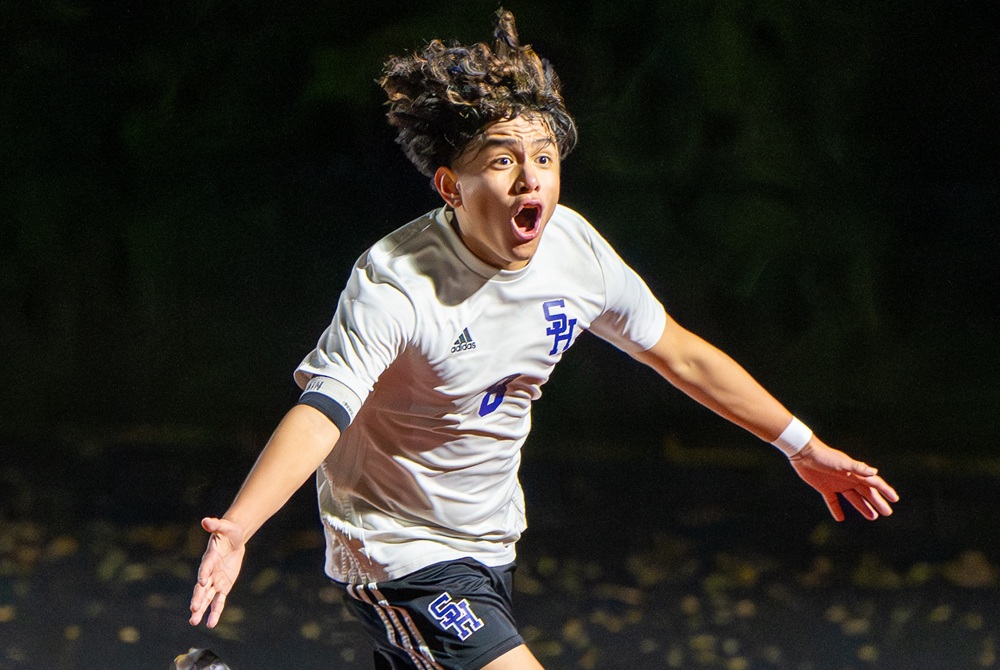
PHOTO Levi DeLaRosa celebrates during South Haven's 2-1 Semifinal win over Fremont on Wednesday. (Photo by Michigan Sports Photo.)