

New Math: Division & Multiplication Problems
July 25, 2017
By Jack Roberts
MHSAA Executive Director
This is the second part in a series on MHSAA tournament classification, past and present, that will be published over the next two weeks. This series originally ran in this spring's edition of MHSAA benchmarks.
High school tournament classifications went viral before there was social media and most of us knew what “viral” meant.
Much as a virus infects computers today or has created epidemics of disease around the world for centuries, high school tournament classification – once introduced – tends to spread uncontrollably. Once started, it tends to keep expanding and rarely contracts.
While we are still some distance from providing every team a trophy as a result of expanding high school tournament classification across the country, there is criticism nevertheless that we are headed in that direction – a philosophy which is supposed to exist only in local youth sports for our youngest children.
Michigan could be blamed for all this. Michigan is generally accepted as the first state to provide different classifications for season-ending tournaments for different sized schools. It started a century ago. Today, every state has various classifications for its tournaments in most if not all sports. And it is a bit ironic that Michigan – creator of the classification chaos – more than most other states has kept the number of tournament classes or divisions under control.
Yes, there is evidence that tournament classifications have expanded over the years in Michigan, especially with the relatively recent introduction of tournaments in football and the late 1990s’ move from classes to divisions in most MHSAA tournaments. But the MHSAA Representative Council has held true to its word when it expanded the playoffs for football from four classes to eight divisions: this is needed because of unique factors of football, factors that exist in no other sport; and all other sports should be capped at a maximum of four classes or divisions.
Kentucky is the preeminent defender of single-class basketball. All of its 276 high schools compete for the single state championship for each gender. In Indiana, there are still open wounds from its move in 1998 from one to four classes for its 400 schools in basketball.
Multi-class tournaments have tended to increase the number of non-public school champions, which some states are trying to lower through enrollment “multipliers,” and also tend to increase the number of repeat champions, which some states are trying to affect with “success factors” which lift smaller schools into classifications for larger schools if they take home too many trophies.
While there is considerable evidence that state tournaments do as much bad as good for educational athletics, state associations persist in providing postseason tournaments because, on balance, the experiences are supposed to be good for student-athletes. And once we reach that conclusion it is just a small leap to believe that if the tournaments are good for a few, they must be better for more – which leads to creating more and more tournament classifications. One becomes two classes, then three, then four and so forth.
While the argument is that more classifications or divisions provides more students with opportunities to compete and win, it is undeniable that the experience changes as the number of tournament classifications expands. It is not possible for state associations to provide the same level of support when tournament classifications expand to multiple venues playing simultaneously. For example, there is less audio and video broadcast potential at each venue, and less media coverage to each venue. Focus is diluted and fans diminished at each championship.
No one can argue reasonably that today's two-day MHSAA Football Finals of eight championship games has the same pizazz as the one-day, four-games event conducted prior to 1990.
In some states the number of divisions has grown so much that it is difficult to see much difference between the many season-ending state championship games and a regular-season event in the same sport.
It is a balancing act. And Michigan has been studying that balance longer than any other state, and charting a steadier course than most.
Addition by Division
The shift to Divisions for MHSAA Tournament play in numerous sports has added up to a greater number of champions for teams and individuals across the state. Following are the sports currently employing a divisional format, and the procedures for determining enrollment and classification.
In 23 statewide or Lower Peninsula tournaments, schools which sponsor the sport are currently divided into nearly equal divisions. They are:
- Baseball - 4 Divisions
- Boys Bowling - 4 Divisions
- Girls Bowling - 4 Divisions
- Girls Competitive Cheer - 4 Divisions
- LP Boys Cross Country - 4 Divisions
- LP Girls Cross Country - 4 Divisions
- LP Boys Golf - 4 Divisions
- LP Girls Golf - 4 Divisions
- Ice Hockey - 3 Divisions
- Boys Lacrosse - 2 Divisions
- Girls Lacrosse - 2 Divisions
- Boys Skiing - 2 Divisions
- Girls Skiing - 2 Divisions
- LP Boys Soccer - 4 Divisions LP
- Girls Soccer - 4 Divisions
- Girls Softball - 4 Divisions
- LP Boys Swimming & Diving - 3 Divisions
- LP Girls Swimming & Diving - 3 Divisions
- LP Boys Tennis - 4 Divisions
- LP Girls Tennis - 4 Divisions
- LP Boys Track & Field - 4 Divisions
- LP Girls Track & Field - 4 Divisions
- Wrestling - 4 Divisions
Lists of schools for each division of these 23 tournaments are posted on MHSAA.com approximately April 1. Listings of schools in Upper Peninsula tournaments for their sports are also posted on MHSAA.com. The lists are based on school memberships and sports sponsorships in effect or anticipated for the following school year, as known to the MHSAA office as of a date in early March.
In football, the 256 schools which qualify for MHSAA 11-player playoffs are placed in eight equal divisions annually on Selection Sunday. Beginning in 2017, the 8-player divisions will be determined in a like manner on Selection Sunday as well, with 32 qualifying schools placed in two divisions.
Schools have the option to play in any higher division in one or more sports for a minimum of two years.
The deadlines for "opt-ups" are as follows:
- Applications for fall sports must be submitted by April 15
- Applications for winter sports must be submitted by Aug. 15
- Applications for spring sports must be submitted by Oct. 15
Subsequent to the date of these postings for these tournaments, no school will have its division raised or lowered by schools opening or closing, schools adding or dropping sports, schools exercising the option to play in a higher division, or approval or dissolution of cooperative programs.
When the same sport is conducted for boys and girls in the same season (e.g., track & field and cross country), the gender that has the most sponsoring schools controls the division breaks for both genders.
Gull Lake Players Find Opportunities to Play, New Friendships as Part of 'Parchment Pride'
By
Pam Shebest
Special for MHSAA.com
September 22, 2026
PARCHMENT — When he took the field for his senior football season, Lucas Hutchinson did not expect to be wearing maroon and white.

The navy blue and white of Gull Lake High School was more his style.
But before the season started, an unusual series of events found Hutchinson and his 18 Gull Lake teammates without any team at all.
That’s when Parchment athletic director Brennan Davis stepped in, contacting Gull Lake AD Karyn Furlong and offering a solution: a cooperative team.
All of a sudden, those 19 players found a new football home.
“Obviously I’d rather be wearing navy blue and white but I’m happy to play in whatever color I can,” Hutchinson said. “Now that I’m playing for Parchment, I gotta have that Parchment Pride so I wear it with honor, and even though it’s not the color I wanted to wear, I’m excited to wear it.”
Gull Lake canceled its football season Aug. 12 after a preseason camp incident that resulted in school and law enforcement investigations.
Davis said his team’s numbers were down this year and adding the Gull Lake players would be the boost his team needed.
“I had heard about Gull Lake canceling their season due to safety concerns, and the schedule they’re playing is tough – to go into the game with 20 kids against some perennial powers,” Davis said. “So I reached out to Karyn (Furlong) on a Wednesday morning (about combining the teams). I heard back from her a few hours later.”
From there, a co-op team was born with the assurance that none of the players involved in the incident would be on the team.
The two groups held their first combined practice a week before the Aug. 27 season opener with just one snag.
“One issue we had was helmets,” Davis said. “We had a specific number of maroon helmets that would have outfitted our varsity and JV players, but then (Gull Lake) came over, they had white helmets.
"We asked the Gull Lake players to give up their white helmets for maroon helmets and gave the white to the JV players.”
First-day jitters
Several Gull Lake players, including Hutchinson, were a bit nervous that first practice.
“I didn’t know how we were going to work together and get along,” Hutchinson said. “I knew no one, but I do now,” he laughed. “When I first went into the locker room it was with a bunch of random faces I didn’t know. I was definitely eager to know everybody.”
He said he was worried about the way he and his teammates would be treated.
“Past two years, I was starting on varsity both ways, so even though I was getting to play football, I was worried how things were going to change, for not just me but all the guys from Gull Lake being treated equally and getting playing time. It transitioned smoothly, definitely no favoring with the coaches.”
Parchment quarterback Jordan Bagley said before the rosters combined the Panthers were preparing for a tough season with just 20 players.
“We knew we were going to have a lot of two-way players so that means we weren’t going to drag butt at practice,” the junior said. “We had to show up and bring it every day.
“It was definitely going to be a tough season mentally and physically. That’s a lot of wear and tear on your body.”
He added that Gull Lake players give the Panthers extra depth.
“It lets everybody come out fresh,” he said. “It reduces the risk of injuries, too. They don’t have to worry about coming out of the game if they’re gassed or need a breather, so it’s a big help.”
A bonus for Parchment was Hutchinson and junior quarterback Zac Pfenning, both past all-Southwest Michigan Athletic Conference first-teamers.
“We have a lot more skill positions so that’s always good for receivers and defensive backs to rotate in,” Bagley said. “They bring some leadership, too. Kessler (Johnson) is a good leader who’s helped X (Xavier Garcia). Depth and more players and a lot of new friendships.
"This has been one of better experiences for football in my career. I’ve actually enjoyed it a lot. It’s been a very positive thing for both sides, I believe. Everybody gets to play some football.”
Todd Nunn, Parchment’s second-year head coach, said he was excited to have his team’s numbers doubled.
“I don’t think we could have asked for a better practice that first day,” he said. “The group seemed to gel well; the Parchment kids were explaining to the Gull Lake kids our offensive plays, helped them understand the defense that was being called. It was like they’d been there the whole time.”
Nunn is no stranger to co-op teams.
He coached at Burr Oak, which combined with Colon for the four years he was there.
“I knew what it felt like being the team coming over to the main school,” he said. “I understood some of the reservations the Gull Lake kids might have coming over here.
“We sat the kids down, explained what was happening and how it would benefit them, not having to play both sides of the ball, getting more time to come to the sidelines to get a break. I think they were very receptive to that.”
Parchment and Gull Lake cheerleaders also have combined for several games.
“The co-op was just for football, but our cheerleaders and Gull Lake’s cheer team and coaches are good friends,” Davis said. “They have practiced together previously over the summer.
“We decided on a specific schedule where their cheerleaders would cheer with ours, four or five games.”
In addition, the football team will play a home game for Senior Night at Gull Lake, against Lawton on Oct. 16. The Blue Devils have 14 seniors and five juniors on the team.
Parchment has six seniors, 11 juniors and three sophomores.
Quick transition, perfect fit
The ease with which the process came together surprised Davis.
“Everything fell into place, which was strange because things usually take forever,” he said.
Over the course of one week:
- Davis and Furlong talked on a Wednesday.
- Parchment already had a staff development day scheduled that day and talked about the cooperative possibility.
- A Southwestern Athletic Conference meeting had been previously postponed from Tuesday to Thursday, and all 18 teams approved the co-op.
- “We did not involve the kids until prior to the (Parchment) board meet on Monday at 5.” Davis said. “I met with four of our team leaders at 4:50, board meeting at 5, meet the team night at 6:30, Gull Lake board meeting at 7, so that whole night was a lot.”
- The MHSAA then approved it.
With the season under way, the Panthers take a 2-2 record into Friday’s game against Kalamazoo United, another co-op team made up of Kalamazoo Christian and Hackett Catholic Prep players.
“(Gull Lake) kids follow our strength and conditioning requirements,” Davis said. “Whenever we have an away game, the kids drive here, ride our buses to our events.
“If there are disciplinary issues, they are a Parchment student-athlete, they function as Parchment students. Luckily nothing (bad) has happened.”
Bagley said the combined team has resulted in friendships that will last beyond this season.
“I got to meet a lot of new people, made a bunch of new friendships, which I’m really thankful for,” he said.
Hutchinson said he and his teammates have adjusted well.
“The first week it was weird seeing everyone wearing a different color (than he wore at Gull Lake), running out to a different field and having it be our home field. But now I’ve embraced it. Now I’m a Parchment Panther … for football,” he added, laughing.
 Pam Shebest served as a sportswriter at the Kalamazoo Gazette from 1985-2009 after 11 years part-time with the Gazette while teaching French and English at White Pigeon High School. She can be reached at [email protected] with story ideas for Calhoun, Kalamazoo and Van Buren counties.
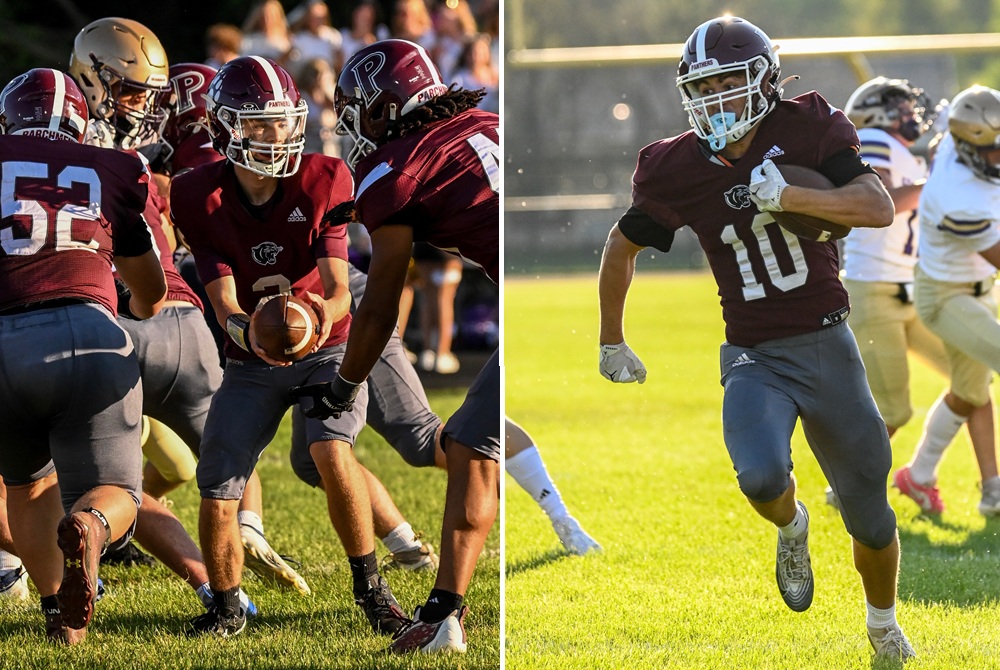
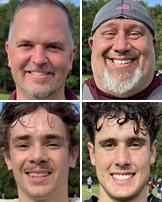
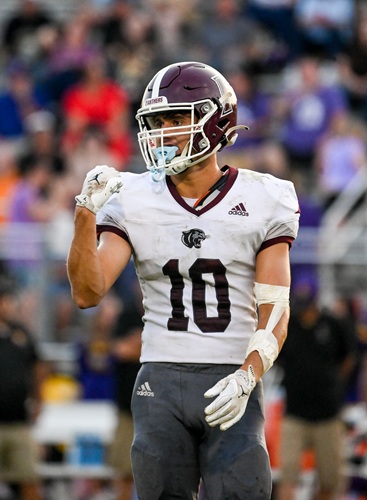
PHOTOS (Top) At left, Parchment quarterback Jordan Bagley (2) hands off during a game this season, and at right, Lucas Hutchinson (10) carries the ball downfield. (Middle) Clockwise from top left: Parchment athletic director Brennan Davis, varsity football coach Todd Nunn, senior Lucas Hutchinson and junior Jordan Bagley. (Below) Hutchinson wears the maroon and white of the Panthers. (Action photos by Kelci Henton. Headshots by Pam Shebest.)