

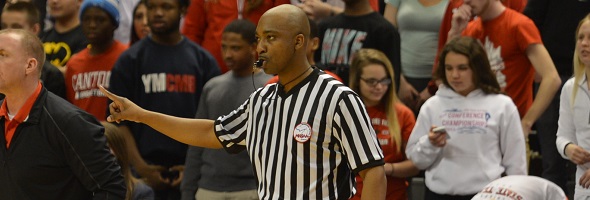
Be the Referee: Basketball Contact
January 22, 2015
This week, MHSAA assistant director Mark Uyl explains new rules that further define contact fouls in high school basketball.
Be The Referee is a series of short messages designed to help educate people on the rules of different sports, to help them better understand the art of officiating, and to recruit officials.
Below is this week's segment - Basketball Physical Contact - Listen
One of the most challenging jobs for any basketball official is determining how much physical contact to allow over the course of the game. This year, new rules in high school basketball better define what contact against the dribbler or ball handler now results in a foul.
First, it is a foul whenever a defender places two hands at the same time on the dribbler. Second, whenever a defender places an extended arm bar on the dribbler. The third automatic foul is when that defender extends and places and keeps a hand on that dribbler for an extended period of time; and lastly, it’s an automatic foul whenever the defender contacts that dribbler more than once with either the same hand or with alternating hands.
Past editions
Jan. 12 - Video Review Part 2 - Listen
Dec. 29 - Video Review Part 1 - Listen
Dec. 17 - Registration Part 2 - Listen
Dec. 10 - Registration Part 1 - Listen
Dec. 3 - Legacy Program - Listen
Nov. 26 - Sideline Management - Listen
Nov. 19 - 7-Person Mechanics - Listen
Nov. 12 - Blocking Below the Waist - Listen
Nov. 5 - Tournament Selection - Listen
Oct. 29 - Uncatchable Pass - Listen
Oct. 22 - Preparation for Officials - Listen
Oct. 15 - Automatic First Downs - Listen
Oct. 8 - Officials & Injuries - Listen
Oct. 1 - Overtime - Listen
Sept. 25 - Field Goals - Listen
Sept. 18 - Tackle Box - Listen
Sept. 11 - Pass Interference - Listen
Aug. 25 - Targeting - Listen
What's My Why: Official Kari Seitz
August 19, 2026
Kari Seitz, Mill Valley (Calif.)
Kari Seitz – the closing speaker at July’s Officiate Michigan Day in Grand Rapids – was one of the top American professional soccer referees and one of the most experienced female referees in the world. She is currently the vice president of refereeing for US Soccer and formerly served as the FIFA head of refereeing.
She worked four FIFA Women's World Cup tournaments (1999, 2003, 2007, and 2011), as well as three Olympic soccer tournaments (2004, 2008, and 2012), and is the only referee – man or woman – to officiate that many of both. Kari was inducted into the National Soccer Hall of Fame in 2026 and is a graduate of Brighton High School and Michigan State University.
So I was a soccer player, played soccer since I was 6. And at some point, I joined an all-girls travel team – that never happened. This was a long time ago.
Our coach required us together, every person on the team, to take the (officiating) course. Now, I believe he didn’t know anything about soccer. He was one of those parents who was reading it from a book and just cared about his kids. So he forced us all to take the referee course, and that altered the path of my life.
“What’s My Why” is a weekly feature telling the stories of MHSAA-registered officials in their own words. If you’re an MHSAA official and would like to share your reason why, please submit a 15 to 45-second video, taken horizontally, to director of officials Sam Davis at [email protected].
What's My Why
Aug. 13: Mike Pereira, Sacramento, Calif. - Watch
Aug. 5: Dino Paganelli, Wyoming - Watch
Aug. 3: Stacy Smith, Caledonia - Watch
July 22: Jason Nickleby, Lake Elmo, Minn. - Watch
July 15: Sam Davis, Lansing - Watch
July 9: Candace Cox, Quincy - Watch
July 1: Robert Williams, Redford - Watch
June 24: Will Godfrey, Jackson - Watch
June 19: Jarrett Skorup, Midland - Watch
June 12: Brady Driver, Sturgis - Watch
June 8: Cindy Tyzo, West Bloomfield - Watch
June 3: Jeff Spedoske, DeWitt - Watch
June 1: Mike Carrier, Commerce Township - Watch
May 27: Stan Wright, Warren - Watch
May 26: Murray Rose, Zeeland - Watch
May 22: Mike VanLaan, Alto - Watch
May 18: Clint Abbott, Newaygo - Watch