

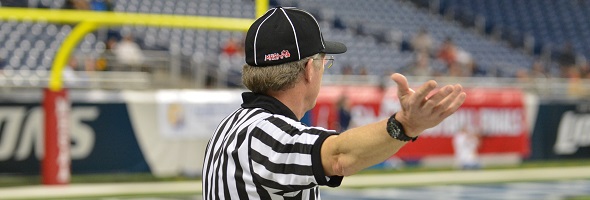
Be the Referee: Helmet Comes Off
October 26, 2017
In this week's edition, assistant director Mark Uyl discusses a recent football rules change geared to improve safety in situations after a player's helmet comes off during play.
Be The Referee is a series of short messages designed to help educate people on the rules of different sports, to help them better understand the art of officiating, and to recruit officials.
Below is this week's segment – Helmet Comes Off - Listen
All rule changes in the game of football, at all levels over the past decade, have been geared mainly to improve player safety.
One of the rules that has come recently deals with players and their helmet. Whenever during the course of play a player’s helmet comes off during the down, that player must leave the game for a minimum of one play for an evaluation to take place to make sure that no possible concussion or head injury has occurred.
Plus – when that helmet comes off a player – we treat that just like an injury situation, to where even a timeout can’t buy that player back into the game to make sure that the proper evaluation has taken place.
Past editions
October 19: Goal Line Rules - Listen
October 12: No 1st-Year Fee - Listen
October 5: Athletic Empty Nesters - Listen
September 28: Misunderstood Football Rules: Kicking - Listen
September 21: Preparation for Officials - Listen
September 14: Always Stay Registered - Listen
September 7: Other Football Rules Changes - Listen
August 31: Pop-Up Onside Kicks - Listen
August 24: Blindside Blocks - Listen
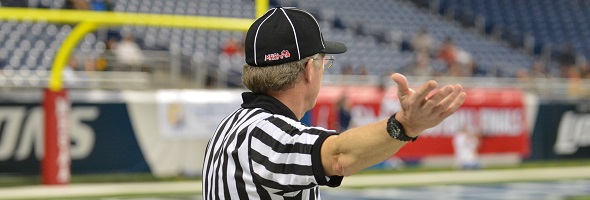
Be the Referee: Registration - Part 1
December 11, 2014
This week, MHSAA assistant director Mark Uyl dicusses the first step in becoming an MHSAA registered official.
"Be the Referee" is designed to help educate people on the rules of different sports, to help them better understand the art of officiating and to recruit officials. The segment can be heard on Mondays, Wednesdays and Fridays during the school year on The Drive With Jack Ebling on WVFN-AM, East Lansing.
Below is this week's segment - Registration Part 1 - Listen
Today we are going to talk about how a person becomes an MHSAA registered official. Depending on the sport, that could mean a referee, umpire or judge.
The first step in the process is to contact the MHSAA and identify the sport or sports in which a person wants to become an official. The next step is to complete the MHSAA Officials Guidebook Exam.
The Officials Guidebook covers some of the basic elements and procedures that are necessary in becoming a sports official. Things such as game assignments, payment of game fees, playing rules and ejection protocols are covered in this first step of the process.
Past editions
Dec. 3 - Legacy Program - Listen
Nov. 26 - Sideline Management - Listen
Nov. 19 - 7-Person Mechanics - Listen
Nov. 12 - Blocking Below the Waist - Listen
Nov. 5 - Tournament Selection - Listen
Oct. 29 - Uncatchable Pass - Listen
Oct. 22 - Preparation for Officials - Listen
Oct. 15 - Automatic First Downs - Listen
Oct. 8 - Officials & Injuries - Listen
Oct. 1 - Overtime - Listen
Sept. 25 - Field Goals - Listen
Sept. 18 - Tackle Box - Listen
Sept. 11 - Pass Interference - Listen
Aug. 25 - Targeting - Listen