


Be the Referee: National Rules Process
February 8, 2018
In this week's edition, assistant director Mark Uyl explains the process by which national playing rules are made and changed.
Be The Referee is a series of short messages designed to help educate people on the rules of different sports, to help them better understand the art of officiating, and to recruit officials.
Below is this week's segment – National Playing Rules Process - Listen
Many times the MHSAA gets asked the question in each sport – how are the national playing rules written?
The MHSAA is a part of the National Federation of State High School Associations. The NFHS, an organization based out of Indianapolis, works to write the playing rules in all sports sponsored by the MHSAA.
The primary focus of all National Federation playing rules is on the health and safety of those playing the game. For suggestions each year, states all across the country can submit proposals for change, and then through the voting process, rules get approved for the following season.
Past editions
February 1: Calling Intentional Fouls - Listen
January 25: Points at the Edge of the Mat - Listen
January 18: Behavior Warning - Listen
January 11: Ice Hockey Safe & Sound - Listen
January 4: Why No Shot Clock - Listen
December 21: Coaches Responsible for Equipment - Listen
December 14: Mentoring New Officials - Listen
December 7: Dive on the Floor - Listen
November 30: Wrestling Weight Monitoring - Listen
November 23: Ejections - Listen
November 16: Toughest Call - Listen
November 9: Hurdling - Listen
November 2: The Survey Says - Listen
October 26: Helmet Comes Off - Listen
October 19: Goal Line Rules - Listen
October 12: No 1st-Year Fee - Listen
October 5: Athletic Empty Nesters - Listen
September 28: Misunderstood Football Rules: Kicking - Listen
September 21: Preparation for Officials - Listen
September 14: Always Stay Registered - Listen
September 7: Other Football Rules Changes - Listen
August 31: Pop-Up Onside Kicks - Listen
August 24: Blindside Blocks - Listen
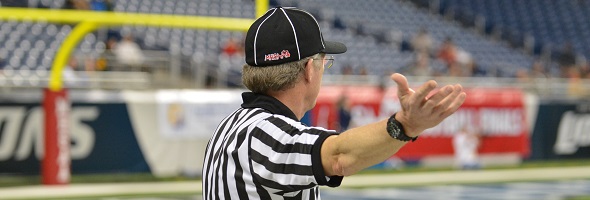
Be the Referee: Personal Fouls
November 5, 2015
This week, MHSAA assistant director Mark Uyl explains how personal fouls are penalized at the high school level.
Be The Referee is a series of short messages designed to help educate people on the rules of different sports, to help them better understand the art of officiating, and to recruit officials.
Below is this week's segment - Make the Call: Personal Fouls - Listen
Late in a key game that’s tied, it’s third down and goal from the 12-yard line after a sack has pushed the offense back. On the third-down play, the quarterback has scrambled and is pulled down again for an apparent sack, but he is pulled to the ground by his facemask.
The officials throw the flag and correctly rule it’s a personal foul facemask. What’s the next down? Under high school rules, personal fouls are NOT an automatic first down. On this play, the officials would walk off the yardage penalty of half-the-distance (to the goal line) and we would replay third down. The only fouls that give the offense an automatic first down are the roughing fouls … roughing the kicker, passer, holder and long snapper.
Past editions:
Oct. 29: Officials Demographics - Listen
Oct. 15: Make the Call: Intentional Grounding - Listen
Oct. 8: Playoff Selection - Listen
Oct. 1: Kick Returns - Listen
Sept. 24: Concussions - Listen
Sept. 17: Automatic First Downs - Listen
Sept. 10: Correcting a Down - Listen
Sept 3: Spearing - Listen
Aug. 27: Missed Field Goal - Listen