

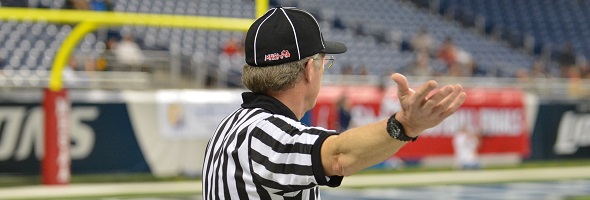
Be the Referee: Sideline Management
December 5, 2014
This week, MHSAA assistant director Mark Uyl dicusses how the sideline rule helps to keep the adults working in football, including coaches and officials, safe during football games.
"Be the Referee" is designed to help educate people on the rules of different sports, to help them better understand the art of officiating and to recruit officials. The segment can be heard on Mondays, Wednesdays and Fridays during the school year on The Drive With Jack Ebling on WVFN-AM, East Lansing.
Below is this week's segment - Sideline Management - Listen
The hottest topic right now in the sport of football deals with safety. We have talked a great deal over the fall about some new rules that have improved player safety. Today we’re going to focus on the adults - specifically coaches and officials that work at the sideline area just in front of the team box.
The rules require that from the time just before the snap until the end of the play, all coaches and team personnel must be completely out of the 6-foot safety zone located in front of the team box at each sideline. This then gives the official plenty of room to work unimpeded in either direction.
Now as soon as the play ends, coaches can move into this area to instruct their players or send in the next play and then move back prior to the next snap.
Past editions
Nov. 19 - 7-Person Mechanics - Listen
Nov. 12 - Blocking Below the Waist - Listen
Nov. 5 - Tournament Selection - Listen
Oct. 29 - Uncatchable Pass - Listen
Oct. 22 - Preparation for Officials - Listen
Oct. 15 - Automatic First Downs - Listen
Oct. 8 - Officials & Injuries - Listen
Oct. 1 - Overtime - Listen
Sept. 25 - Field Goals - Listen
Sept. 18 - Tackle Box - Listen
Sept. 11 - Pass Interference - Listen
Aug. 25 - Targeting - Listen
Officiate Michigan Day 2026 - Register to Join Us!
By
Geoff Kimmerly
MHSAA.com senior editor
May 19, 2026
Officiate Michigan Day 2026 will welcome 2,000 MHSAA-registered game officials to Grand Rapids on July 25 – and registration is available now for this historic gathering expected to draw participants from all over the state.
 Doors open at 7:30 a.m., with the first session at 9 a.m. at DeVos Place. The day-long event will feature dynamic speakers and presenters providing knowledge in several sports and all levels including collegiate and professional. We will be highlighting several of those speakers over the next many weeks on MHSAA.com and social media as part of the lead-up to the event.
Cost is $45 if officials register by the end of June, and $50 beginning July 1. More information is on the way; keep posted at MHSAA.com/OMD.
This will be the third Officiate Michigan Day, joining events in 2013 and 2018.
OMD will accompany the annual National Association of Sports Officials (NASO) Summit that will take place July 26-28, also at DeVos Place.