

Be the Referee: Trick Plays
November 19, 2015
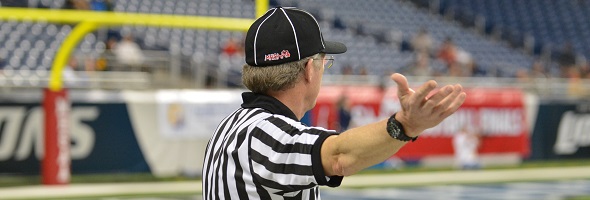
This week, MHSAA assistant director Mark Uyl explains which trick plays in football are allowed, and not allowed, under high school rules.
Be The Referee is a series of short messages designed to help educate people on the rules of different sports, to help them better understand the art of officiating, and to recruit officials.
Below is this week's segment - Trick Plays - Listen
In some of the biggest football games of the year, often times a trick play can be the difference between winning and losing.
Many types of these trick plays are perfectly legal – the halfback pass, the hook and ladder, or the double pass with the first pass being backward behind the line of scrimmage and the second pass going forward. There are several types of trick plays, however, that are prohibited by rule.
One is the old fumblerooski play, where a team intentionally fumbles near the center and a lineman picks up the ball and advances. A second type that is illegal is whenever you’re using substitutions or pretended substitutions to free up a receiver or player standing out along the sidelines.
Past editions:
Nov. 12: 7-Person Football Mechanics - Listen
Nov. 5: Make the Call: Personal Fouls - Listen
Oct. 29: Officials Demographics - Listen
Oct. 15: Make the Call: Intentional Grounding - Listen
Oct. 8: Playoff Selection - Listen
Oct. 1: Kick Returns - Listen
Sept. 24: Concussions - Listen
Sept. 17: Automatic First Downs - Listen
Sept. 10: Correcting a Down - Listen
Sept 3: Spearing - Listen
Aug. 27: Missed Field Goal - Listen
What's My Why: Official Jenna Schroeder
September 9, 2026
Jenna Schroeder, Berkley
Jenna Schroeder has been an NBA referee since 2020 and previously worked in the NBA-G League. Prior to officiating, she played basketball at Oakland University and Saginaw Valley State University.
She was an MHSAA-registered basketball official in 2003-04, 2005-06, and then from 2010-18, and also officiated girls lacrosse for four seasons. She's Clio's all-time leading girls basketball scorer and participated in the MHSAA Officials Legacy Program.
I got into it because I played basketball my entire life. I graduated college in 2009, during the housing crisis and no job prospects, so I tried refereeing and got bit by the bug and I’ve been obsessed with it ever since then.
“What’s My Why” is a weekly feature telling the stories of MHSAA-registered officials in their own words. If you’re an MHSAA official and would like to share your reason why, please submit a 15 to 45-second video, taken horizontally, to director of officials Sam Davis at [email protected].
What's My Why
Sept. 2: Joey Crawford, Newton Square, Pa. - Watch
Aug. 26: Ron Torbert, Hanover, Md. - Watch
Aug. 19: Kari Seitz, Mill Valley, Calif. - Watch
Aug. 13: Mike Pereira, Sacramento, Calif. - Watch
Aug. 5: Dino Paganelli, Wyoming - Watch
Aug. 3: Stacy Smith, Caledonia - Watch
July 22: Jason Nickleby, Lake Elmo, Minn. - Watch
July 15: Sam Davis, Lansing - Watch
July 9: Candace Cox, Quincy - Watch
July 1: Robert Williams, Redford - Watch
June 24: Will Godfrey, Jackson - Watch
June 19: Jarrett Skorup, Midland - Watch
June 12: Brady Driver, Sturgis - Watch
June 8: Cindy Tyzo, West Bloomfield - Watch
June 3: Jeff Spedoske, DeWitt - Watch
June 1: Mike Carrier, Commerce Township - Watch
May 27: Stan Wright, Warren - Watch
May 26: Murray Rose, Zeeland - Watch
May 22: Mike VanLaan, Alto - Watch
May 18: Clint Abbott, Newaygo - Watch