

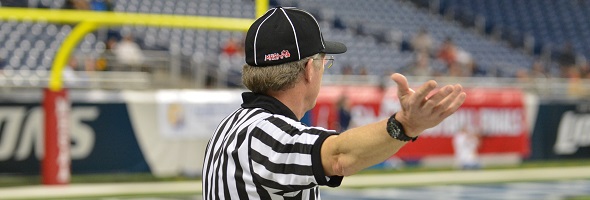
Be the Referee: What Officials Don't Do
October 11, 2018
This week, MHSAA officials coordinator Sam Davis discusses some of the things that do not fall under officials' many game-day responsibilities.
Be The Referee is a series of short messages designed to help educate people on the rules of different sports, to help them better understand the art of officiating, and to recruit officials.
Below is this week's segment – What Officials Don't Do - Listen
Game officials at all levels have a lot of responsibilities. But there are some critical things that take place at local high school games where officials don’t have the authority that some folks think they do.
Let’s start with injuries – specifically concussions. Concussion management starts and ends with the local school. If an official suspects a concussion – or any injury – all he or she can do is notify the coach of the team. The school makes the decision about whether or not a player stays in the game.
We often get calls about whether or not an official is responsible for enforcing MHSAA Handbook rules. Again, it’s up to the school, which agrees to follow and enforce the rules when joining the Association. Even if the official suspects an ineligible player is in the game, it’s not his or her role to enforce that rule. It’s all on the school.
Past editions
October 4: Always 1st-and-Goal - Listen
September 27: Unique Kickoff Option - Listen
September 20: Uncatchable Pass - Listen
September 13: Soccer Rules Change - Listen
September 6: You Make the Call: Face Guarding - Listen
August 30: 40-Second Play Clock - Listen
August 23: Football Rules Changes - Listen
What's My Why: Official Stacey Swiatlowski
October 21, 2026
Stacey Swiatlowski, Ludington
Swiatlowski began officiating during the 1990-91 school year, jumping in with football, basketball, wrestling and baseball. Four years in, he added softball, and is now into his 37th as an MHSAA-registered official.
I’ve been a high school official in football, basketball, baseball, softball and wrestling for over 35 years. It’s a great way to stay in shape and stay in touch with sports, and with the kids today.
You get to develop friendships and have a positive impact on these kids that they will remember the rest of their lives.
“What’s My Why” is a weekly feature telling the stories of MHSAA-registered officials in their own words. If you’re an MHSAA official and would like to share your reason why, please submit a 15 to 45-second video, taken horizontally, to director of officials Sam Davis at [email protected].
What's My Why
Oct. 14: Joe Popiel, Spring Lake - Watch
Oct. 8: Shawn Ballor, Alpena - Watch
Oct. 1: Tim Erickson, Rockford - Watch
Sept. 23: Patricia Treman, Grand Rapids - Watch
Sept. 16: Tony Bertuca, Coloma - Watch
Sept 9: Jenna Schroeder, Berkley - Watch
Sept. 2: Joey Crawford, Newton Square, Pa. - Watch
Aug. 26: Ron Torbert, Hanover, Md. - Watch
Aug. 19: Kari Seitz, Mill Valley, Calif. - Watch
Aug. 13: Mike Pereira, Sacramento, Calif. - Watch
Aug. 5: Dino Paganelli, Wyoming - Watch
Aug. 3: Stacy Smith, Caledonia - Watch
July 22: Jason Nickleby, Lake Elmo, Minn. - Watch
July 15: Sam Davis, Lansing - Watch
July 9: Candace Cox, Quincy - Watch
July 1: Robert Williams, Redford - Watch
June 24: Will Godfrey, Jackson - Watch
June 19: Jarrett Skorup, Midland - Watch
June 12: Brady Driver, Sturgis - Watch
June 8: Cindy Tyzo, West Bloomfield - Watch
June 3: Jeff Spedoske, DeWitt - Watch
June 1: Mike Carrier, Commerce Township - Watch
May 27: Stan Wright, Warren - Watch
May 26: Murray Rose, Zeeland - Watch
May 22: Mike VanLaan, Alto - Watch
May 18: Clint Abbott, Newaygo - Watch