


Be the Referee: YMTC - Face Guarding
September 6, 2018
In this week's edition, MHSAA officials coordinator Sam Davis takes us through a "You Make the Call" scenario regarding football face guarding.
Be The Referee is a series of short messages designed to help educate people on the rules of different sports, to help them better understand the art of officiating, and to recruit officials.
Below is this week's segment – You Make the Call: Face Guarding - Listen
Let’s check out your knowledge of high school football rules with a “you make the call.”
The quarterback drops back to pass, and his intended receiver gets a step on the cornerback. As the ball approaches the receiver, the defensive player sticks his hands and arms out in front of the receiver’s face without contact. The receiver loses sight of the ball, and the pass falls to the ground.
What’s the call?
A national high school playing rule instituted last year removed the penalty for face guarding without contact. The change brought high school football rules in line with collegiate and professional rules. The pass is incomplete and there is no flag for defensive pass interference.
Past editions
August 30: 40-Second Play Clock - Listen
August 23: Football Rules Changes - Listen
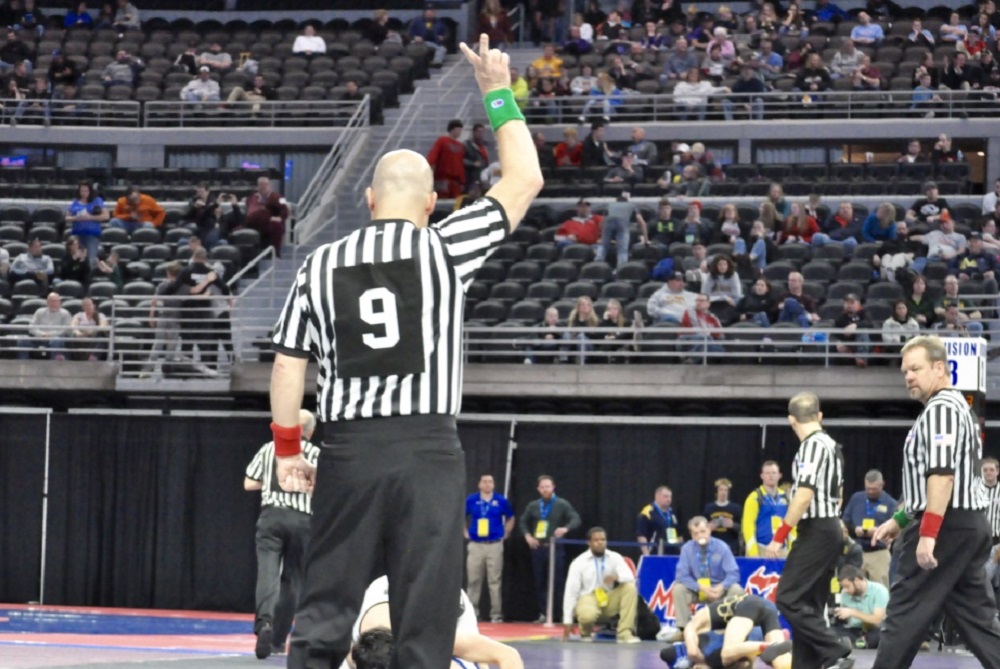
Be the Referee: Wrestling Start Position
By
Brent Rice
MHSAA Assistant Director
February 24, 2022
Be The Referee is a series of short messages designed to help educate people on the rules of different sports, to help them better understand the art of officiating, and to recruit officials.
Below is this week's segment – Wrestling Start Position - Listen
Today we’re on the mat, ready for the next wrestling match.
We’ve got a wrestler ready to get into the offensive starting position. Which of these should he or she do?
► Place their head on or above the mid-line of the opponent’s back
► Place their arm loosely around the opponent’s body with the palm of the hand placed loosely over the defensive wrestler’s navel
► Not have their legs or feet in contact with the defensive wrestler.
If you said yes to all of these things – you are correct. The wrestler in the offensive position should do all three of those things.
Do that – and you are ready to wrestle.
Previous editions
Feb. 17: Hockey Delayed Offside - Listen
Feb. 10: Basketball Timeout - Listen
Feb. 3: Basketball Video Review - Listen
Jan. 27: Wrestling Inspections - Listen
Dec. 16: Ball Over Backboard - Listen
Dec. 9: Winter Officials Mechanics - Listen
Nov. 26: Instant Replay - Listen
Nov. 11: Tourney Selection - Listen
Nov. 4: Receiver Carried Out of End Zone – Listen
Oct. 28: Volleyball Back-Row Block – Listen
Oct. 21: Soccer Disallowed Goal – Listen
Sept 30: Field Goal Falls Short – Listen
Sept. 23: Volleyball Obstruction – Listen
Sept. 16: Catch or No Catch – Listen
Sept. 9: Intentional Grounding – Listen
Sept. 2: Pass Interference – Listen
Aug. 26: Protocols and Mechanics – Listen