

The Official View: Winter Wonderland
By
Brent Rice
MHSAA Assistant Director
November 12, 2018
By Brent Rice
MHSAA Assistant Director
In this week’s “Official View” we explain the important of insurance and offer a brief primer on how the MHSAA helps officials stay covered.
 We also work through some rule scenarios in football, volleyball and swimming and take a look at a few of the wintery scenes braved not only by teams on the field and fans in the stands but officials in stripes as well.
It’s Official!
Most officials will go their entire lives without needing to utilize insurance coverage for something that occurred while officiating. In the often rough-and-tough world of school sports, though, the need for officials to protect themselves on and off the field has never been greater. While officiating is not considered a dangerous avocation, officials should prepare themselves for those one-in-a-million situations.
There are a variety of coverage options out there for officials, ranging from medical and loss of income coverage due to injuries sustained while officiating to liability coverage and legal fees. Officials, individually and through their associations, can purchase increased coverages that suit their needs.
The MHSAA continues to look out for the best interests of our registered officials in this area and in other ways. When officials annually register with the MHSAA, they are included in both a comprehensive liability plan and catastrophic medical coverage for incidents that occur during MHSAA contests. Major injuries due to officiating are rare, but it is nice to have the security that you’re covered in the event of some tragic event. Though the few lawsuits that officials are a party to are often summarily dismissed, the MHSAA’s liability coverage kicks in at dollar one, including any legal fees or attorney retainers.
We will be seeking your feedback in how we can best serve these interests as they pertain to increased insurance coverage, training and development and providing additional useful resources. We thank you for your input and continued commitment and dedication to the MHSAA and the Officials Program.
Rule of the Week
FOOTBALL It’s 4th-and-8 on Team K’s 35-yard line. R1 signals for a fair catch at Team R’s 40-yard line. R1 muffs the punt, and the ball is picked up by K5 at Team R’s 35. With no one else around, K5 runs into his end zone for an apparent touchdown.
Ruling: The ball is dead at the moment the muffed kick is possessed by Team K. The ball cannot be advanced. It will be 1st-and-10 for Team K on R’s 35.
It’s Your Call
VOLLEYBALL This week’s clip shows a back row player for Team S making a back row attack and then landing on the attack line. What’s the call?
Last Week’s IYC Ruling: Last week’s video shows a swimmer drifting into the lane divider before ultimately finishing first in the meet. This incidental contact with the lane divider is legal since she did not grab ahold or otherwise use the divider to pull herself through the water. (Click to see last week's video.)
Official View: Reffing in a Winter Wonderland
The first day of winter is scheduled for Dec. 21, but you wouldn’t know that by the weather from this past weekend’s football games.
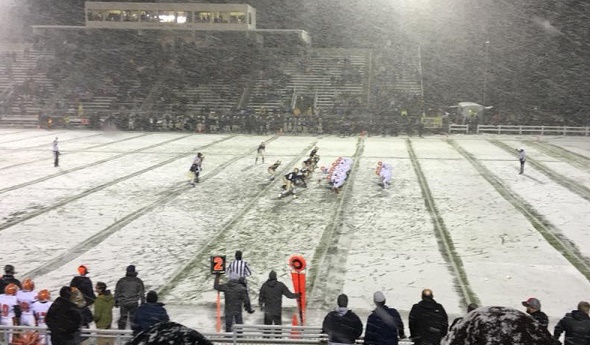
 Snow covered most of the state Friday and Saturday, even causing some teams to play in a couple of inches of the falling white stuff. Just like our teams, the officials braved the cold and flurries to ensure another great week of MHSAA football.
The top photo shows Thirlby Field during the Division 6 Regional Final between Traverse City St. Francis and Kingley.
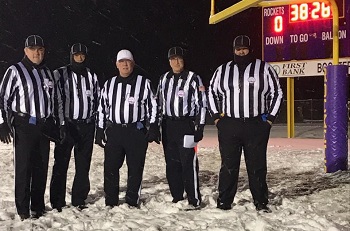
The photo above and to the right is from the 8-Player Semifinal between host Rapid River and Cedarville. The crew, from left: Joel Mitrzyk, Mark Pieniozek, Jan Viliquette, Paul Binder and David Paananen.
The Official View: We Are Family
By
Brent Rice
MHSAA Assistant Director
September 8, 2020
Camaraderie – and a feeling of being part of a bigger sports family – is among draws for nearly 10,000 officials who register with the MHSAA each school year.
As “The Official View” returns today for the 2020-21 school year, we feature a trio of sisters who have embraced the avocation and also announce a social media opportunity to further draw Michigan’s officiating community together as we play again for the first time in nearly half a year.
It’s Official!
Officials Awards and Alumni Banquet: Unfortunately, we weren’t able to get together this spring as a group for the annual Officials Awards and Alumni Banquet. Because of the importance of recognizing officials for their service, dedication and contributions to the MHSAA, John Johnson and Faye Verellen-Brown in our office created an excellent virtual stand-in for the traditional banquet. Check out the short video montage HERE.
For those receiving 20-, 30-, 40-, 45- and 50-year service awards, they have been received in the MHSAA office after a delay in production by our supplier due to COVID-19, and they are being sent to you via USPS.
Mark your calendars for May 8, 2021. This is the scheduled date for next year’s Officials Awards and Alumni Banquet. Plan on joining us in person to honor and recognize accomplishments by MHSAA officials across the state.
Officials Deadlines: The registration deadline for officials has been extended until Sept. 14. Consideration for further extensions will be made as necessary.
Other officials deadlines (i.e., MIGS, schedule submission, rules meetings and exams as applicable) for all fall sports remain in place for Sept. 17. The MHSAA has provided Local Approved Associations with flexibility for the 50 percent minimum-attendance requirement. Officials in those sports should submit the schedule they were assigned to start the season. While this may change as the season progresses, it will suffice for the purpose of providing the MHSAA with the assignments each official receives.
MHSAA Officials Facebook Page: To better engage and communicate with officials, the MHSAA has created a Facebook page specifically for all things officiating. Here, you’ll be able to get updates, connect with other officials and discuss rules, mechanics and plays for the high school sports you officiate. Please take some time to connect with us and others by visiting this new resource HERE.
Know Your Rules
FOOTBALL In high school football, in what ways can a team score using a kick?
Ruling: There are two categories of kicks – free kicks and scrimmage kicks. Free kicks include kickoffs (place kick or drop kick), safety kicks (place kick, drop kick or punt) and fair-catch kicks (place kick or drop kick). Of these, only fair-catch kicks can score (because the receiving team may attempt a field goal from the spot of the catch).
Scrimmage kicks include field goals (place kick or drop kick), tries (place kick or drop kick) and punts (punt). Of these, only field goals and tries can score.
NOTE: In high school an attempted field goal that does not score has the same effect as a punt.
It’s Your Call
SOCCER This newest IYC involves a trick play by the team in red. On this corner kick, players of the red team begin running out of play and around the back of the net. Then, one of those players reenters the field just as the corner kick is made, heading the ball into the net. Does the goal count? What’s the call?
The Official View: We are Family
If you were to ask any of the Bedrosian sisters a way that young women can stay physically active, learn skills that can be applied to their daily lives and make some money doing it, they undoubtedly would tell you “officiating.”
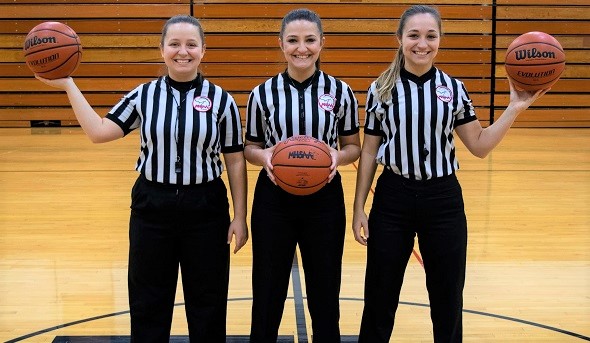
Each of the women (Sara Bauman, Leslie Bedrosian and Alex Bedrosian), who all graduated from New Lothrop, spend much of their winters on the hardcourt doing just that – officiating MHSAA basketball games. And last season, before COVID-19 caused a premature end to the basketball season, the sisters were able to work a three-person crew together for the first time.
Sara, 23, said she started officiating after meeting veteran official Mike Clark, and as a way to stay connected to the game she loved. “At that point in my life I had already coached, but I wanted something closer to what it felt like to play,” said Bauman, now a third-year law student at the MSU College of Law.
Leslie and Alex, both current college students themselves, said they each started officiating after following in their older sister footsteps and for similar reasons. Leslie said, “I love being a part of the game. In addition, refereeing has been my income while I attend college. I’m thankful for all of the friendships and connections I’ve made and the people I’ve met who are appreciative of the work that goes into officiating.”
The impact officiating has had on their lives is not lost on the sisters. Alex, 19, looks at officiating as a challenge.
“Being a female official can be tough, but I feel like it only makes me more confident and has given me a desire to show people what I am capable of doing,” says the youngest Bedrosian sister.
Similarly, 20-year-old Leslie says that officiating has “helped me become more assertive, ready to talk to people and handle difficult situations head on.”
Sara said she hopes displaying those same traits will inspire women to also take up officiating: “It is truly the best feeling to have a female player come up to you in awe because they have yet to have a female officiate (her) game.”
This trio of officiating sisters gives credit for their quick starts to the camps they attended and all of the veteran mentor officials who have helped them along the way, namely Clark and Sharon Sawyers. Bauman and the Bedrosians are committed to continued improvement, working their way up the high school ranks and maybe even working at the college level. It’s clear they enjoy everything officiating has to offer, and we expect long and successful careers from all of them.
If you have an interesting story or an official you’d like to see featured, send details and pictures to [email protected].
PHOTO: Sisters Leslie Bedrosian (left), Sara Bauman (middle) and Alex Bedrosian are MHSAA-registered basketball officials and last year worked together as a crew for the first time. (Photo by Ashley Breiler.)