

Seeing Need, New SE Officials Work to Fill It

October 26, 2018

By Doug Donnelly
Special for Second Half

TEMPERANCE – Clyde Canales says his life experiences have prepared him for this. Bryant Moore says his new role as a football referee has taught him a new respect for the game. And Herb Bertz says he signed up to stay part of a game that has meant so much to his family the last several years.

The three southeast Michigan men are among new high school football officiating recruits for the Michigan High School Athletic Association. And they are a welcome addition to the ranks.

More and more, the lack of high school officials is starting to take its toll, forcing game times to be shifted and leaving athletic directors scrambling to fill crews for sub-varsity and even varsity games.

The shortage has hit southeast Michigan particularly hard. Earlier this season, multiple Tri-County Conference and Lenawee County Athletic Association games were moved from the traditional Friday night under lights start time to Saturday morning. There are several reasons contributing to this shortage – among them officials retiring, some leagues moving toward seven-man crews instead of five and the lack of sportsmanship being shown by adults.

Bertz has watched his sons play the last several years for Ottawa Lake Whiteford. He’s been on the chain gang for much of that time, volunteering his time and getting an on-the-field view of the games. He became a referee just this year.

“I wasn’t ready to give up the game,” he said. “I love football.”

Bertz said he’s worked about 40 games this fall, at all levels, and is already putting together a schedule for next year with a crew made up of all second-year officials. He said his experience has been great. The players, he said, are for the most part very respectful of officials. If the adults are yelling from the stands, he says, he’s able to tune them out.

“I don’t let any of that bother me; I just don’t,” Bertz said. “If you understand that football is an emotional game and emotions are going to run high out there, you won’t let that stuff bother you. Some people are rude, sure, but that doesn’t bother me. If it does bother you, you probably shouldn’t be a ref.”

Two years ago, Moore was a two-way starter for the Sand Creek football team. The only time he worried about the referees was when he’d spot a yellow flag on the field. Now, he’s carrying the flag around and throwing it when necessary.

“Most of the experience has been good,” he said. “Coaches for the most part are supportive, but they’ll let you know when you screw up. You have to be thick-skinned, that’s for sure. It gives you a new perspective and respect for the referee. As a player, you think it would be easy to step into their shoes. It’s not easy being a referee.”

The shortage, he said, is real. He has received text messages and calls on game days asking if he is available. Most of his weeks are filled with football nights, something he is juggling around attending Adrian College. The money he’s earned helps pay the bills, he said, and he’s learned a lot about the sport and interacting with others.

“The more you go out there and do it, the more comfortable you get,” he said. “I’ve been busy every week. They definitely need us.”

Canales was a member of Erie Mason’s 1987 Class C championship football team. He’s worked several jobs since then, from being in the restaurant business to probation officer. He signed up to be an official this year for the first time. He’s working games almost every day of the week, from youth games to varsity competition. And, he said, it’s been an eye-opening ride.

“The first few times, I felt bad taking their money,” Canales said. “I felt like I was out there to give back and these organizations needed the money. After a while, though, for all you have to go through, I don’t mind taking the money.”

For the most part, Canales said, it’s been a positive experience becoming a registered MHSAA official. He researched the rules, took online tests and went through a training period. He had the idea to become a referee because of a shortage of officials that has hit the region, state and, really, the country.

“This is my first year, so it’s good to have a lot of things thrown at me,” said Canales, 49. “Everyone thinks they can make the right call from the stands. It’s not that easy. But, I’m doing this now. I’m enjoying it. I think I’ve made it through the rough times.”

If he and the others do continue being a referee, that’s good news to the MHSAA. Once a referee has been working games for three years, officials say, they tend to stay with it.

The reasons officials cite most when they leave the sport is they are getting older and don’t feel they can continue to perform at the level they want, work or family changes and adult sportsmanship.

The MHSAA held an in-service for athletic directors this month and one of the topics was the situation with officials.

“In 2006-07, there were 12,000 officials; today there are 10,000,” said Whiteford athletic director Jason Mensing. “The numbers are going down. If we want to continue playing games, we need to have people that are willing to step up and do those jobs.”

Mensing said new guys like Canales, Bertz and Moore need to be welcomed.

“Our goal as an athletic department is to show them more gratitude if we can,” he said. “We’ll continue to work with our coaches and our community to make sure we are showing them great respect. They aren’t making a lot of money, but they are giving back to the game. It’s something we should be appreciative of.”

The MHSAA has a new executive director and director of officials. They have worked on initiatives to bring attention to the issue and recruit more officials to the avocation, while also developing strategies to retain those currently taking part.

Blissfield athletic director Steve Babbitt cautioned it’s not just football affected by the high school officials shortage. He’s had soccer matches this year forced to go with two instead of three referees.

“There is still a shortage in all sports,” he said. “We had three scheduled for one of our soccer matches, but due to a shortage one was pulled to fill in another match. This is not just a Michigan issue, as there are stories across the country about the same issue.”

Babbitt said if everyone showed a little more respect for the game and officials, the situation likely would improve.

“Officiating is one of the few professions where you are expected to be perfect on day one,” he said, “and get better from there.”

The MHSAA and National Association of Sports Officials (NASO) encourage all interested to consider becoming an official. Click to check out MHSAA resources and the NASO's "Say Yes to Officiating" website.

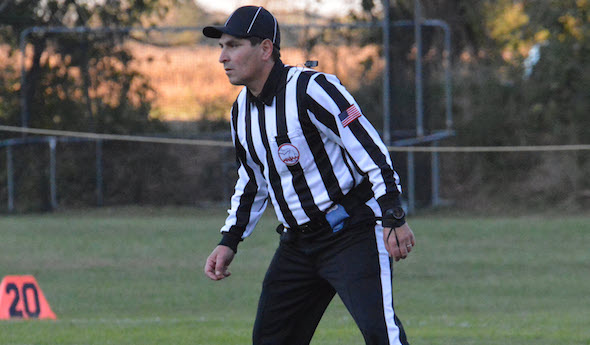
PHOTO: Clyde Canales officiates a game this season. (Photo by Cari Hayes.)

Hoping to be 'Hardly Noticed,' 50-Year Official Allen Certainly Recognizable, Respected

By Mike Dunn
Special for MHSAA.com

December 18, 2025

Editor's Note: An extended version of this article appeared originally in the Cadillac News in March. Since then, Allen has been inducted into the Basketball Coaches Association of Michigan's Hall of Honor in October and is wearing the striped shirt again this basketball season, officially his 50th year.

CADILLAC – Bill Allen’s story is similar to that of many area sports officials, particularly those officials who have been active for many years.

A background in sports, typically playing team sports while growing up, combined with a desire to continue to be involved after high school or college, coupled with an inner urge to be part of the solution – these characteristics find a natural outlet for those brave souls who choose to be officials. and these traits are nearly always part of the make-up of the officials who receive high grades for their efforts and serve capably for many years.

Allen, of Cadillac, would not say this about himself. But he is one of those officials whom coaches are glad to see on the floor because they know they’re getting someone who will be fair and consistent. The same could also be said of Allen when he was umpiring, though he doesn’t work the diamonds anymore.

As Allen can tell you as he enters his 50th year wearing the striped shirt on the hardwood, officiating is a demanding vocation – and it is rewarding at the same time. It requires the right temperament as well as an above-average level of mental and physical fitness, especially as age makes its inevitable demands. It requires the ability to make decisions quickly, sometimes under very stressful conditions. It requires the ability to face criticism, sometimes expressed loudly or very loudly. It requires the ability to be a peacemaker at times and also the willingness not to hold grudges or become petty.

For those like Allen who have what it takes, those who are up to the challenges and the rigors that officiating requires from an individual, there is a deep satisfaction in knowing they are making a positive difference.

“I think that’s a common thread among all the officials, whether it’s basketball or baseball or softball,” Allen said. “You obviously want to do your best, but you want to manage the game in a way that helps it to flow the way it should flow and enables everyone, the players and the coaches and the fans, to get the most out of it.

“It’s an old cliché but it’s true: The best officials are the ones you hardly notice. If you can officiate a game and walk through the crowd afterward and no one recognizes you, then you’ve probably done your job pretty well that game. That’s what every official strives for.

Allen waits at the baseline for action to resume.“You’re never going to get every call right, and you have to be willing to accept that going into it,” he added. “But you know the rules and apply the rules the best you can, you put yourself in the best position to make the calls, especially in basketball, and you call it the way you see it.

“Are you always right? No. But if you put yourself in the right position and make the call you believe is correct, you can live with that and normally the coaches can too, even if they’re angry about a particular call in the moment.”

Allen, like most officials, was an athlete himself growing up in Traverse City and playing multiple sports for what was then known as Traverse City High School, the largest high school in Michigan in the early 1970s. By his own admission, he wasn’t one of the top stars in basketball and baseball but he was a good, reliable player for his coaches and a dependable teammate who loved the atmosphere of the arena during each season as well as the sense of achievement that the act of competing brought out in him like nothing else.

“I was pretty athletic growing up, but not a great athlete at Traverse City High School,” he said. “I was good enough to make the teams, but I wasn’t what you would call an impact player. A lot of officials have the same kind of background as mine. Maybe we weren’t the greatest players, but we still enjoy sports and we like being part of the action.”

It was during his final two years at Michigan State during the mid-1970s that Allen received his start in officiating.

“In my junior year at Michigan State, one of the fellows I roomed with did assignments for the intramural programs at the college,” he said. “Everything from touch football to basketball to slow-pitch softball. He told me to take the officiating class and he would assign me to games, and that’s how it all started 50 years ago.”

Allen jumped into the world of officiating eagerly with both feet, working a sporting event “nearly every night” at MSU.

“I would go to school during the day, ref at night, and do it again the next day,” he recalled.

“There were so many contests, maybe thousands, that I got to work with a number of other officials. Tim McClelland, who later became a Major League umpire and made the illegal pine tar bat call against George Brett, was a colleague back then. It was a lot of good experience and good mentoring and laid a great foundation for what turned out to be ahead.”

Allen initially earned a degree in criminal justice, graduating from Michigan State University in 1977, and worked in the field of corrections for a period of time before his love of baseball and a sense of personal confidence in his potential to officiate at a higher level prompted him to attend a school for prospective umpires in Daytona Beach, Fla.

That didn’t quite work out, but Allen was not deterred. He changed his career plans from criminal justice to education, and the switch would also lead to abundant opportunities for officiating down the road not just on the baseball and softball diamonds but the basketball court as well.

“When I didn’t get picked (for umpiring), I went back to school to earn my teaching certificate and a graduate degree in history with the goal of becoming a teacher at Cadillac,” he explained. Allen’s wife Sue already was employed as a teacher with the school district.

Bill’s goal at that point was to join Sue as a member of the faculty, as a social studies teacher, and that’s just what happened. Bill served for 26 years in the classroom before retiring along with Sue 12 years ago.

“I viewed Cadillac schools as a great organization to work for as a teacher before I got hired there, and I was right,” he said. “I wouldn’t trade my years at Cadillac for anything. Susie and I both thoroughly enjoyed our years there.”

Allen talks casually with McBain Northern Michigan Christian boys assistant coach Terry Pluger prior to the start of the varsity game with Buckley on Dec. 8. In conjunction with teaching, Allen continued to officiate basketball in the winter and baseball in the spring and summer. He umpired a lot of men’s summer league softball games through the years and grew to love in particular working the games under the lights at Cadillac’s Lincoln Field.

He also became a registered official with the MHSAA and has continued in that role, though he decided to hang up his umpire cleats a few years ago.

“I registered with the MHSAA while I was still in Lansing,” he said. “The first place I ever did a sanctioned event was in Perry, Michigan. I had barely enough (umpiring) equipment and I’m sure I looked like a real yahoo out there, but I got through it.”

After coming to Cadillac, Allen met Dave Martin, who was an active official and a fellow teacher at Marion, and Martin became his first “crew chief.”

“They needed some JV officials and I got signed up and was off and running,” Allen recalled. “That’s how you got into it back then. You found a crew and the crew chief assigned you some games, and you were evaluated. As long as they liked you and liked what you were doing, they kept you around.”

Allen expressed admiration and appreciation for Martin and also the late June Helmboldt from Lake City, another crew leader “who had a great perspective on the game.”

Allen served as a crew chief himself for a long time and has built rewarding relationships with fellow officials through the years. He has worked many games with Penny McDonald of Cadillac, another longtime official who has earned much respect for her consistency and quality of work in multiple sports over the decades. Allen, in a reversal of roles, is the one receiving assignments from McDonald these days.

Bill Bartholomew is another longtime officiating partner with whom Allen has worked many games over the years and for whom Allen has great respect. This school year, in fact, marks Bartholomew’s 51st year as an official. There are a few others from northern Michigan who have stood the test of time and have passed the 50-year service milestone, such as Paul Williams of Mesick, Tom Post and Mike Muldowney of Traverse City, Tom Johnson of Gaylord, and Dan Aldrich of Charlevoix. All of these, Allen said, are a credit to the craft of officiating and have earned the respect they receive.

Allen also has fond memories of working frequently through the years with Don Blue of Falmouth and Jill Baker-Cooley of Big Rapids, who was chosen for the MHSAA’s prestigious Vern L. Norris Award in 2018.

“I was there when Don and Julie and Penny all got their start in officiating, and they all found their skill set and became excellent officials,” Allen said.

Bill is included in the 50-year milestone group of basketball officials now that the 2025-26 season is underway. He is pleased that he has been able to maintain his longevity; as to the future, he is ready and willing to keep going.

“As long as I’m healthy and can do it properly, I hope to continue,” said Allen, who remains physically fit, jogging regularly along with activities including downhill skiing in the winters and golf during the warmer months.

“I’ll know when it’s time to step aside. When I can’t see well enough to judge the baseline and need to rely on my partners more than I should, then it’s time to hang up the whistle and let the younger ones take over. I hope that’s not for a while though.”

Mike Dunn is a sportswriter for the Cadillac News and the sports editor of the Missaukee Sentinel weekly. He has won numerous awards through the Michigan Press Association as well as the Michigan Associated Press.

PHOTOS (Top) Cadillac’s Bill Allen, shown here following a varsity girls basketball game in February in Evart, is in his 50th year as an MHSAA registered official. (Middle) Allen waits at the baseline for action to resume. (Below) Allen talks casually with McBain Northern Michigan Christian boys assistant coach Terry Pluger prior to the start of the varsity game with Buckley on Dec. 8. (Photos by Mike Dunn.)