


Powerful Voice for High School Sports
December 19, 2014
By Geoff Kimmerly
Second Half editor
Paul Carey was home from the U.S. Army only a few months and just shy of 25 years old when Beal City embarked on its first trip deep into the MHSAA boys basketball tournament.
On the call for local radio station WCEN from gyms at Saginaw Arthur Hill and Lansing Sexton, Carey served as the voice of the previously “laughable” Aggies as they reached the Class D Semifinals before falling just six points short of playing for the title.
“All of Beal City emptied out. They’d never had anything before,” Carey recalled during his annual Thanksgiving weekend visit to the MHSAA Football Finals at Ford Field. “When I got home, within the next two weeks I got a letter from every citizen of Beal City thanking me for broadcasting their games. That’s the kind of appreciation that meant so much.”
During 42 years on the airwaves, Carey was best known as a voice of the Detroit Tigers bounding out of transistor radios all over Michigan, thanks to WJR’s powerful signal.
But for the state’s high school sports community, his legacy is similarly memorable as the voice of the longtime football and basketball scoreboard show and a voter for various all-state teams and wire polls over the decades.
Now 86 and retired since 1991, Carey remains a regular during the first day of the Football Finals, taking in games he broadcast for the MHSAA during the late 1970s and that continue to hold his eye as they have for more than a half-century.
“It was a passion of mine. High school sports always has been,” Carey said. “I think because my dad was a high school coach, and teacher initially, and my brother was a high school coach and teacher, I just grew up in families that appreciated coaching and athletics. I was not a great athlete, but it kept my hand in following sports that way.”
Now, the scores
Carey partnered with Ernie Harwell for Tigers radio broadcasts from 1973-91, including during the march to the 1984 World Series championship. He was named Michigan Sportscaster of the Year six times and to the Michigan Sports Hall of Fame in 1992.
But Carey’s early career included sitting on top of a car, plugged into a phone pole, for a Sacred Heart football game at old Fancher Field just a few blocks from his family’s Mount Pleasant home. Among many more accolades are a Distinguished Service Award from the Michigan High School Coaches Association and a place in the Basketball Coaches Association of Michigan Hall of Fame.
In fact, the start of his weekly announcing of statewide football and basketball scores preceded his baseball career by 16 years and ended two months after he announced his final professional out.
The Michigan High School Scoreboard show was a staple of WJR’s late Friday nights from 1957-91. Carey would read every score he could collect from a variety of sources, often organized by league and with state rankings and context mixed in.
His idea came from something similar read by Len Colby for Kalamazoo’s WKZO. Carey’s brother Terry was coaching at Niles during the second half of the 1950s, and he and other coaches would get together to listen to the Friday night scores from the southwestern part of the state.
Carey, who left WKNX in Saginaw for WJR in 1956, explained to then-sports director Bob Reynolds that the station’s strong signal could provide for a truly statewide scoreboard experience.
Carey then connected with Edgar Hayes of the former Detroit Times, who gave the OK for Carey to call the paper on Friday nights to get scores from the Detroit metro area. For the rest, Carey relied on wire services – there were three at the time – who relied on newspapers from all over Michigan to call in scores over the course of an evening.
Before every Friday during high school football season – and later Tuesdays and Fridays during boys basketball season – Carey typed up lists of games based on schedules in the newspaper, with spaces to add scores. More than a few times, Carey raced down a back ramp at Tiger Stadium after a Friday night game, back to the WJR studio, with 15 minutes to prep for the show’s 11:30 p.m. start.
“If the Flint Journal, the Grand Rapids Press, the Traverse City paper didn’t call in scores to the AP, then I was out of luck too. And that happened all the time,” Carey said. “I would call back occasionally, say, ‘Did you get anything more?’ It was a rat race.”
The show originally was set for 10 minutes and then extended to 15. American Airlines sponsored a record show that followed, and Carey’s scoreboard show had a sponsor only once in 35 years. Finishing up on time was expected, even with more than 200 scores to read.
But Carey said he always went 20 minutes, sometimes 25.
“Because I wasn’t done. I just kept right on going,” Carey said. “Jay Roberts did the all-night show most of the time, and he was patient with me. He didn’t say too much on the air about ‘that guy ahead of me took all of my time.’”
Carey continued the “rat race” until his final scoreboard show, Dec. 20, 1991. He retired from WJR at the end of that calendar year. And it's important to note: Carey was never paid a dime extra for doing the program. .
“I think Paul is really just a sports fan, and that came across to the listener on his broadcasts,” MHSAA historian Ron Pesch said. “Paul would gather as much as possible off the wire. He'd interject if scores were missing from sections of the state. Press polls from the Free Press, News, AP and UPI were big, so he could point out close calls and upsets.
“He provided immediacy, or the closest thing to it in the days before cable TV and the Internet, and because of his scoreboard show, you could get the results before the morning paper. For listeners, he brought life to something as simple as game scores.”
First team all the way
Carey, who resides in Rochester, also served as the engineer on Tigers broadcasts for 16 years, through 1990. He broadcast Pistons games on the radio for six seasons and did the first broadcast of a Central Michigan University football game, in 1949.
Harry Atkins, covering Detroit’s teams while with The Associated Press for 29 years including the last 21 as its sports editor for Detroit, took note of his colleague's hard work – and especially that Carey was one of few broadcasters who was a journalist in addition to a voice.
That made Carey's other major role in high school sports a natural fit.
Atkins split The Associated Press all-state selection panels for football and basketball into 11 regions, and Carey represented the Detroit area for a number of years. He also was a longtime voter in those sports' weekly polls.
“Paul is just that kind of guy. He thought it was important and he made time in his busy schedule to do it,” Atkins said “And it had an impact on the other 10 voters on the All-State panels, too.
“Some of them were from small out-state newspapers or radio or TV stations. Yet every one of them knew who Paul Carey was. And when he spoke, of course, with what often is called "The Voice of God," those voters paid attention.”
And he still does, as well.
At the end of each fall, Carey still puts together a compilation of the three high school all-state football teams – Associated Press, Detroit Free Press and Detroit News – and files them with years of research and results.
“It’s important to me. Nobody sees it but me, but I get a certain kick,” Carey said. “Once in a while I’ll see a kid playing at Central, Western or (Michigan) State or Michigan, and they’ll say he came from Clawson. I’ll go into my all-state collections, say that would’ve been 2009 he played, and I find a name.”
In addition to the Football Finals on WJR, Carey was part of the Baseball Finals broadcasts into the early 1990s, continuing to contribute even after his retirement from his fulltime gig.
He spent high school games over the years sitting next to legends like the Free Press’ Hal Schram and remembers when current Free Press longtime scribe Mick McCabe was just a rookie. One of Carey's final broadcasts was a 1992 Baseball Final with his nephew Mike Carey, who continues to broadcast MHSAA championship games to this day.
“I am eternally grateful to Paul Carey. His contribution to high school sports in Michigan has been great and significant,” Atkins said.
“We are lucky to have him.”
PHOTO: Paul Carey (left) and nephew Mike Carey broadcast the MHSAA 1992 Class D Baseball Final between Hillman and Athens for PASS.
2026 Scholar-Athlete Award Recipients Announced in Class C & D
By
Geoff Kimmerly
MHSAA.com senior editor
February 3, 2026
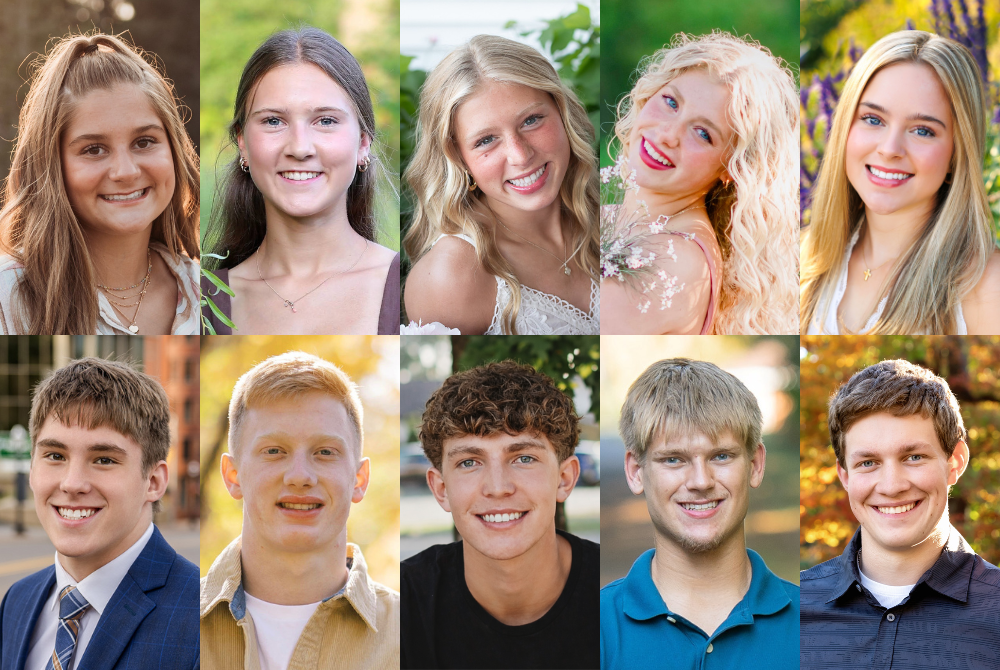
The Michigan High School Athletic Association has selected 10 student-athletes from Class C and D member schools to receive scholarships through the MHSAA/Farm Bureau Insurance Scholar-Athlete Award program.
 Farm Bureau Insurance, in its 37th year of sponsoring the award, will give $2,000 college scholarships to 32 individuals who represent their member schools in at least one sport in which the Association sponsors a postseason tournament. The first 30 scholarships are awarded proportionately by school classification and the number of student-athletes involved in those classes; also, there are two at-large honorees who can come from any classification.
Students applying for the Scholar-Athlete Award must be carrying at least a 3.5 (on a 4.0 scale) grade-point average and have previously won a letter in a varsity sport in which the Michigan High School Athletic Association sponsors a postseason tournament. Other requirements for the applicants were to show active participation in other school and community activities and produce an essay on the importance of sportsmanship in educational athletics.
The 32 scholarship recipients will be recognized March 14 during the MHSAA Boys Basketball Finals at the Breslin Student Events Center in East Lansing.
The Class C Scholar-Athlete Award honorees are Maya Carlson, Manistique; Hope Miller, Blissfield; Irelynn Pachulski, Saranac; Gavin Comero, Ishpeming Westwood; Drew Ruddy, Ottawa Lake Whiteford; and Ethan Stine, Bridgman.
The Class D Scholar-Athlete Award recipients are Caila Fitchett, Dryden; Madison Karakashian, Bloomfield Hills Academy of the Sacred Heart; Jack Nelson, Ontonagon; and David Wahl, Gaylord St. Mary.
Overviews of the scholarship recipients of the Class C Scholar-Athlete Award follow. A quote from each recipient's essay also is included:
 Maya Carlson, Manistique
Played three seasons of varsity volleyball, ran three of cross country, played two seasons of varsity basketball, one of golf, and is finishing her first season of swimming & diving. She also will compete in her fourth season of track & field this spring and has played travel ice hockey throughout high school. Finished among the top four at MHSAA Cross Country Finals twice and earned all-state and academic all-state in that sport. Earned all-region and academic all-state in volleyball and qualified for MHSAA Finals all of her first three seasons of track. Participating in second year of National Honor Society and as treasurer, serving third year as student council president and first as student leadership vice president. Served on Youth Advisory Council and participated in YETI service club throughout high school and served as president of both. Will attend Trine University and major in exercise science.
Essay Quote: “I learned that being competitive and being a good sport aren’t opposites. In fact, they depend on each other. When you respect the game and the people playing it, your victories feel more accomplished, and your losses teach you more.”
 Hope Miller, Blissfield
Ran four seasons of cross country, is playing her second of varsity basketball, and will compete in fourth of varsity track & field this spring; also played two seasons of varsity soccer. Earned all-state in cross country three times and set school record in that sport, earned all-state two seasons in track and set school records in two races, and earned all-league in soccer. Helped basketball team to league and District titles. Served as cross country team captain the last two seasons. Participating in second year of National Honor Society and as secretary, fourth on student council and as vice president, and third on Lenawee Youth Council. Founded and serving as editor of school newspaper. Participated in two years of debate and received top speaker awards. Is undecided where she will attend college but intends to study ecology or environmental sciences.
Essay Quote: “Sportsmanship allows for a community to be built around a shared love for the sport and a goal of improving oneself as much as possible. In order for athletes to reach their full potential they must be in an environment that supports their goals and their needs as well as encourages them to have fun with their sport.”
 Irelynn Pachulski, Saranac
Played two seasons of varsity volleyball, is completing her second of varsity basketball, and will play her third season of varsity softball and compete in her fourth season of track & field this spring. Also played two seasons of junior varsity football, and participated on the sideline cheer team as a senior. Earned all-league recognition in volleyball, softball and track, also all-region in softball and qualified for the MHSAA Finals in track the last two seasons. Served as captain in volleyball and softball and served on hiring committees for varsity volleyball and softball coaches. Participated in Scouting throughout high school and attained Eagle Scout rank as a sophomore. Played in marching and concert bands throughout high school, serving as marching band drum major and percussion section leader. Participating in third year of National Honor Society and second on student council, as treasurer. Played lead roles in three drama productions. Will attend Montcalm Community College and study exercise science, then transfer to finish her studies in physical therapy.
Essay Quote: “Sportsmanship in high school athletics starts with strong leadership. When coaches set the pace, players follow. Where an intentional culture of good sportsmanship exists, you can try new things. You can be brave. You can learn.”
 Gavin Comero, Ishpeming Westwood
Played two seasons of varsity football, is completing his fourth season of wrestling and will compete in his fourth season of track & field this spring. Earned all-state in track & field and all-conference in football and wrestling, and all-academic in wrestling as well. Served as team captain for football and wrestling. Participating in second year of National Honor Society and third on student council. Played in concert/pep band throughout high school and competed with Business Professionals of America the last three years, earning state and national places in BPA and serving as president as a senior. Served as student council vice president as a freshman and sophomore and band council vice president this school year. Participated two years in Key Club and as part of local Big Brothers Big Sisters organization, and served as volunteer youth wrestling coach throughout high school. Will attend University of Michigan and study business administration.
Essay Quote: “Throughout the season I learned the bigger picture of sportsmanship, playing with integrity at all times. No matter what that scoreboard read at the end each Friday night, we continued to play with 110-percent effort. We had every reason to be negative and start pouting, but we remained positive and persisted.”
 Drew Ruddy, Ottawa Lake Whiteford
Played three seasons of varsity football, is playing his second season of varsity basketball and will compete in his fourth season of track & field this spring. Earned all-state and academic all-state in football and played on Finals championship and runner-up teams. Qualified for MHSAA Finals in track & field and earned academic all-state in that sport, and earned league scholar-athlete awards in all three sports all four years. Served as captain of all three varsity teams. Serving fourth year as class president and participating in second year of National Honor Society. Participating in third year of Fellowship of Christian Athletes and as huddle leader. Participated three years in Future Farmers of America and was a state competitor, and has contributed to multiple community service projects. Will attend Hillsdale College, but is undecided what he will study.
Essay Quote: “Sportsmanship is a mental discipline that requires integrity, strength of character, and the willingness to make the right decisions every time. It is also about practicing emotional intelligence, exercising self-control, and speaking with respect to others while on and off the field. Sportsmanship is about respecting yourself enough to accept both wins and losses with humility.”
 Ethan Stine, Bridgman
Played three seasons of varsity football and two of varsity soccer, is playing his fourth of varsity basketball and will play his fourth of varsity baseball this spring. Earned all-league honors in football, basketball and baseball, all-state recognition in soccer and academic all-state in baseball. Helped baseball team to Division 3 Finals championship as a freshman and all three of his other teams to league and/or District championships. Served as captain of football, basketball and baseball varsity teams. Serving second year on MHSAA Student Advisory Council and participating in third year of National Honor Society, and this year as chapter president. Competed on DECA team throughout high school, twice qualifying for state finals. Is undecided where he will attend college but intends to study engineering.
Essay Quote: “… Sportsmanship is the active choice to empathize with the people around you – whether they wear a stripe, a rival uniform, or our own colors. It's the unwavering commitment to life lessons over scoreboard outcomes. Our wins fade, but the way we treat people under pressure defines us forever. That competitive integrity, built on genuine respect and humility, is the most valuable degree we earn in educational athletics.”
Other Class C girls finalists for the Scholar-Athlete Award were Ashley Carlson, Norway; Lillian Kwiatkowski, Rudyard; Izabella Latuszek, Laingsburg; Anna Poppema, Bath; Addyson Rhodes, Grandville Calvin Christian; Brynne Schulte, Elk Rapids; Molly Soper, Hanover-Horton; Luella Whipkey, Oscoda; and Emma Winans, Perry.
Other Class C boys finalists for the Scholar-Athlete Award were Sean Dammann, New Lothrop; Joe Gaffney, Charlevoix; Ryan Kowalczyk, Pinconning; Amos Miller, Saginaw Arts & Sciences Academy; Luke Paxton, Pewamo-Westphalia; Sean Siems, Kalamazoo Hackett Catholic Prep; Logan Slimko, North Muskegon; Eli Smith, LeRoy Pine River; and Grason Weber, Leslie.
Overviews of the scholarship recipients of the Class D Scholar-Athlete Award follow. A quote from each recipient's essay also is included:
 Caila Fitchett, Dryden
Ran four seasons of cross country and also played her first of varsity volleyball in the fall, bowled as a junior and played two seasons of varsity soccer, and will compete in her fourth season of track & field this spring. Earned all-conference in eight track events during her career and all-state as part of the 1,600 relay as a sophomore. Won league cross country championship and served as captain of both the cross country and track teams. Participating in third year of National Honor Society and has served as chapter president two years. Serving fourth year on student council and has held office of vice president, and also has served as president of National Junior Honor Society, Spanish Club and school’s indoor track club. Participating in fourth year of youth group and co-founded Fellowship of Christian Athletes chapter. Earned Rural and Small Town Award from College Board and Horatio Alger Association scholarship. Will attend Hope College and study psychology.
Essay Quote: “Sportsmanship is powerful because it teaches something the stopwatch never could. … It’s not about perfection. It’s not about medals or times. It’s about creating an environment where athletes realize that kindness, belief, and respect can change a season, or even a life.”
 Madison Karakashian, Bloomfield Hills Academy of the Sacred Heart
Ran third year of cross country in the fall, is competing in third season of varsity skiing and will play third year of varsity tennis this spring. Earned all-region recognition in skiing and has served as that team’s captain three seasons. Competed in equestrian for more than five years including her first two of high school and qualified for national events multiple times. Participating in National Honor Society and serving fourth year in student government. Earned College Board recognition and the Dartmouth Book Award, Women in STEM Award from Rochester Institute of Technology and Rensselaer Medalist Award. Served as captain three years for debate and ethics bowl team, earning all-Catholic honors. Founded school’s all-girls robotics team that qualified for state competition. Founded and served as president of school’s Mental Health Matters Club, and founded company that generated more than $50,000 in revenue in the equine care industry. Is undecided on where she will attend college but intends to study biomedical engineering.
Essay Quote: “Athletics have also taught me that sports mirror real life. There are wins and losses, moments of confidence and moments of doubt. Sportsmanship is what helps you navigate all of it.”
 Jack Nelson, Ontonagon
Played three seasons of varsity football, playing fourth of varsity basketball and will compete in fourth of track & field and golf and second of varsity baseball this spring. Also ran cross country as a freshman. Earned all-conference recognition in football and basketball, all-Upper Peninsula in golf and qualified for the MHSAA Finals in that sport. Served as captain of basketball team for four seasons and football team for two. Participating in third year of National Honor Society – this school year as chapter vice president – serving fourth as class vice president and attended American Legion Boys State. Serving as school radio station student manager, participating in second year of yearbook committee and fourth with school’s TANGO service group, and has participated all four years as part of St. Nicholas Project service efforts. Will attend Northern Michigan University and study multimedia production.
Essay Quote: “To me, the two core values of sportsmanship are respect and humility. These traits are important in every aspect of life, whether it's on the court, in the office, or at your grandparent’s house. Sportsmanship is like a compass, not only guiding athletes through competition, but pointing them towards the character values that will shape their lives, long after the final whistle blows.”
 David Wahl, Gaylord St. Mary
Played three seasons of varsity football, is playing second of varsity basketball and will play fourth of varsity baseball this spring. Earned all-league recognition in football and served as captain of that team. Earned National Merit Scholarship Commended Scholar and AP Scholar with Distinction awards, and College Board National Rural and Small Town recognition. Participating in third year of National Honor Society, serving as president, and third year as part of school student leadership team. Serving third year as local Downtown Development Authority student representative, and served as representative on national Youth Leadership Council. Participating in fourth years in school’s theatre club and music ministry, and played two years in marching/concert/jazz band earning Division 1 ratings for district and state solo and ensemble. Will attend University of Notre Dame and intends to study civil engineering.
Essay Quote: “Since that day, I approach competition differently. I’ve become a captain who models respect for opponents and empathy for teammates. I appreciate every moment I’m given, recognizing that each play, each season, is a privilege rather than a guarantee. I have learned to temper my drive with humanity and to pursue perfection without sacrificing compassion.”
Other Class D girls finalists for the Scholar-Athlete Award were Emily DelFavero, Wakefield-Marenisco; Isabel Rookard, Mount Pleasant Sacred Heart; Alexa Ross, Bloomfield Hills Academy of the Sacred Heart; Audrey Stone, Bessemer; Lorna Wiesen, Leland; and Hope Woolman, Sterling Heights Parkway Christian.
Other Class D boys finalists for the Scholar-Athlete Award were Zyan Breznik, Adrian Lenawee Christian; Ian Flanagan, Deckerville; Connor Hill, Hillsdale Academy; Brady Jungwirth, Felch North Dickinson; Louis Kowalsky, West Bloomfield FJA; and Noah Zeien, Mount Pleasant Sacred Heart.
The Class B scholarship award recipients will be announced Feb. 10, and the Class A honorees will be announced Feb. 17.
Farm Bureau Insurance of Michigan was founded in 1949 by Michigan farmers who wanted an insurance company that worked as hard as they did. Those values still guide the company today and are a big reason why it is known as Michigan’s Insurance Company, dedicated to protecting the farms, families, and businesses of this great state. Farm Bureau Insurance agents across Michigan provide a full range of insurance services — life, home, auto, farm, business, retirement, Lake Estate®, and more — protecting nearly 500,000 Michigan policyholders.
The MHSAA is a private, not-for-profit corporation of voluntary membership by more than 1,500 public and private senior high schools and junior high/middle schools which exists to develop common rules for athletic eligibility and competition. No government funds or tax dollars support the MHSAA, which was the first such association nationally to not accept membership dues or tournament entry fees from schools. Member schools which enforce these rules are permitted to participate in MHSAA tournaments, which attract more than 1.4 million spectators each year.
-0-