

Powerful Voice for High School Sports
December 19, 2014
By Geoff Kimmerly
Second Half editor
Paul Carey was home from the U.S. Army only a few months and just shy of 25 years old when Beal City embarked on its first trip deep into the MHSAA boys basketball tournament.
On the call for local radio station WCEN from gyms at Saginaw Arthur Hill and Lansing Sexton, Carey served as the voice of the previously “laughable” Aggies as they reached the Class D Semifinals before falling just six points short of playing for the title.
“All of Beal City emptied out. They’d never had anything before,” Carey recalled during his annual Thanksgiving weekend visit to the MHSAA Football Finals at Ford Field. “When I got home, within the next two weeks I got a letter from every citizen of Beal City thanking me for broadcasting their games. That’s the kind of appreciation that meant so much.”
During 42 years on the airwaves, Carey was best known as a voice of the Detroit Tigers bounding out of transistor radios all over Michigan, thanks to WJR’s powerful signal.
But for the state’s high school sports community, his legacy is similarly memorable as the voice of the longtime football and basketball scoreboard show and a voter for various all-state teams and wire polls over the decades.
Now 86 and retired since 1991, Carey remains a regular during the first day of the Football Finals, taking in games he broadcast for the MHSAA during the late 1970s and that continue to hold his eye as they have for more than a half-century.
“It was a passion of mine. High school sports always has been,” Carey said. “I think because my dad was a high school coach, and teacher initially, and my brother was a high school coach and teacher, I just grew up in families that appreciated coaching and athletics. I was not a great athlete, but it kept my hand in following sports that way.”
Now, the scores
Carey partnered with Ernie Harwell for Tigers radio broadcasts from 1973-91, including during the march to the 1984 World Series championship. He was named Michigan Sportscaster of the Year six times and to the Michigan Sports Hall of Fame in 1992.
But Carey’s early career included sitting on top of a car, plugged into a phone pole, for a Sacred Heart football game at old Fancher Field just a few blocks from his family’s Mount Pleasant home. Among many more accolades are a Distinguished Service Award from the Michigan High School Coaches Association and a place in the Basketball Coaches Association of Michigan Hall of Fame.
In fact, the start of his weekly announcing of statewide football and basketball scores preceded his baseball career by 16 years and ended two months after he announced his final professional out.
The Michigan High School Scoreboard show was a staple of WJR’s late Friday nights from 1957-91. Carey would read every score he could collect from a variety of sources, often organized by league and with state rankings and context mixed in.
His idea came from something similar read by Len Colby for Kalamazoo’s WKZO. Carey’s brother Terry was coaching at Niles during the second half of the 1950s, and he and other coaches would get together to listen to the Friday night scores from the southwestern part of the state.
Carey, who left WKNX in Saginaw for WJR in 1956, explained to then-sports director Bob Reynolds that the station’s strong signal could provide for a truly statewide scoreboard experience.
Carey then connected with Edgar Hayes of the former Detroit Times, who gave the OK for Carey to call the paper on Friday nights to get scores from the Detroit metro area. For the rest, Carey relied on wire services – there were three at the time – who relied on newspapers from all over Michigan to call in scores over the course of an evening.
Before every Friday during high school football season – and later Tuesdays and Fridays during boys basketball season – Carey typed up lists of games based on schedules in the newspaper, with spaces to add scores. More than a few times, Carey raced down a back ramp at Tiger Stadium after a Friday night game, back to the WJR studio, with 15 minutes to prep for the show’s 11:30 p.m. start.
“If the Flint Journal, the Grand Rapids Press, the Traverse City paper didn’t call in scores to the AP, then I was out of luck too. And that happened all the time,” Carey said. “I would call back occasionally, say, ‘Did you get anything more?’ It was a rat race.”
The show originally was set for 10 minutes and then extended to 15. American Airlines sponsored a record show that followed, and Carey’s scoreboard show had a sponsor only once in 35 years. Finishing up on time was expected, even with more than 200 scores to read.
But Carey said he always went 20 minutes, sometimes 25.
“Because I wasn’t done. I just kept right on going,” Carey said. “Jay Roberts did the all-night show most of the time, and he was patient with me. He didn’t say too much on the air about ‘that guy ahead of me took all of my time.’”
Carey continued the “rat race” until his final scoreboard show, Dec. 20, 1991. He retired from WJR at the end of that calendar year. And it's important to note: Carey was never paid a dime extra for doing the program. .
“I think Paul is really just a sports fan, and that came across to the listener on his broadcasts,” MHSAA historian Ron Pesch said. “Paul would gather as much as possible off the wire. He'd interject if scores were missing from sections of the state. Press polls from the Free Press, News, AP and UPI were big, so he could point out close calls and upsets.
“He provided immediacy, or the closest thing to it in the days before cable TV and the Internet, and because of his scoreboard show, you could get the results before the morning paper. For listeners, he brought life to something as simple as game scores.”
First team all the way
Carey, who resides in Rochester, also served as the engineer on Tigers broadcasts for 16 years, through 1990. He broadcast Pistons games on the radio for six seasons and did the first broadcast of a Central Michigan University football game, in 1949.
Harry Atkins, covering Detroit’s teams while with The Associated Press for 29 years including the last 21 as its sports editor for Detroit, took note of his colleague's hard work – and especially that Carey was one of few broadcasters who was a journalist in addition to a voice.
That made Carey's other major role in high school sports a natural fit.
Atkins split The Associated Press all-state selection panels for football and basketball into 11 regions, and Carey represented the Detroit area for a number of years. He also was a longtime voter in those sports' weekly polls.
“Paul is just that kind of guy. He thought it was important and he made time in his busy schedule to do it,” Atkins said “And it had an impact on the other 10 voters on the All-State panels, too.
“Some of them were from small out-state newspapers or radio or TV stations. Yet every one of them knew who Paul Carey was. And when he spoke, of course, with what often is called "The Voice of God," those voters paid attention.”
And he still does, as well.
At the end of each fall, Carey still puts together a compilation of the three high school all-state football teams – Associated Press, Detroit Free Press and Detroit News – and files them with years of research and results.
“It’s important to me. Nobody sees it but me, but I get a certain kick,” Carey said. “Once in a while I’ll see a kid playing at Central, Western or (Michigan) State or Michigan, and they’ll say he came from Clawson. I’ll go into my all-state collections, say that would’ve been 2009 he played, and I find a name.”
In addition to the Football Finals on WJR, Carey was part of the Baseball Finals broadcasts into the early 1990s, continuing to contribute even after his retirement from his fulltime gig.
He spent high school games over the years sitting next to legends like the Free Press’ Hal Schram and remembers when current Free Press longtime scribe Mick McCabe was just a rookie. One of Carey's final broadcasts was a 1992 Baseball Final with his nephew Mike Carey, who continues to broadcast MHSAA championship games to this day.
“I am eternally grateful to Paul Carey. His contribution to high school sports in Michigan has been great and significant,” Atkins said.
“We are lucky to have him.”
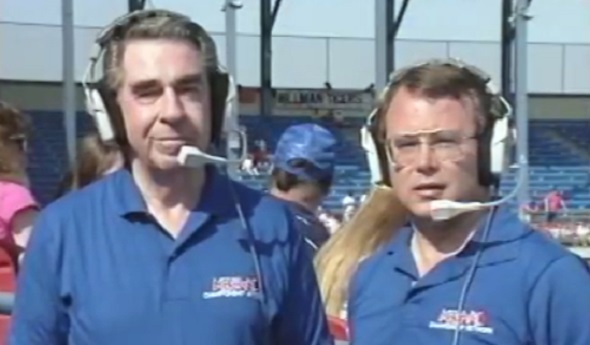
PHOTO: Paul Carey (left) and nephew Mike Carey broadcast the MHSAA 1992 Class D Baseball Final between Hillman and Athens for PASS.
Flashback 1980: Thrilling Conclusions
June 2, 2020
By Ron Pesch
Special for Second Half
With all Spring sports canceled for 2020 because of the COVID-19 pandemic, it’s been a season of recalling fond memories as we all sit and wait for the return of high school athletics in Michigan.
This time we’re diving 40 years deep to the Baseball and Softball Finals from 1980, which saw five of eight championship games decided by two runs or fewer and mostly on late-inning dramatics while played at various parks across the Lower Peninsula.
Here’s a flashback to the 1980 championship rounds:
BASEBALL
A strong argument could be made that Matt Costello’s ninth-inning heroics rank among the top moments in MHSAA tournament history.
In the days when the state Semifinals and Finals were played on the same day, and split across four separate sites spread across the state, an impressive 1,025 fans turned out for the Class A title game between Royal Oak Kimball and Grosse Pointe North, hosted at Wyandotte’s Memorial Park.
For Kimball, it was the fourth appearance in the state title game. The Knights, led by coach Frank Clouser, had appeared in the Class A title game for three straight years, 1971-1973, earning a championship in 1972 with a 3-1 win over Detroit Western.
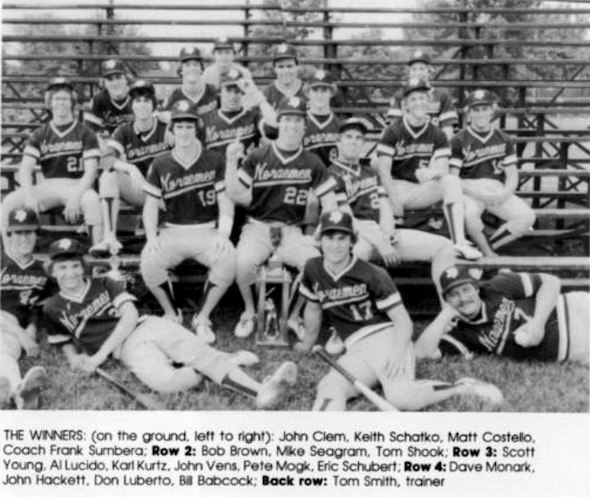
It was the first appearance in the Finals for North and coach Frank Sumbera. Earlier in the year, the Norsemen had been the top-ranked team in the Michigan High School Baseball Coaches Association Class A poll, but the squad hit a mid-May speedbump. Within five hours, North dropped two games, falling to St. Clair Shores Lakeview, 6-5, then 3-2 to Harper Woods, which was undefeated and ranked No. 1 in Class C. North rebounded, and finished the regular season as the top team in the Class A rankings with a 23-4 mark.
North opened the championship game scoring with three quick runs in the first inning. Kimball made it 3-1 in the bottom half of the inning, then grabbed a 4-3 lead in the third as 6-foot-4 senior Dave Kopf, (a 32nd-round draft pick of the Detroit Tigers one week earlier) crushed a three-run homer. North tied the game at 4-4 in the sixth when junior Bill Babcock led off with a double, moved to third on a sacrifice, then scored when the throw to first base on Keith Schatko’s suicide squeeze bunt went wild. Following a pop out, Costello picked up his first RBI on the day, on a double over the left fielder’s head that scored Schatko, giving North a 5-4 lead.
 Babcock, who had tossed a 2-0 no-hitter earlier in the day in the Norsemen’s Semifinal against Wayne Memorial, replaced starter Tom Shook in the bottom of the sixth inning. Following a walk, Kimball’s Scott Sturley smashed a two-out triple to tie the game, 5-5.
Neither team could push across a run in the last inning of regulation play. Kimball threatened in the bottom of the eighth, notching a leadoff double. But the danger ended when North catcher Mike Seagram picked off the runner.
Sumbera told Wright Wilson of the Grosse Pointe News that the play was the “turning point of the game.”
Singles by Babcock and Scott Young and a walk by Al Lucido in the top of the ninth inning set the stage for Costello.
“I had Matt swinging away because they were charging their infielders all the time, so we were playing for the hit,” said Sumbera to the Detroit Free Press following the title contest.
“I was just trying to get the run in when I went up there,” stated Costello, who “cracked a 2-2 pitch over the left field fence, more than 365 feet away.”
“When I hit it I knew it was going to be a home run. That was the greatest.”
Costello finished with three hits and an MHSAA championship game-record five RBIs, a mark that stood alone until Jacob Holt from Muskegon Catholic Central tied the record 35 years later, in 2015.
Trailing 9-5, Kimball loaded the bases in the bottom of the ninth inning and scored a run on a two-out wild pitch. But a pop-out to first ended the rally, and North grabbed a 9-6 win and its first diamond title.
Sumbera , who had taken the reins of the North program in 1973, would lead the Norsemen to a second title in 2006. Today, he ranks third in all-time baseball victories in Michigan after a 45-year coaching career.
Flint Powers downed Mount Pleasant 8-7 in a Class B thriller, played at Lansing’s Municipal Park. Mount Pleasant grabbed a 2-0 lead in the bottom of the second inning, before Powers’ Jim Morrissey popped a two-run homer to knot the game in the fourth. The Chargers added two more runs in the top of the fifth, but Mount Pleasant shortstop Bob Lee followed in the bottom of the inning with a two-run shot that tied the game at 4-4.
Powers took a 7-4 lead in the sixth inning and upped the lead to 8-4 on a Mike Morgan bases-loaded single in the seventh. With the game on the line, Mount Pleasant’s Scott Tuma blasted a two-out, three-run homer to cut the margin to 8-7. Morgan, who tossed a five-hit shutout complete game for Powers in its win over Farmington Hills Harrison earlier in the day, allowed two more runners before striking out pinch-hitter Todd Tuma to end the game.
Rain delayed the second Class C Semifinal game and postponed the championship contest until Monday, June 16. Leading 5-0 after three innings, Dundee finished off Lansing Catholic Central 7-2, then topped Parchment 3-1 for its first and only baseball crown. Norm Pentercs, who would later pitch at Grand Valley State, struck out 11 and allowed only four hits in the title game. Those games were played at Broome Park in Flint.
A seventh-inning walk-off bases-loaded single by Scott Trudell broke a 1-1 deadlock to give Grass Lake a 2-1 win over Muskegon Western Michigan Christian in Class D, hosted at Marshall High School. David Knoll allowed just three hits and struck out 13 for the win. It was the second appearance in a Final on the year for WMC, which fell to Detroit East Catholic in an MHSAA basketball championship game in March.
SOFTBALL
Veronica Miller’s single with two outs in the fifth inning drove home Julie Guerra, snapping a 1-1 tie and propelling Flint Carman to a 2-1 victory over East Detroit and all-state pitcher Roxanne ‘Rocky’ Szczesniak in the Class A championship game. Linda Allen picked up her second win on the day. Earlier she tossed a shutout in Carman’s 14-0 victory over Holland West Ottawa. Szczesniak, who would later star at Wayne State, allowed only three hits in the contest after delivering a one-hitter in East Detroit’s 11-3 victory over Ann Arbor Huron in the Semifinal.
“Everything worked great for me today,” Deanne Moore told the Lansing State Journal after tossing a two-hit, 6-0 shutout in Fenton’s Class B Final victory over Grand Rapids Northview. “I knew I had to pitch strikes and my fastball was moving around. I threw a couple of changeups to keep them guessing.”
In the title game, Moore opened the scoring with a solo home run in the second inning. It was followed by a triple by Sandy Thornton, who scored when Theresa Flynn singled up the middle. Moore scored again in the fourth inning following sacrifices by Sue Mora and Flynn, for a 3-0 lead. Northview’s fate was sealed in the fifth as Fenton tallied three more on Thornton’s two-run single and a fielder’s choice by Lori Glass.
It was the third-consecutive Class B title for the Tigers. Moore, a senior righthander, finished with a 24-2 record and would go on to an All-American career at Michigan State, earning entry into MSU’s Hall of Fame in 1996.
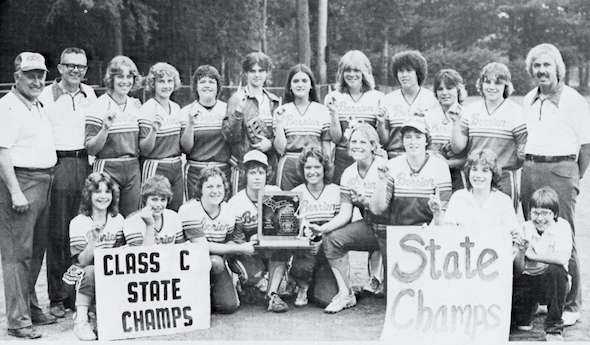
Rhonda Thran added her name to the MHSAA Championship Game Record Book, knocking in five runs as Berrien Springs routed Lakeview 11-4 in the Class C title game. Thran matched the RBI record set by DeWitt’s Cindy White in the Panthers’ Class C title victory over Center Line St. Clement in 1977. The sophomore centerfielder, along with second baseman Jan Dowell, was one of two regulars who were also starters on the Shamrocks’ volleyball team that won the Class C championship during the 1979-80 winter sports season.
 Junior Cindy DeFay fired a three-hitter in the championship. “The whole team really wanted this one. I had a good feeling that we were going to win so I was ready to play. It’s the best game I’ve pitched all year,” she told Jack Walkden of the Benton Harbor Herald-Palladium following the game. DeFay had “missed much of the first half of the season with a severely sprained ankle.”
In the Semifinal, Berrien Springs downed Leroy Pine River 10-8 and banged out 21 hits across the day’s two games, highlighted by five hits by both Rachel Roots and Sheila Duffel, followed with four by Thran.
A police escort guided the team and its retiring coach, Roy Rennhack, back into town after the games played across the state in Oak Park near Detroit – “More than 150 cars joined the caravan, which paraded the team through town atop firetrucks.”
“It was a perfect going away present,” said Rennhack.
It was truly an amazing sports year for the Shamrocks girls, who also won Regional titles in track and basketball. Between 1979 and 1985, Berrien Springs volleyball teams won five Finals volleyball titles. (Those squads were honored in the second year of the MHSAA’s Legends of the Game program in 1999).
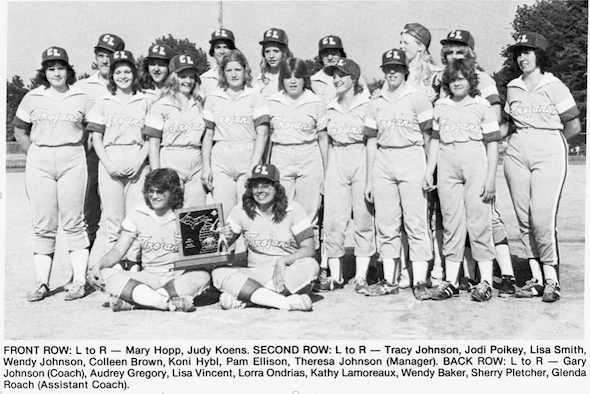
In Class D, Central Lake scored a dramatic 2-1 win over Vestaburg. In the top of the seventh inning, Vestaburg had knotted the game at 1-1 before relinquishing a walk to Pam Ellison in the bottom of the inning that set things in motion for the Trojans. Ellison stole second, then advanced to third on a sacrifice by Wendy Johnson. Following a walk to Wendy Baker, catcher Mary Hopp singled Ellison home for the win. Central Lake had finished as state runner-up to Laingsburg in 1978, then fell to Morenci 6-5 in the Semifinals in 1979.
“We were a pretty close-knit team,” said Ellison., recapping the rally.
“I had fantastic kids,” recalled coach Gary Johnson 40 years later. “We played a lot of big-time schools. I never had a second pitcher when I coached. Back then, if you had a girl who could throw a fastball you were at the top of the world. We had Judy Koens.“
Koens allowed just four-hits in the title game and along with Hopp was named to The Associated Press Class D all-state team as Central Lake finished 33-4. Koens would pitch at Central Michigan, posting stellar ERAs during her four seasons and earning all-Mid-American Conference honors in 1984 as a senior.
 Ron Pesch has taken an active role in researching the history of MHSAA events since 1985 and began writing for MHSAA Finals programs in 1986, adding additional features and "flashbacks" in 1992. He inherited the title of MHSAA historian from the late Dick Kishpaugh following the 1993-94 school year, and resides in Muskegon. Contact him at [email protected] with ideas for historical articles.
PHOTOS: (Top) Berrien Springs celebrates its 1980 Class C softball championship. (Middle) Grosse Pointe North claims the Class A baseball title in its first Finals under coach Frank Sumbera. (Below) Central Lake improves from Class D softball runner-up in 1978 to champion two years later. (Photos gathered by Ron Pesch.)