

Powerful Voice for High School Sports
December 19, 2014
By Geoff Kimmerly
Second Half editor
Paul Carey was home from the U.S. Army only a few months and just shy of 25 years old when Beal City embarked on its first trip deep into the MHSAA boys basketball tournament.
On the call for local radio station WCEN from gyms at Saginaw Arthur Hill and Lansing Sexton, Carey served as the voice of the previously “laughable” Aggies as they reached the Class D Semifinals before falling just six points short of playing for the title.
“All of Beal City emptied out. They’d never had anything before,” Carey recalled during his annual Thanksgiving weekend visit to the MHSAA Football Finals at Ford Field. “When I got home, within the next two weeks I got a letter from every citizen of Beal City thanking me for broadcasting their games. That’s the kind of appreciation that meant so much.”
During 42 years on the airwaves, Carey was best known as a voice of the Detroit Tigers bounding out of transistor radios all over Michigan, thanks to WJR’s powerful signal.
But for the state’s high school sports community, his legacy is similarly memorable as the voice of the longtime football and basketball scoreboard show and a voter for various all-state teams and wire polls over the decades.
Now 86 and retired since 1991, Carey remains a regular during the first day of the Football Finals, taking in games he broadcast for the MHSAA during the late 1970s and that continue to hold his eye as they have for more than a half-century.
“It was a passion of mine. High school sports always has been,” Carey said. “I think because my dad was a high school coach, and teacher initially, and my brother was a high school coach and teacher, I just grew up in families that appreciated coaching and athletics. I was not a great athlete, but it kept my hand in following sports that way.”
Now, the scores
Carey partnered with Ernie Harwell for Tigers radio broadcasts from 1973-91, including during the march to the 1984 World Series championship. He was named Michigan Sportscaster of the Year six times and to the Michigan Sports Hall of Fame in 1992.
But Carey’s early career included sitting on top of a car, plugged into a phone pole, for a Sacred Heart football game at old Fancher Field just a few blocks from his family’s Mount Pleasant home. Among many more accolades are a Distinguished Service Award from the Michigan High School Coaches Association and a place in the Basketball Coaches Association of Michigan Hall of Fame.
In fact, the start of his weekly announcing of statewide football and basketball scores preceded his baseball career by 16 years and ended two months after he announced his final professional out.
The Michigan High School Scoreboard show was a staple of WJR’s late Friday nights from 1957-91. Carey would read every score he could collect from a variety of sources, often organized by league and with state rankings and context mixed in.
His idea came from something similar read by Len Colby for Kalamazoo’s WKZO. Carey’s brother Terry was coaching at Niles during the second half of the 1950s, and he and other coaches would get together to listen to the Friday night scores from the southwestern part of the state.
Carey, who left WKNX in Saginaw for WJR in 1956, explained to then-sports director Bob Reynolds that the station’s strong signal could provide for a truly statewide scoreboard experience.
Carey then connected with Edgar Hayes of the former Detroit Times, who gave the OK for Carey to call the paper on Friday nights to get scores from the Detroit metro area. For the rest, Carey relied on wire services – there were three at the time – who relied on newspapers from all over Michigan to call in scores over the course of an evening.
Before every Friday during high school football season – and later Tuesdays and Fridays during boys basketball season – Carey typed up lists of games based on schedules in the newspaper, with spaces to add scores. More than a few times, Carey raced down a back ramp at Tiger Stadium after a Friday night game, back to the WJR studio, with 15 minutes to prep for the show’s 11:30 p.m. start.
“If the Flint Journal, the Grand Rapids Press, the Traverse City paper didn’t call in scores to the AP, then I was out of luck too. And that happened all the time,” Carey said. “I would call back occasionally, say, ‘Did you get anything more?’ It was a rat race.”
The show originally was set for 10 minutes and then extended to 15. American Airlines sponsored a record show that followed, and Carey’s scoreboard show had a sponsor only once in 35 years. Finishing up on time was expected, even with more than 200 scores to read.
But Carey said he always went 20 minutes, sometimes 25.
“Because I wasn’t done. I just kept right on going,” Carey said. “Jay Roberts did the all-night show most of the time, and he was patient with me. He didn’t say too much on the air about ‘that guy ahead of me took all of my time.’”
Carey continued the “rat race” until his final scoreboard show, Dec. 20, 1991. He retired from WJR at the end of that calendar year. And it's important to note: Carey was never paid a dime extra for doing the program. .
“I think Paul is really just a sports fan, and that came across to the listener on his broadcasts,” MHSAA historian Ron Pesch said. “Paul would gather as much as possible off the wire. He'd interject if scores were missing from sections of the state. Press polls from the Free Press, News, AP and UPI were big, so he could point out close calls and upsets.
“He provided immediacy, or the closest thing to it in the days before cable TV and the Internet, and because of his scoreboard show, you could get the results before the morning paper. For listeners, he brought life to something as simple as game scores.”
First team all the way
Carey, who resides in Rochester, also served as the engineer on Tigers broadcasts for 16 years, through 1990. He broadcast Pistons games on the radio for six seasons and did the first broadcast of a Central Michigan University football game, in 1949.
Harry Atkins, covering Detroit’s teams while with The Associated Press for 29 years including the last 21 as its sports editor for Detroit, took note of his colleague's hard work – and especially that Carey was one of few broadcasters who was a journalist in addition to a voice.
That made Carey's other major role in high school sports a natural fit.
Atkins split The Associated Press all-state selection panels for football and basketball into 11 regions, and Carey represented the Detroit area for a number of years. He also was a longtime voter in those sports' weekly polls.
“Paul is just that kind of guy. He thought it was important and he made time in his busy schedule to do it,” Atkins said “And it had an impact on the other 10 voters on the All-State panels, too.
“Some of them were from small out-state newspapers or radio or TV stations. Yet every one of them knew who Paul Carey was. And when he spoke, of course, with what often is called "The Voice of God," those voters paid attention.”
And he still does, as well.
At the end of each fall, Carey still puts together a compilation of the three high school all-state football teams – Associated Press, Detroit Free Press and Detroit News – and files them with years of research and results.
“It’s important to me. Nobody sees it but me, but I get a certain kick,” Carey said. “Once in a while I’ll see a kid playing at Central, Western or (Michigan) State or Michigan, and they’ll say he came from Clawson. I’ll go into my all-state collections, say that would’ve been 2009 he played, and I find a name.”
In addition to the Football Finals on WJR, Carey was part of the Baseball Finals broadcasts into the early 1990s, continuing to contribute even after his retirement from his fulltime gig.
He spent high school games over the years sitting next to legends like the Free Press’ Hal Schram and remembers when current Free Press longtime scribe Mick McCabe was just a rookie. One of Carey's final broadcasts was a 1992 Baseball Final with his nephew Mike Carey, who continues to broadcast MHSAA championship games to this day.
“I am eternally grateful to Paul Carey. His contribution to high school sports in Michigan has been great and significant,” Atkins said.
“We are lucky to have him.”
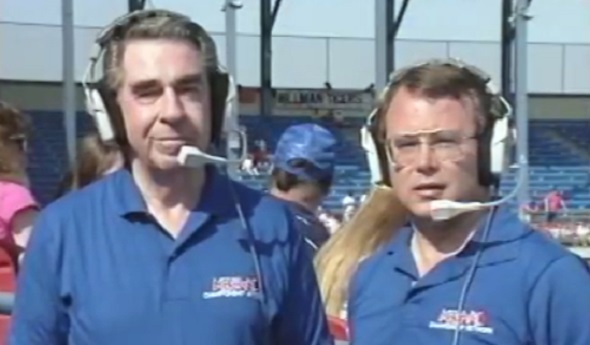
PHOTO: Paul Carey (left) and nephew Mike Carey broadcast the MHSAA 1992 Class D Baseball Final between Hillman and Athens for PASS.
Norse Nation Roars North Muskegon Pride
February 15, 2019
By Geoff Kimmerly
Second Half editor
NORTH MUSKEGON – North Muskegon junior Caleb Rypstra readily remembers being an elementary schooler in 2012 and watching 2,000-point scorer Spencer Krannitz take on Whitehall in front of a gym jammed in part by a giant student section.
Senior Nicholas Rossiter didn’t like going to high school football games when he was young, in part because of the loud crowd – but living a few blocks from the Norsemen’s stadium, he couldn’t completely avoid hearing the Norse Nation boom.
That’s how North Muskegon students cheered on their classmates back then. That’s what they do now. The only difference? Norse Nation is more organized this winter – and showing the rest of Michigan what it’s about as one of three Battle of the Fans finalists.
“As a senior this year, we’ve really been pushing to make a difference as a class and do something no one else has done,” senior Kendal Hoppa said. “And I think we’ve really run with this theme of having such a huge and welcoming sense of community within our school.
“Between the K-12 grades and even then community coming out and supporting, we’ve really just harnessed that love and embraced it. Just made it super, super big this year and wanted to broadcast that. We have Norse pride, and we want the whole community to see.”
Seeing was believing Wednesday, as we visited North Muskegon for the second of three stops on this year’s Battle of the Fans VIII finalists tour. We met with seniors Rossiter, Hoppa and Brady Lindell and juniors Rypstra, Camryn Klint and Bella Lindsay to learn about the student section’s rich past, newly-organized present and to watch the Nation in action during the boys basketball team’s rematch with rival Montague.
We’re reporting on all three of our BOTF finalists visits this month following the format of a typical game night. We kick things off below with some of the Norse Nation’s “cheat codes” for other student sections hoping to grow and improve, followed by the video from our visit and then more of the “game story” from our trip.
Norse Nation’s Gameplan
Take some of these tips from the Norse Nation:
Take action. Getting something going can seem like a tall task, but someone has to start the conversation. Leaders lead. Don’t be afraid to be one.
Talk to your principal. That was the key in North Muskegon’s case, but it could be any administrator, teacher, coach, etc. Norse Nation leaders credit principal Ken Byard specifically not just for bringing a boost of school spirit when he was hired in 2016, but also for being always available and open to ideas. He's willing to help in any variety of ways, like working with the school board and sports boosters to get free fan buses for away games.
Start small: First find and develop a passionate core group that will lead the charge, and then spread the message through channels like social media, daily announcements and whatever else is available.
Start simple: A student section doesn’t have to do something completely out of the box to get people interested. Something as simple as getting everyone to wear school colors to a game can get things moving, bring people together and make them feel part of something.
Pregame Prep
A thin channel connects Lake Michigan to Muskegon Lake, a sizable bay with North Muskegon on its north shore, directly across the lake from the city proper. By car, the closest neighboring school to North Muskegon is Reeths-Puffer, a little less than six miles away, and the region as a whole is dotted by communities with their own substantial local pride. Many of the smaller communities make up the West Michigan Conference. Victories dating to the 1930s are among those celebrated in North Muskegon’s trophy case. The league was formed during the early 1930s, and the school opened in 1935.
That’s not to say Norse Nation is pushing a century of cheering. But there’s certainly tradition in a community where generations tend to return to raise their own families, and people know each other usually by more than name at a school with just under 330 high school students.
In fact, the high school students make up most of the first floor of the community’s Mills Avenue building, while middle school students attend most of their classes on the second floor (with some crossover between the two) and the elementary school wing connected on the northeast side of the property.
That proximity is a key part of Norse Nation’s history and continuing story. “For as long as I can remember, our school has had such a big turnout for all sports games and especially boys basketball right now because the team is pretty good recently,” Lindsay said. “But what makes us so special is that since we’re such a small school, K-12, we have the elementary, middle school and high school all involved in the games regularly. That’s just a normal thing for us.”
And that would’ve continued into this winter, to be sure, without any added incentive. But on a bus ride back from a cross country meet this fall, Lindsay and Rossiter had a conversation: Why not give Battle of the Fans a try?
That sparked changes to the organization of the section that should keep it rolling strong for years to come.
In past years, students informally rallied each other to come to games. Hoppa was one of them – in fact, she and Rossiter were mock-elected class “Norscots” to recognize their school spirit. So they were sure things when the “Student Section Council” held its first meeting at the start of this winter. Nearly five percent of the high school student body – at this small school 14 students, mostly seniors and juniors with a couple of sophomores – took the first steps that afternoon toward bringing organization to the already prevailing spirit at the school.
The newly-organized Norse Nation got rolling quickly. After that first meeting, Principal Byard allowed the SSC to hold an all-class assembly to explain BOTF and how it would be a great way to show the school’s sense of pride and family. They’ve since had multiple assemblies to teach cheers and get students pepped to come to games.
The 14 members of the SSC correspond on a group chat, and all interested classmates are invited to join. With Hoppa running Instagram and Snapchat accounts and Byard the school’s Facebook and Twitter feeds, the Nation got the word out on all of the fun it had planned.
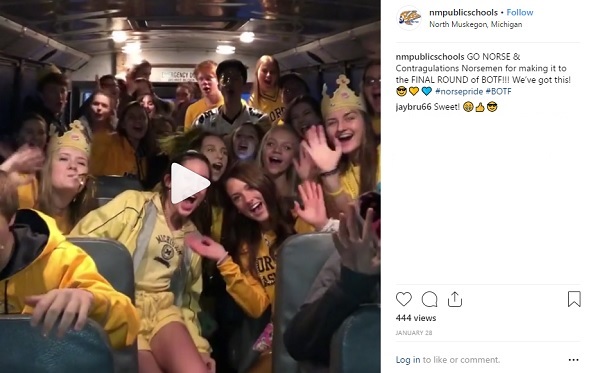
An elementary school night allowed families to attend games for $1 if their children were wearing Norse gear. An upcoming throwback game was hatched, and basketball players will be wearing retro uniforms to join in. Impressively, the Nation completed its mandatory BOTF semifinals “takeover” of the MHSAA’s Instrgram at a ROAD game with a “gold out” that made that away gym seem a lot like home (see bus ride post below).
“(In the past) we’d have a whole bunch of people come to the games. A couple of people did the theme because the rest didn’t really know,” Hoppa said. “But once I got a whole bunch of different people involved in spreading out and communicating the themes; we have a whole bunch of different friend groups here. So if you get (the message) into the friend groups … it just became more cohesive, and people did it.”
And that brought us to Wednesday’s “Slumber Party” for one of the boys basketball team’s biggest games of the regular season.
Game Time
North Muskegon’s gym has an old-time, small-school flavor, and the packed-in nature made it difficult to estimate how many students filled a quarter of the stands for what obviously was a big game – Montague had handed the Norsemen their only loss this season Jan. 10.
Still, this was a Wednesday. And had been a snow day. And the Nation still turned out in force, even if it was tough to figure out how many of 150-170 students were high schoolers or the youngsters from the elementary – aside from the first few rows, all grades seemed to mix pretty easily all the way to the rafters.
“Everyone grows up with each other. I don’t know what it is. It’s just this place,” Rypstra said.
Pajamas were the gear for the day, but sleep was not an option. Although the Norscots led a lot of cheers, anyone could get things going – and the yelling started before the opening tip and lasted through the final seconds of the home team’s 58-44 win.
There were favorite chants and cheers for individual players, and all positive. A student on electric guitar provided a unique spin to the national anthem, and the pep drum line provided accompaniment throughout the night. Halftime got a little wild – a pillow fight in front of the student section, followed by limbo at halfcourt and finishing with a “Cha-Cha Slide” – but no one was injured and everyone had fun, and the team became the focus again as soon as the second half started.
“They bring it all the time,” said Lindell, a football player during the fall. “It’s not just boys basketball. It’s girls basketball. It’s at football, it’s at soccer, it’s all the events. The student section is there, they’re cheering. Being on the football field, you can hear them going crazy in the student section. It’s year-round. We’re always doing it.
“We’re not here to support players. We’re here to support friends.”
Postgame Analysis
More than cheering: “I’ve kinda always been that person that’s super open and super inviting and (the one to) be like, ‘Let’s do this cheer. Let’s be loud,’” Hoppa said. “(But) I was never really close with Nick until this started, and now we’re friends and within the same friend group almost. Being in the Student Section Council has been cool for my school, but it’s been super cool for me and my friends because I’m growing my friend group too."
 Intimidating in a good way: “As a competitor, I almost want (opponents) to be a little intimidated,” Lindell said. “I mean, not in a bad way. But be like, you know they’re going to be loud. You know they’re going to be in the game, and you know they’re going to make a difference in the game.”
Set the positive tone: “I feel like what we do against the rivals is cheer louder. We get more into it,” Lindsay said. “We stay with our positive cheers, but we just fire back at them if they say something; whether it’s positive or negative, we fire back louder. Just say ‘Go Norse’ even louder.”
Best possible compliment: “I have a lot of friends in our conference, and they’re like, ‘Your student section is always so fun. I wish I could go to North Muskegon and just be a part of that.’ And I’m like, ‘You can come. You know the theme; just come and do it,’” Hoppa said. “I think that’s a positive answer. That’s something awesome, that you want to hear. Somebody that’s not a part of something that you are part of, wanting to be a part of it.”
Next stop on BOTF: We will visit Buchanan for its boys basketball game tonight, Feb. 15, against Niles Brandywine. Public voting for Battle of the Fans begins Tuesday on the MHSAA’s Facebook, Twitter and Instagram sites – come back to Second Half on Monday for our Buchanan report and Tuesday for instructions on how to vote.
The Battle of the Fans is sponsored in part by the United Dairy Industry of Michigan.
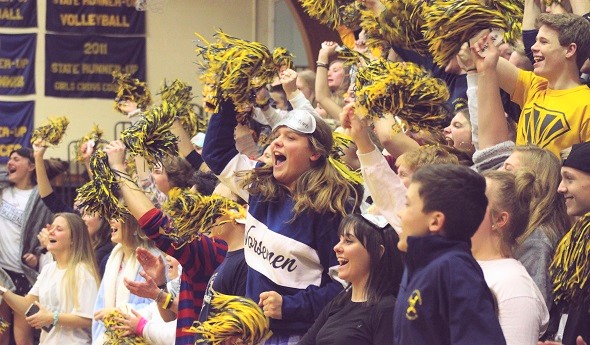
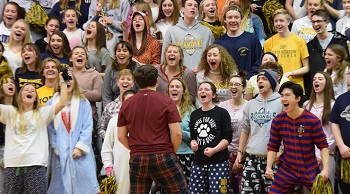
PHOTOS: (Top) The Norse Nation cheers on the North Muskegon boys basketball team during its game Wednesday against Montague. (Middle) Junior Chris Rypstra, front, leads his classmates in a chant during a break on the floor. (Photos courtesy of North Muskegon High School yearbook staff.)