


Rivaling for a Cause
January 25, 2013
It’s impossible to include all the perspective we gain from every “Battle of the Fans” visit.
But this anecdote, although it didn't make Tuesday’s story about our Frankenmuth trip, tells of another great example for what student cheering sections can accomplish.
Frankenmuth and Millington are heated rivals, to say the least, separated by 13 miles and made more competitive by plenty of championship-deciding matchups over the years.
But for their boys basketball game Jan. 10 at Frankenmuth, student section leaders from both schools almost completely on their own set up the game as a cancer awareness night, complete with Frankenmuth students in black shirts and Millington’s wearing pink.
The idea was the brainchild of a of Frankenmuth section leader, who then received help from a local bank and contacted Millington to get the ball rolling.
Battle of the Fans has shown us the obvious – these student sections need strong leaders – but also the special things they can accomplish with additional initiative.
“Never Forgotten”
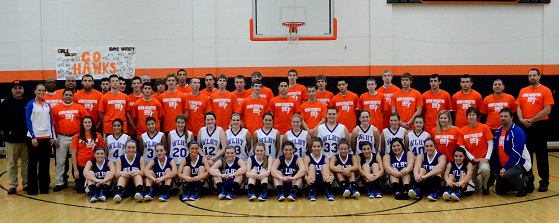 Two more rivals, Fennville and Saugatuck, met late last month for their second “Never Forgotten” boys and girls basketball games with proceeds going to the Wes Leonard Heart Team for the purchase of AEDs.
Players wore jerseys with names on the backs of friends and family members who had died, and those jerseys were then given to family members after the games. Officials Ace Cover, Chris Dennie and Kyle Bowen also donated their game checks to the Heart Team, as did the winner of that night’s 50-50 raffle.
Leonard died from sudden cardiac arrest after making the game-winning shot in a basketball game March 3, 2011. The two schools played their first “Never Forgotten” games last season.
More support for less specialization
I’m asked once a year at least about sport specialization – that is, athletes focusing on just one sport, often from an early age, and if it pays off some way down the road.
Most of my evidence to support my belief in the well-rounded athlete has been anecdotal, based on conversations with people at the high school and college levels over the years. But a British study published this fall in the Journal of Sport Sciences by University of Birmingham researchers provides some interesting empirical findings.
The study of 1,006 people from the United Kingdom showed that those who participated in three sports at ages 11, 13 and 15 were “significantly more likely to compete at a national rather than club standard” between ages 16-18 than those who had practiced only one sport.
In other words, the study found that those who played more sports at earlier ages played at a higher level during their high school-age years, which seems to contradict the one-sport focus philosophy.
Click for more perspective on the study from Chris Kennedy, the Superintendent of Schools in West Vancouver, British Columbia.
PHOTO: The boys and girls teams for Fennville and Saugatuck pose together after their "Never Forgotten" games Dec. 21 at Fennville High. (Photo courtesy of Al LaShell.)
Edwardsburg 'Family' Dreaming Big Again Building On History-Making Run
By
Scott Hassinger
Special for MHSAA.com
September 9, 2026
EDWARDSBURG – “Family” was Edwardsburg boys soccer's mantra last fall as the Eddies enjoyed a historic season.
 Sean Jesse's team compiled the best record in school history at 17-2-1, while claiming an outright Wolverine Conference championship and raising a Division 2 District trophy before losing 4-1 in a Regional championship match to Hudsonville Unity Christian, the eventual Finals runner-up.
Even though a few key pieces are now gone who made last year's success possible, the bar still remains high at Edwardsburg.
Jesse's involvement with school’s soccer program goes back a long time. This autumn he’s begun his 15th year leading the boys and will serve his 16th campaign next spring as varsity girls coach.
The boys team has picked right back up where it left off last season with a 5-1-0 record so far this fall. Senior Brayden Fischer returns as the top scorer after totaling 22 goals and four assists last season.
"We lost some great players from last season, but we have lots of returners who can step up and fill those vacant positions and really help the team out," said Fischer, who has played soccer for 14 years and hopes to play baseball and study engineering at the college level. "Our goals this season are to become even closer as a team and to play better than we did the day before. Of course, we'd like to make it further than last year. Right now, we're just focused on growing as a group. I feel like my vision and physicality make me strong at the striker position. You have to be strong and be able to hold the team up. Last year's experience brought more of a family culture in soccer here."
Building a strong soccer culture hasn't happened overnight at Edwardsburg. It's been many years in the process.
"We've been kind of building towards this kind of family culture and atmosphere here at Edwardsburg for a while now. It's the result of having guys who are willing to put in a great deal of time outside of the regular season to become better players," Jesse said.
 When he arrived at Edwardsburg, the program had at most five players who played club soccer during the offseason. Now he has 15 who are involved in the sport year-round.
"That makes a huge difference. When you have the fundamentals down, we can work more on the strategy of the game during the high school season," Jesse said.
Edwardsburg graduated a few key seniors in the spring, including star center back Austin Leak, but a majority of the roster a year ago was comprised of younger talent. Eight of the Eddies' 11 starters are back this fall.
"If we can replace Austin, we feel we could be every bit as dangerous as we were last year or even better," Jesse said.
Sophomore Conner Fischer, Brayden's younger brother, has stepped up big so far to fill that spot. The Eddies also lost standout wings from last year in Maverick Gates (10 goals) and Logan Stubblefield, but Jesse has found capable replacements.
"Maverick and Logan were our captains and great leaders for us. They were kids who could just go continually," Jesse said.
Staying humble will be a key ingredient this season.
"This group knows they are a good team. Right now, we are trying to find that balance between confidence and arrogance. I don't like to lose, but the early loss to St. Joseph might've been a good thing to happen to us this early," Jesse said. "It gives us motivation to keep working hard and get better."
With another year of experience under his players' belts, Jesse expects the Eddies to have a much stronger attack on the offensive end of the field. "We actually struggled to score at times last year. Brayden was our only player who was able to finish consistently," Jesse said.
Junior wing/forward Collin Tefft returns to the Eddies' 30-man roster after playing club soccer last fall.
"Collin is that dynamic and dangerous that every team we face is going to be afraid of him. Finding his way in our system is going to take a few games, but he'll get there," Jesse said.
Tefft has played soccer for 13 years, starting at age 3.
"Our guys want to pick up the intensity and work on getting better and not look back on any losses and learn from them. Our goal is to push forward and be better soccer players every day," said Tefft. "We have good chemistry and are always picking one another up. Those are big positives."
Senior Landon Goetz returns at holding midfielder and likes being able to control the tempo of the game and getting the ball to the playmakers up top. "Landon is our vocal leader. When he's on the pitch, we are a very stable group," Jesse said.
"I was an outside back for quite a few years. Once I got to high school, Coach Jesse converted me to my current position,” said Goetz, who plans to attend Michigan State University next year and study finance or marketing. “Two years ago as a freshman, I feel our team was a bit cocky. I think last year's success brought more of a humble atmosphere. That really helped push us to that District championship and to the Regional Finals.
 "We're trying to remain close like a family again this season, but I think we're also more of a technical team ability-wise this time. That could help us go even further in this year's tournament. It's so early in the season. We have to just push one another each day in practice and build that connection. We're still trying to find that rhythm."
Returning for his third season as Edwardsburg's starting goalkeeper is junior Law Gates. He finished his sophomore season in goal with a 0.65 goals-against average and has made several saves already this fall, Jesse said.
Junior Aleck Rodriguez is a standout attacking midfielder and had four goals and 12 assists for the Eddies as a sophomore. "When Aleck is playing well, our whole team is doing well. A great deal of our attack goes through him," Jesse said.
Big contributions are also expected from senior outside back Chance Jacobs and junior Riley Szalai, who contributed six assists as a sophomore. "Chance is probably the most reliable player I've ever had here. He can play anywhere on the field and just doesn't make mistakes," Jesse said.
Jesse – previously a prep standout at Buchanan and a math instructor at Edwardsburg – understands how difficult it will be to duplicate the accomplishments of last year's squad. His team is the favorite on paper to win the Wolverine Conference, and Jesse expects the Eddies to battle St. Joseph for a District crown as well.
"It's always so tough because soccer is about different matchups. You might honestly be the better team in the state, and you come up against someone else who just matches up better against you,” he said. “Our goal is to win a state title, and I think we're good enough to do that. Obviously, things are going to have to fall into the right pattern for that to happen."
"Our Regional is a bit more manageable this year with some of the powers on the other side of the bracket. This is our year to attain some of these goals, but we will need a lot to fall in our favor too.”
 Scott Hassinger is a contributing sportswriter for Leader Publications and previously served as the sports editor for the Three Rivers Commercial-News from 1994-2022. He can be reached at [email protected] with story ideas for Berrien, Cass, St. Joseph and Branch counties.
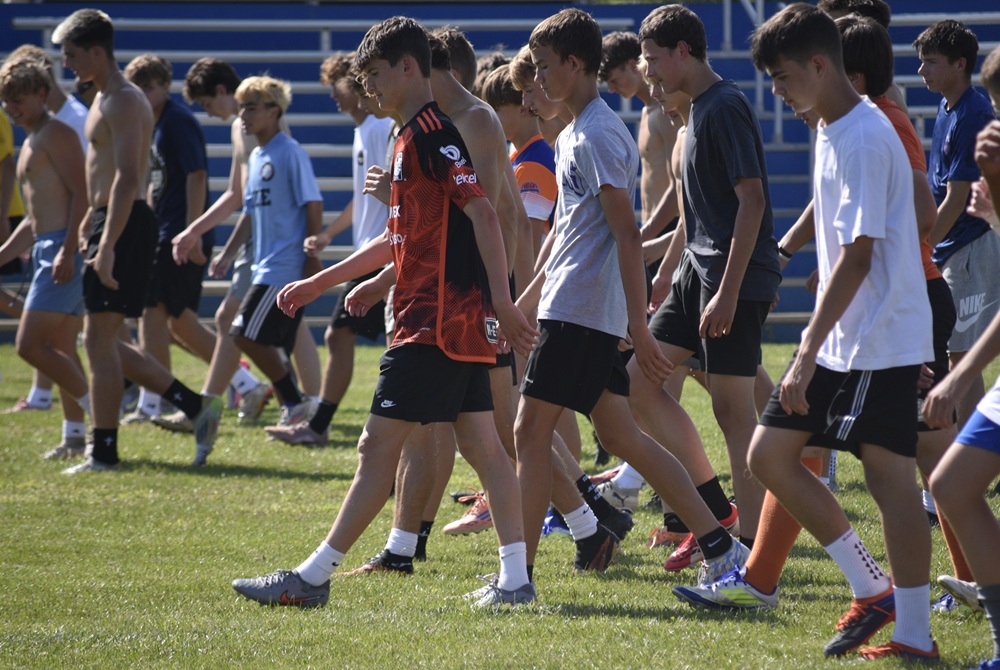
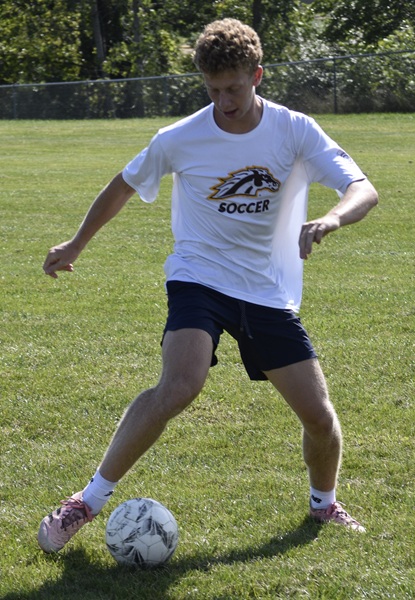
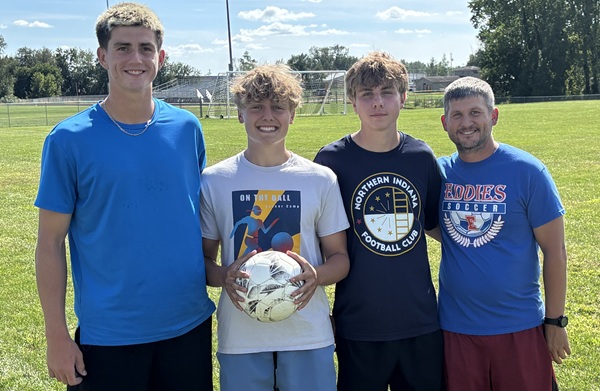
PHOTOS (Top) Edwardsburg soccer players warm up during a yoga and calisthenics session. (Middle) Senior Law Gates works on his ball control during a recent practice. (Below) Eddies boys soccer coach Sean Jesse, far right, poses for a photo with key returnees, from far left, Brayden Fischer, Landon Goetz and Collin Tefft. (Photos by Scott Hassinger.)