


One Community at a Time
July 24, 2012
In the northwest corner of Michigan’s Lower Peninsula there is a group of volunteers who are focusing on the character-building potential of youth and high school sports. They are teaching the principles and recognizing the people that make character education happen frequently and by design, rather than only rarely and by accident.
The group is known as Beyond The Scoreboard. It draws on resources from Character Counts, Positive Coaching Alliance and others; and it delivers character education through inexpensive workshops for athletes, coaches, officials, sports leaders and spectators.
Beyond The Scoreboard also conducts a Champions of Character Awards Dinner, the 8th Annual held June 11, 2012 in Petoskey. I’ve attended most and was the speaker in 2011. This year’s speaker was my counterpart with the Arizona Interscholastic Association, Commissioner Harold Slemmer.
At an event like this there are many moments that uplift the best of youth and school sports. Here are two from this year’s banquet:
-
When East Jordan High School runner Luke Hawley was thanking those who helped him be the kind of person who would be honored as the high school male athlete, he thanked many people, including the maintenance person who prepared the high school track. I had never before heard a high school student-athlete include a groundskeeper in his support group. And it told me a lot about this young man. He’s likely to be a good employee, spouse and parent someday.
-
When a member of the Petoskey High School football team was introducing his coach, Kerry VanOrman, who was being honored as the high school coach, he said the first thing Coach VanOrman would say to every player he greeted was a question about something other than sports; and he would be the same way to every player, no matter how skilled. He’s coaching more than a sport; he’s coaching kids. Helping them become better people.
After a single banquet, an attentive person could develop a game plan for character building for an entire season. Imagine all that’s been shared to improve youth and school sports after eight years! Congratulations to founder Jack Taylor, Executive Director Ron Goodman and all board members and volunteers.
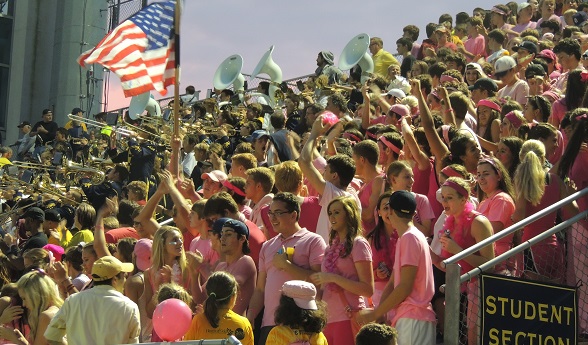
Let the Battle of the Fans Begin!
December 10, 2013
By Geoff Kimmerly
Second Half editor
First, there was a call from a student on the west side of the state who wondered if we'd still be holding the contest. Then came a few Facebook posters looking for information on when it all would begin.
Those sparks came just last week – and don't include the handfuls of tweets we received during the fall as student sections ramped up in preparation of one of our favorite parts of the school year.
Apparently, there's some excitement brewing for Battle of the Fans III. And we can't wait to see what you've cooked up.
The MHSAA's Student Advisory Council will host its third “Battle of the Fans” contest this winter to award the top high school student cheering section in Michigan and promote the opportunity for a fun, positive cheering experience for fans supporting their teams.
A total of 27 sections submitted videos for the 2012-13 contest, and 43 schools total have submitted applications during the contest’s first two years. Buchanan was named last year’s champion and presented with a banner during the MHSAA Boys Basketball Finals at Michigan State University’s Breslin Center. Sections from Ann Arbor Gabriel Richard, Frankenmuth, Vandercook Lake and Zeeland East also were finalists last winter.
Schools are invited to submit a short video, via YouTube, of their cheering sections in action. Video submissions should be between 90 seconds and three minutes long and explain how that section meets the following contest criteria: positive sportsmanship, student body participation, school spirit, originality of cheers, organization of the group, student section leadership and fun.
The deadline for student-submitted video applications is noon Jan. 11. Five finalists including at least one Class C or D school then will be chosen and visited on a home game night by MHSAA staff and Advisory Council representatives. The MHSAA will produce a video of that finalist after each visit, with the champion being selected by the Student Advisory Council based in part on activity on the MHSAA’s social media sites.
This year’s winner will be announced Feb. 21 and recognized March 21 at the Breslin Center.
Contest rules, directions for submitting videos, plus links to coverage of the 2012 and 2013 finalists can be found on the MHSAA Website. This year’s finalist videos, plus the announcement of the 2013-14 winner, will be published on Second Half. Click the links below to see the stories and videos from all five of our finalist visits.
Ann Arbor Gabriel Richard - Buchanan - Frankenmuth - Vandercook Lake - Zeeland East
Make sure to mark all of your social media postings regarding Battle of the Fans III with the hashtag #BOTF – and keep an eye out for more information on the MHSAA's Facebook, Twitter and Instagram sites.
The Student Advisory Council is made up of eight seniors and eight juniors, who each serve two-year terms. The Council acts as the voice of Michigan's student-athletes; it serves as a student sounding board for the MHSAA's Representative Council, assists in planning Sportsmanship Summits, Captains Clinics and other student leadership events; participates in a yearly focus group about the state of high school sports for Michigan State University's Institute for the Study of Youth Sports and assists with medal ceremonies at MHSAA championship events.
PHOTO: East Grand Rapids students cheer on their football team against Lowell this fall.