

SAC Leaders Represent at NFHS Summit
By
Geoff Kimmerly
MHSAA.com senior editor
August 10, 2015
By Geoff Kimmerly
Second Half editor
New members of the MHSAA Student Advisory Council quickly find themselves among new friends from different schools who are similarly motivated to provide valuable leadership to their classmates.
Four SAC seniors were among 100 students at the inaugural National Student Leadership Summit on July 20 in Indianapolis – and again found plenty of common ground with leaders from all over the country also driven to provide strong student voices in their schools and communities.
The event was hosted over three days by the National Federation of State High School Associations. Students were split into discussion groups tackling a variety of topics and also spent time working with Indiana Special Olympians.
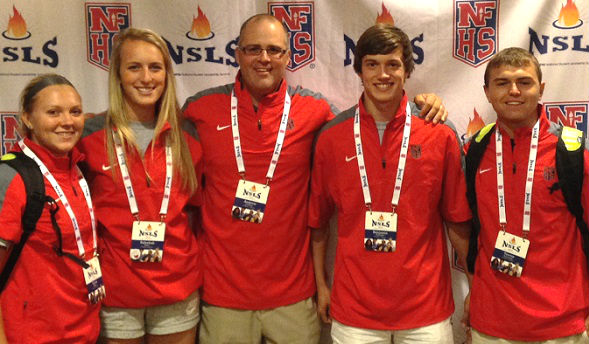
Now home, the MHSAA's four representatives – Ben Kowalske of Livonia Stevenson, Bekah Myler of Gaylord St. Mary, Trevor Trierweiler of Portland and Greta Wilker of Belding – reflected briefly on the experience and what they’ll take into this year to pass on both at their schools and to leaders all over Michigan.
What was your first impression of being surrounded by student leaders from all over the country?
Trevor: When I first arrived at the camp I didn't know want to expect; I did not know whether to be nervous, excited or happy. Then when I started being around other leaders with similar personalities, and mindsets, it was easy to be around them and interact with them.
Bekah: My first impression of being surrounded by leaders was that I felt comfortable and secure because I knew everyone around me had the same goal of becoming a better leader.
Ben: At first I was wondering how well all the leaders would mix in during the activities. My first impression was how nice and respectful everyone was.
Greta: I thought it was really cool to see all the leaders from different states and know that we got to be a part of something pretty selective.
What was the most fun part of the trip?
Trevor: I had the most fun during activities with other student leaders, and in the leadership lounge. In the lounge all the student leaders spent time together playing games and enjoying fun activities.
Bekah: Walking to Steak 'n Shake after the dance with my new friends; also hanging out in my room with my roommate who I became good friends with. All in all, I enjoyed meeting new people!
Greta: The most fun part was getting to make friends with kids from across the country and getting to hang out with them for the three days. The late night Steak 'n Shake runs were a lot of fun and just hanging out in the rooms afterwards, just getting to know everyone.
What was the most eye-opening part?
Ben: Not to sound stuck up, but the most eye-opening was how well the MHSAA SAC is doing. Most states don't even have a council, so seeing how much we do and that we have a council unlike most states was eye opening
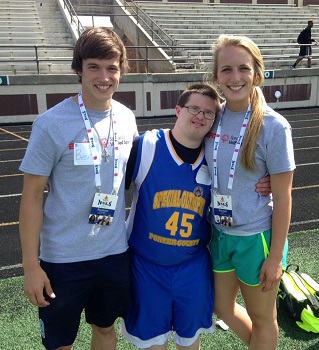 Bekah: The Special Olympics event opened my eyes. I was able to experience something that I never have before. When I play any given game whether it be checkers or basketball, I have a desire to win. But that day, it wasn't about winning or losing. It was about giving and sharing the joy of accomplishments that so many of us take for granted.
Greta: It was amazing how hard the athletes work and how skilled they are at the sports they play. I got to work with Nick and he was beating me badly in corn hole, but we did make a pretty good team in bocce ball.
Trevor: Seeing the smiles on the Olympians faces really made me feel special and realize how lucky I am.
What did you learn that will be most useful during your senior season, either on the field or off?
Trevor: Two really important things the counselors preached was that everyone has different perspectives. That just because it’s not your way does not mean it’s wrong; it just means someone else may have seen it differently or solved it differently.
Greta: The most useful thing I learned was about relationships with one another and how you can create a positive environment through them – and also how to be a respected leader while still being able to confront others on your team to push them.
Bekah: To be a leader, you don't have to be liked by everyone, but you must gain respect from your teammates and give them a reason to respect you through your actions on and off the field.
Ben: Being a great leader doesn't always mean you have to be the boss or be in charge. You can lead by example by doing the little things, and people will follow you.
Trevor: Another thing that I want to bring back to my school, and teams, is that all players, and people, should be treated equally no matter what age or grade. For example, all players should be delegated (to carry) supplies, not just the freshman or underclassmen.
What from the conference would be best to pass on to student leaders throughout the MHSAA?
Greta: I think the thing to pass on is that you can make an impact; you just have to have the confidence in yourself to do so. Leading is all about the influence you can have on people by setting a good example and believing in yourself.
Ben: Stand up for what is right and always do the right thing, because you never know who is watching.
PHOTOS: (Top) From left, Belding's Greta Wilker, Gaylord St. Mary's Bekah Myler, the MHSAA's Andy Frushour, Livonia Stevenson's Ben Kowalske and Portland's Trevor Trierweiler attend the first-ever National Student Leadership Summit. (Middle) Kowalske and Myler pose with a Special Olympian during their activities as part of the NFHS experience.
#BOTF V: Make Way for a New Champion
January 11, 2016
By Geoff Kimmerly
Second Half editor
The second-largest and arguably strongest pool of applicants in Battle of the Fans history made it especially hard for members of the MHSAA Student Advisory Council to pick only five finalists for this year’s competition.
 The result? A mix of past contenders and rising candidates that together guarantee there will be a first-time winner for the fifth time in the contest’s five-year history.
Yale, a finalist in 2015, again is in the running and joined by Charlotte, Munising, Muskegon Western Michigan Christian and 2014 finalist Traverse City West. This year’s pool of 22 applicants was the second-largest in Battle of the Fans history and largest since 2013.
Battle of the Fans V, organized by MHSAA staff and its 16-member Student Advisory Council, will reward the cheering section that best creates the positive and festive atmosphere made possible when students show enthusiasm, togetherness and sportsmanship while rooting for their team. MHSAA staff and Student Advisory Council members will visit all five finalists for home boys basketball games during the second half of this regular season, with coverage and video from those visits and the announcement of the winner all to be published on Second Half.
Schools were invited in December to submit short videos, via YouTube, of their cheering sections in action. The winner will be announced Feb. 19, and video of all five sections will be played on the Breslin Center HD scoreboard during the Finals in March. The champion and finalists also will be recognized during the Boys Semifinals on March 25.
This year’s finalists include at least one school from each MHSAA Class – A, B, C and D – and 16 of 22 finalists received at least one top-five vote from a member of the Student Advisory Council.
“This was not only one of the largest, but top-to-bottom it's one of the strongest fields of applicants we’ve had during the five years of Battle of the Fans,” said Andy Frushour, MHSAA director of brand management and advisor to the Student Advisory Council. “It shows this program is growing. Schools know about it and look forward to taking part. And most importantly, the message is continuing to spread that students can have a blast rooting on their classmates in a positive way.”
Video submissions included explanations on how each section met the following contest criteria: positive sportsmanship, student body participation, school spirit, originality of cheers, organization of the group, student section leadership and overall fun.
Click the links below to see the videos submitted by the finalists:
Charlotte - Munising - Muskegon Western Michigan Christian - Traverse City West - Yale
The winner will be selected by another Advisory Council vote based in part on activity on the MHSAA’s social media sites. All social media postings regarding Battle of the Fans V should include the hashtag #BOTF. The MHSAA will post throughout the finalists tour on its Facebook, Twitter and Instagram sites and Snapchat feed.
Finalists will be visited for the following home basketball games:
Jan. 15: Armada at Yale
Jan. 23: Spring Lake at Muskegon Western Michigan Christian
Feb. 4: Traverse City Central at Traverse City West
Feb. 5: Eben Junction Superior Central at Munising
Feb. 12: Parma Western at Charlotte
Big Rapids, Detroit U-D Jesuit, Dowagiac, Tawas and Wayland, listed here in alphabetical order, rounded out the top 10 in the vote to select the finalists. Dowagiac was last year's champion, following Frankenmuth in 2012, Buchanan in 2013 and Beaverton in 2014.
This year’s applicants brought the total number of schools that have entered the contest at least once to 75, with Ann Arbor Gabriel Richard – a finalist in 2013 – the only school to apply all five years. Traverse City West has applied three times, Munising and Yale twice, and Charlotte and Western Michigan Christian were first-time entrants this year. There were 15 first-time applicants total, also including Big Rapids, Detroit U-D Jesuit, Fulton-Middleton, Holland, Imlay City, Manton, Norway, Pontiac Notre Dame Prep, Tawas, Utica Ford, Walled Lake Western, Wayland and Wyoming Godwin Heights. Saginaw Michigan Lutheran Seminary applied for the second time.
Click to view all applications on YouTube.
The contest is sponsored in part by the United Dairy Industry of Michigan, which promotes Michigan's locally-produced dairy products and nutrition education.
Rules plus links to last year’s coverage of the contest can be found on the BOTF page of the MHSAA site.
The Student Advisory Council is made up of eight seniors and eight juniors who each serve two-year terms. The Council acts as the voice of Michigan's student-athletes; it serves as a student sounding board for the MHSAA's Representative Council, assists in planning Sportsmanship Summits, Captains Clinics and other student leadership events; participates in a yearly focus group about the state of high schools sports for Michigan State University's Institute for the Study of Youth Sports and assists with medal ceremonies at MHSAA championship events.
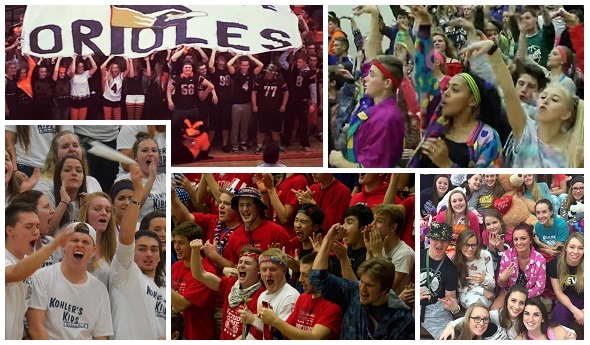
PHOTOS: MHSAA Battle of the Fans finalists cheer on their teams, clockwise from top left: Buchanan, Dowagiac, Yale, St. Johns and Beaverton.