

Yale Kohler's Krazies Rise to Roar
January 27, 2015
By Geoff Kimmerly
Second Half editor
YALE – The magnitude of last season’s Boys Basketball District Final gave Yale’s “Kohler's Krazies” a glimpse of their potential as a booming student cheering section.
But a 90-minute delay during that eventual overtime loss to Imlay City showed junior Karli Klocke how a collection of her classmates watching a basketball game could impact their entire school.
 The game was forced into an unexpected break after humidity in the gym made the floor too slippery. The teams went to their locker rooms during clean-up, and many of the 1,000 fans in the sold-out stands took their seats.
And despite the wait, all of more than 100 Krazies stayed through the final buzzer.
“I just like how it brought everybody, all grades, together,” Klocke said. “And during that hour and a half, we were all sitting there together. We’ve never been a group that’s usually been all together.”
Ten months later, the Krazies have ridden the momentum of that March evening – and grown into a top-five contender for this season’s Battle of the Fans IV championship.
Yale hosted the latest MHSAA finalists visit Friday for its boys basketball game against Almont. Reigning champion Beaverton was the first tour stop, Jan. 16, with Buchanan scheduled for this Friday and then St. Johns and Dowagiac over the next three weeks leading up to the naming of this year’s champion Feb. 20. The public may vote for its favorite on the MHSAA’s Facebook, Twitter and Instagram sites beginning Feb. 17, with the MHSAA Student Advisory Council taking results into consideration when selecting the champion after the vote has concluded.
The Krazies were first-time BOTF applicants this winter, following the transformation of a section that existed on a much smaller and informal scale over the last half-decade.
The former Kohler’s Kids, then Kohler’s Krew and Krew 2.0 before becoming the Krazies for 2013-14 – all in recognition of boys hoops coach Garnett Kohler – previously was a group of 20-40 upperclassmen who gathered to cheer on the team.
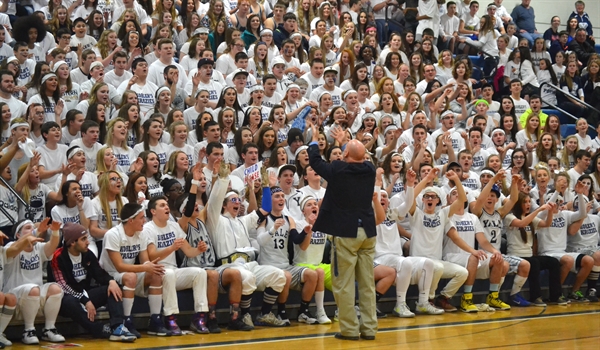
With last season’s District turnout helping fuel the effort, new section leaders this fall began organizing a section that would be more inclusive – encouraging the entire student body to take part – and have enjoyed immediate results. The Krazies swelled to an estimated 450 and filled a quarter of Yale’s gym to the rafters for Friday's girls and boys hoops doubleheader.
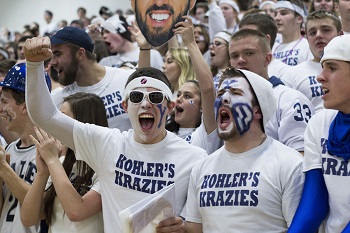 There hasn’t been anything complicated about Yale’s campaign; it’s as simple as trying to get more students to watch games together. And the Krazies have a rather straightforward goal for each game night; they don't stop cheering, aside from halftime, from the opening tip until the final buzzer – even when Yale's lead tops 20 points.
“This is such a new thing, everybody’s so excited about it and they just want to be a part of it,” junior Kaylee Schiffelbine said.
The Krazies took steps toward formalizing last season, when a group of four seniors sold T-shirts and created some of the favorite cheers. But their vision for the section was “small,” senior Spencer French said, and he and a few others began talking over the summer about how to expand it.
For starters, the section would no longer be about juniors and seniors only. Over two weeks this fall, the Krazies sold 210 section T-shirts – three times more than the year before. They started Facebook and Twitter feeds to get the word out, and parents joined in the social media loop; the Krazies’ BOTF application video enjoyed more than 1,000 views in just a few days after it was posted and now has been watched more than 5,000 times.
“Even with the video, (we thought) it would be cool to get top five (of BOTF),” senior Robert Vinckier said, “but getting the video shared around, it gets more people in the game, and they see how fun it is.
“We’re such good friends with the players on the team, so we’d go to the game whether we had a student section or not. But we might as well have more fun while we’re watching them play.”
The section’s rallying cry for 2013-14 could’ve been summed up as “wear your shirt and show up.”
“Wear your shirt and show up” should now include the word “early.” Although the girls varsity game Friday didn’t begin until 6 p.m., the first Krazies showed at 4:30 to secure seats closest to midcourt and the floor.
And the Krazies are a basketball cheering section in the literal sense. They cheered, nearly non-stop, through the end of a mostly one-sided 68-46 win by their boys team. Of course, they mixed some creative frills – bowling using the Bulldog mascot to knock down a group of fans, and the first superintendent-led roller coaster in BOTF tour history – but those merely kept the mood amped during breaks in play.
The objective is simple as well – be loud. Loud enough that an opposing player tweets that the section is “crazy.” Loud enough to encourage a rumor the Krazies won’t be allowed to cheer at a rival’s gym later this season. Loud enough to force an opponent’s point guard to motion to his bench because he can’t hear his coach yelling in the plays. Loud enough that Yale’s coach and players also had to come up with hand signals so they could communicate over the blare.
“Loud” would’ve been an understatement Friday. The Krazies’ roar, heard standing on the opposite side of Yale’s gym, registered noticeable decibels above the norm for a high school game.
French admits he didn’t know what they were taking on when he and a group of about 10 began meeting twice a week in late October armed only with ideas and what senior Steven Jordan calls “unwritten rules of sportsmanship.” But they forged strong relationships with principal Paul Flynn and athletic director Maureen Klocke (no relation to Karli), who have provided plenty of input while trusting the leaders to police the group when it’s rarely necessary. Leaders run ideas past administrators first, and that has allowed for what leaders feel is a bit more leniency.
Their classmates, meanwhile, have followed the lead and made good on last year’s potential.
“In high school, there are groups. Some groups aren’t going to be there (at games),” French said. “But it’s those kids who are coming out and saying, ‘Hey, what can we do? Can we do this? Are we wearing this? Can we do a costume night?’ That’s been the coolest thing for me. There’s people that I would never think would go to a basketball game, and they come up to me and say, ‘Hey, what can I do to help?’”
Spencer admits he was a bit anxious before the first boys basketball game this winter – until 115 students showed. The school’s athletic booster club has since donated $100 for gift cards to give out as prizes, and the student council supplied a sling shot Friday to send free shirts into the crowd.
“When we started off this year, a lot of people didn’t think it would be that big of a deal; it would just be another student section,” he said. “But as we’ve progressed throughout the season, people realized this is a big deal.
“We weren’t that tight-knit beforehand. Slowly but surely as the season has progressed, the parents, student organizations and administration all have been brought closer together. And we’re not even halfway through the season yet.”
PHOTOS: (Top) Yale superintendent Ken Nicholl leads the roller coaster during Yale's boys basketball game Friday against Almont. (Middle) Kohler's Krazies cheer numbered 450 for the MHSAA visit. (Top photo by Lisa Depelsmaeker, middle by Katie Priehs.)
Scholars and Athletes 2015: Class A
By
Geoff Kimmerly
MHSAA.com senior editor
February 13, 2015
By Geoff Kimmerly
Second Half Editor
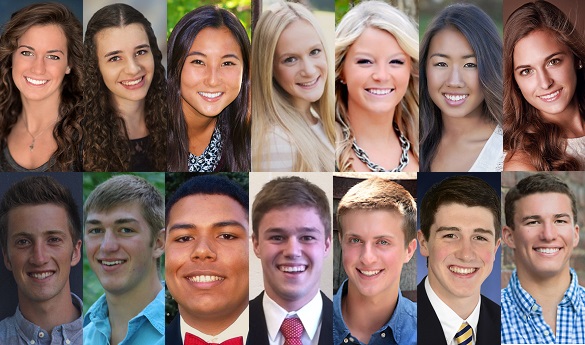
The Michigan High School Athletic Association has selected 14 student-athletes from Class A member schools to receive scholarships through its Scholar-Athlete Award program.
 Farm Bureau Insurance, in its 26th year of sponsoring the award, will give $1,000 college scholarships to 32 individuals who represent their member schools in at least one sport in which the Association sponsors a postseason tournament. The first 30 scholarships are awarded proportionately by school classification and the number of student-athletes involved in those classes; also, there are two at-large honorees which can come from any classification.
Each of the scholarship recipients will be honored during a ceremony at halftime of the Class C Boys Basketball Final game March 28 at the Breslin Student Events Center in East Lansing. Commemorative medallions will be given to the finalists in recognition of their accomplishments.
The Class A Scholar-Athlete Award honorees are: Sara Condra, Hartland; Emily Diehl, Saline; Ashley Ko, Traverse City Central; Diane Reed, Bloomfield Hills; Alex Sorgi, Utica Ford; Caycee Turczyn, Lapeer; Allison Utting, Grandville; Kyler Beal, Holland; Andrew Bennett, Linden; Matthew Carter, Ypsilanti Lincoln; Collin DeShaw, Holland West Ottawa; Andrew James Fox, Grand Rapids Forest Hills Central; Michael Kenney, Detroit U-D Jesuit; and Matthew J. Orringer, Ann Arbor Skyline.
Overviews of the scholarship recipients of the Class A Scholar-Athlete Award follow. A quote from each recipient's essay also is included:
Sara Condra, Hartland
Participated three seasons on her varsity swimming and diving team and will play her third season of varsity soccer this spring. Served as captain of both teams; earned all-state recognition all three of her swimming and diving seasons and all-league honors in soccer. Also earned all-league academic awards in both sports. Serving fourth year in student government, with tenures as president and secretary and also is in her fourth year on her school’s Student Advisory Board. Participating in second year of National Honor Society and was on a state finalist for her school’s DECA business club. Serves as director of a youth water ski team, trainer for a recreational youth soccer team and teaches Sunday school. Also participated on the Livingston County Diversity Council as a junior. Will attend Michigan State University and study sports marketing and dietetics.
Essay Quote: “Sportsmanship is easy to preach, yet it’s a little more difficult to carry out. It is easy to get caught up in personal demands and forget what the competition is really about. Sportsmanship constitutes teamwork, self-discipline and appreciation of others. Sportsmanship does not only show one’s character, it also shows pride: pride in oneself and pride in one’s competition.”
Emily Diehl, Saline
Ran three seasons of varsity cross country and will participate in her third of varsity track and field this spring. Served as cross country team’s captain in the fall and earned league scholar-athlete awards all four years of high school. Serves as vice president of student council and previously served as committee chair during her four-year tenure. Also serves as president of her school’s Key Club after three years as vice president. Participating in National Honor Society for the second year and has volunteered more than 1,100 hours for a variety of services. Earned AP Scholar with Distinction recognition for her scores on College Board Advanced Placement exams. Will attend either Brown University or Northwestern University to study psychology and neuroscience in pursuit of a career in the medical field.
Essay Quote: “As students reflect on their careers as high school athletes, they will not remember the girl they passed in a race, but rather the girl that encouraged them as they fought for a new personal record. … It is all too easy to become absorbed in the times or the medals or the trophies, but that’s not what high school athletics are about.”
Ashley Ko, Traverse City Central
Ran four seasons of varsity cross country and will run her fourth of varsity track and field this spring. Served as her team’s co-captain in the fall and posted all-state finishes the last two seasons of eighth and 12th at the Lower Peninsula Division 1 Finals. Earned academic all-state honors in cross country her final three seasons. Qualified for the MHSAA LP Division 1 Track and Field Finals the last two seasons in the 3,200-meter run. Participating in National Honor Society for the second year and has served as her class’ president the last two school years. Received AP Scholar with Honor award and the Johns Hopkins University Center for Talented Youth Award for high honors in mathematics. Volunteered for various organizations including three years with Special Olympics. Taught English to children during mission trip to Guatemala as a sophomore. Will attend Northwestern University to study psychology and pre-medicine; she also intends to sign a letter of intent to run cross country.
Essay Quote: “(Sportsmanship) is not about finishing first or setting new records. Genuine sportsmanship is about lifting one another up during difficult times and knowing that, no matter what, your teammates will be there to support and encourage you.”
Diane Reed, Bloomfield Hills
Participated four seasons on the varsity swimming and diving teams at her schools (Bloomfield Hills was formed from the former Lahser and Andover for 2013-14; Reed attended Lahser previously), and plans to play her fourth season of varsity lacrosse. Earned all-state recognition with a 10th-place finish in the 100-yard butterfly as a sophomore. Served as swimming and diving team captain in the fall and earned academic all-state honors for the second time. Will serve as captain of the lacrosse team after making first-team all-state as a junior. Earned AP Scholar with Honors recognition and is participating in National Honor Society for the second year. Served as editor of her school’s newspaper as a junior; earned multiple awards from the Michigan Interscholastic Press Association during three years on staff. Volunteered as a swimming coach for Special Olympics and founded a social club for special needs students. Remains undecided where she will attend college, but will study biomedical engineering.
Essay Quote: “If you break it down, sportsmanship is being gracious whether you win or lose. The ethos of fair play and compassion for other participants is the starting point, and ideally the reason, why we all play sports.”
Alex Sorgi, Utica Ford
Played four years of varsity basketball and will play her fourth of varsity softball this spring; also played volleyball as a freshman. Served as captain of both varsities two seasons, earning all-state honors twice in softball and once in basketball. Scored her 1,000th career basketball point this season and has two school records in that sport to go with four records in softball; also helped softball team to a school-record 30 wins last season and first MHSAA Semifinal appearance. Serving on student council for fourth year and participating in National Honor Society for the second. Also participating in Students Against Destructive Decisions, her school’s DECA and Pink Girls clubs and as a mentor to middle and elementary school students encouraging school sports participation. Will attend Bowling Green State University and study health sciences in pursuit of a career in the medical field.
Essay Quote: “High school sports have easily been the most influential aspect of my high school years. I have learned life lessons like work ethic, commitment, time management and the value of hard work. More important, I have learned the value of respect and friendship through the sportsmanship displayed in sports.”
Caycee Turczyn, Lapeer
Played four seasons of varsity golf and is playing her third of varsity basketball. Served as captain of the golf team in the fall and tied for 10th at the 2013 MHSAA Lower Peninsula Division 2 Final. Also serving as captain of the basketball team this winter and earned all-league honorable mention as a junior for Lapeer West before West and East merged into one school for 2014-15. Co-founded and serves as president of her school’s Business Professionals of America chapter and is in her second year of National Honor Society and as a member of the MHSAA’s Student Advisory Council. Serving on student council for third year and founded pep club at Lapeer West; played part in combining with East’s pep club when the schools merged. Also volunteers at youth sports camps and clinics. Will attend the University of Michigan and study business.
Essay Quote: “The lessons of respect, integrity and good character can be found in educational athletics. Players, coaches, officials and spectators are entrusted to promote these qualities. So respect your opponent. Play by the rules. Cheer for your team. You will find (sportsmanship) extends to your family, community and workplace.”
Allison Utting, Grandville
Ran four seasons of varsity cross country and will participate in her second of track and field this spring. Served as captain of the cross country team the last two seasons and ran on three straight MHSAA Finals qualifiers, earning all-area and academic all-state honors. Serving fourth year on student council and second as president and also is participating in her second year of National Honor Society. Earned AP Scholar of Distinction and National Merit Scholarship Commended Student designations while ranking third in her senior class of 455 students. Participating in fourth year of Women’s Varsity Leadership Club mentoring young athletes, and coached two years as part of the Grandville Trail Dawgs running club for elementary students. Serves on her school’s Leadership and Student Life committees. Will attend Hope College to study secondary education with a focus on history and political science.
Essay Quote: “We race like the fiercest enemies, but cross country rivalries stay amidst the hills and trails of the course where they belong. We are girls from different schools and divisions, but remain united by a common love for our sport. Good sportsmanship allows these bonds to last a lifetime, much longer than any race or any season.”
Kyler Beal, Holland
Played three full seasons of varsity soccer and is in his first of varsity basketball after joining the soccer team midway through freshman season and basketball at the end of his sophomore season. Earned all-state and academic all-state honors for soccer in the fall while serving as team captain. Contributed to a number of volunteer projects over all four years of high school, including for Young Life, as a soccer camp counselor, and for a low income housing summer program. Named Volunteer of the Year by Holland-based Community Action House and received the Wooden Shoe Award for leadership at his school. After spending this fall in Guatemala as part of Pray America, Beal will attend Liberty University and study communications.
Essay Quote: “Many times during a game, players have the chance to let their emotions get the best of them. A competitive attitude is crucial in sports, and winning is important, but there comes a point when winning cannot be the end all. Sports are just games in the grand scheme of life, and because of that, athletes must have respect for other athletes, coaches, referees and for themselves.”
Andrew Bennett, Linden
Ran two years of varsity cross country and is in his second of varsity skiing, and will run his third of track and field this spring; also played soccer as a freshman. Serving as captain of ski team after serving as captain in the fall of the cross country team that finished seventh at the LP Division 2 Final and earned an academic all-state award. Qualified as part of 3,200 relay for the LP Division 2 Track and Field Final. Participated all four years as part of the Southern Lakes Youth Advisory Committee including as chair, and also has participated throughout high school in Boy Scouts, earning the rank of Eagle Scout. Participating in National Honor Society for the second year. Volunteered for Salvation Army and as part of local, national and international mission trips. Will attend Northern Michigan University to study nursing.
Essay Quote: “The general acceptance and supportiveness of every athlete struck me. This is the true meaning of sportsmanship. It isn’t following some instinctual etiquette taught from childhood; it is the acknowledgement by every individual that they are here like everyone else to make memories and build friendships.”
Matthew Carter, Ypsilanti Lincoln
Played two years of varsity football and wrestled for two seasons, and will play his third season of varsity lacrosse this spring. Earned all-league honorable mention and a league scholar-athlete award for football and helped his team to two league titles. Playing fourth year in concert/marching band and played two in the Ypsilanti Youth Orchestra. Earned solo and ensemble superior rankings all four years from the Michigan School Band and Orchestra Association. Participating in National Honor Society for second year and has participated in Boy Scouts throughout high school and is an Eagle Scout nominee. Named semifinalist for National Achievement Scholarship and a Young Man of Promise by Alpha Kappa Alpha Sorority. Participated in American Legion Boys State government education program. Remains undecided on where he will attend college, but intends to study biochemistry with a focus on pre-medicine.
Essay Quote: “Sportsmanship to me is about realizing that both your teammates and opponents aren’t just athletes, but a part of a family. Every high school athlete who has ever lived shares a bond. We all went through tough practices and even tougher games, amazing wins and bitter losses, but what mattered in the end is what we learned from it.”
Collin DeShaw, Holland West Ottawa
Placed fourth at the MHSAA Lower Peninsula Division 1 Final in diving as a junior and 10th as a sophomore, and dove all four years of high school; also played two seasons of varsity football and varsity baseball as a junior. Served as captain of the football team in the fall. Participating in second year of National Honor Society and serving second as student representative to the Holland West Ottawa Board of Education; also participated in the Holland Area Mayor’s Round Table as a junior. Serving fourth year on student senate and as executive president after previously serving multiple terms as his class’ president. Participating in both Young Life and his church’s youth ministry for fourth years. Will attend the University of Michigan to study finance and economics and has signed a letter of intent to accept a diving scholarship.
Essay Quote: “Sportsmanship is easy to practice when a team is winning and everything is going well. But the true test of sportsmanship is when a team is losing and everything seems to be going against them.”
Andrew James Fox, Grand Rapids Forest Hills Central
Played three seasons of varsity tennis and will play his second of varsity baseball in the spring. Played on tennis teams that won three Regional titles and the MHSAA LP Division 2 Final in the fall; he and his partner won the No. 2 doubles championship. Earned academic all-state recognition for baseball as a junior. Participated in Boy Scouts throughout high school and earned Eagle Scout award in 2013; selected for two summers to serve on Mackinac Island Governor’s Honor Guard. Playing fourth year in marching band and drumline and participating in second year of National Honor Society. Volunteered more than 300 hours of service during high school and serves as a board member for his church youth group. Will attend either Purdue University or the University of Michigan and study engineering.
Essay Quote: “Every sport has rules that each athlete must follow, but sportsmanship is a choice – a conscious decision an athlete makes to play the game with integrity, honor and respect. How athletes play the game, how they practice and how they treat their teammates and coaches defines their character.”
Michael Kenney, Detroit U-D Jesuit
Ran three seasons of varsity cross country and will run his fourth of track and field this spring; also played basketball two seasons and soccer as a freshman. Served as a captain of cross country and track and field varsities while earning all-District honors in the fall and all-Regional in the spring. Serving fourth year on student government and was co-chairperson and master of ceremonies for the Building Bridges to a Culture of Life conference in Royal Oak that drew more than 250 students and speakers. Volunteers for a number of projects and services including Gleaners Community Food Bank, Angela Hospice Home Care and the Special Olympics, and has served as a camp counselor at Madonna University’s basketball camp for three years. Remains undecided where he will attend college, but will study English and theology.
Essay Quote: “Sportsmanship allows athletes to win with grace, lose with dignity and celebrate the game with both fans and other athletes. Because no one can compete well without hours of preparing, sportsmanship is very important as it recognizes the inevitable discipline, time, endurance and pain necessary to participate in educational athletics.”
Matthew J. Orringer, Ann Arbor Skyline
Competed on the varsity swimming and diving team all four years of high school and held 10 of 11 varsity records heading into his final season. Earned multiple individual all-state honors in each of his first three seasons and is team captain this winter. Named to Ann Arbor Area Community Foundation Youth Council as a sophomore and joined the foundation’s Board of Trustees this school year. Playing fourth year in concert and symphony band. Participating in second year of National Honor Society. Volunteers as a swim instructor to children fighting cancer and their siblings through Gold Group and as a Spanish language translator for the University of Michigan Migrant Outreach Clinic/Head Start program. Will attend Brown University and study either biology or neuroscience, and has committed to join the swimming and diving team.
Essay Quote: “It is very clear to me that there are many aspects of the sport that are far more important than wins and losses. Among them are the tight bonds of friendship and mutual respect that are fostered by a handshake across a lane marker after a race and that extend well beyond the pool or our time as athletes.”
Other Class A girls finalists for the Scholar-Athlete Award were: Kara N. Gehrke, Alpena; Rachel Menge, Ann Arbor Pioneer; Eliza Laramee, Berkley; Rachel DaDamio, Birmingham Seaholm; Sheridan Skopczynski, Gibraltar Carlson; Isabella Buck, Grandville; Allegra Lanae Berry, Greenville; Carson Vestergaard, Hartland; Kirsten Smith, Lansing Eastern; Meg Darmofal, Mason; Cydney Martell, Richland Gull Lake; Hayley Rogers, Salem; Courtney Rooker, St. Joseph; Ellie Lauren Taylor, Traverse City Central; Mikenna Ray, Traverse City West; Danielle Maxwell, Utica Ford; and Jessica Erickson, White Lake Lakeland.
Other Class A boys finalists for the Scholar-Athlete Award were: Stone Mathers, Ann Arbor Pioneer; Jacob W. Herbers, Battle Creek Lakeview; Eric Braun, Berkley; Justin Boogaart, Byron Center; David A. Posawatz, Clarkston; Sean Lang, East Grand Rapids; Mikey Roth, East Grand Rapids; Joseph Pummill, Garden City; Miles Kuperus, Grand Rapids Christian; Raymond Surya, Holland; Ryan Susterich, Muskegon Mona Shores; Shunhe Wang, Northville; Mark Luoma, Okemos; Ravin Randall, Port Huron; Benjamin Hill, Royal Oak; Alex Scott, Traverse City West; and Blake McComas, White Lake Lakeland.
Students applying for the Scholar-Athlete Award must be carrying at least a 3.5 (on a 4.0 scale) grade-point average and have previously won a letter in a varsity sport in which the Michigan High School Athletic Association sponsors a postseason tournament. Other requirements for the applicants were to show active participation in other school and community activities and produce an essay on the importance of sportsmanship in educational athletics.
The Class C and D scholarship award recipients were announced Feb. 3, and the Class B honorees were announced Feb. 10.
Farm Bureau Insurance, one of Michigan's major insurers, has a statewide force of 450 agents serving nearly 500,000 Michigan policyholders. Besides providing life, home, auto, farm, business and retirement insurance, the company also sponsors life-saving, real-time Doppler weather tracking systems in several Michigan communities.
The MHSAA is a private, not-for-profit corporation of voluntary membership by more than 1,400 public and private senior high schools and junior high/middle schools which exists to develop common rules for athletic eligibility and competition. No government funds or tax dollars support the MHSAA, which was the first such association nationally to not accept membership dues or tournament entry fees from schools. Member schools which enforce these rules are permitted to participate in MHSAA tournaments, which attract more than 1.4 million spectators each year.