

Battle of the Fans: Blue Crew Legacy
February 18, 2012
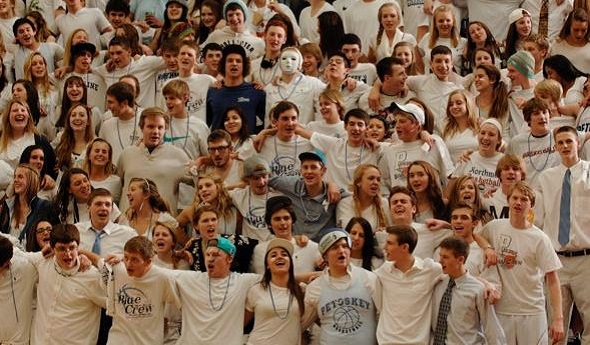
PETOSKEY -- Directly across the gym from the Petoskey student cheering section Friday, a toddler played on the first row of bleachers.
He wasn’t paying much attention to the Northmen’s boys basketball game against West Branch Ogemaw Heights. But he was wearing a blue T-shirt that read “Future Blue Crew” -- guaranteeing he will be soon enough.
At Petoskey High, a Class A school in a town where families have lived for generations, kids grow up aspiring not just to be the athletes playing for championships -- but also the Blue Crew members cheering them on.
While the other cheering section finalists in this season’s MHSAA “Battle of the Fans” contest were officially organized, for the most part, over the last year or two, Petoskey’s Blue Crew is nearing a decade as a constant at its school’s athletic events -- and a source of community pride.
“It’s such a legacy. Eighth grade, you’re looking forward to to being even involved in the Blue Crew, ... and now that we’re all seniors, everyone is listening to us, and we just want our teams to do well,” Petoskey senior Hayley Fettig said. “That’s a big part of it. We’re here to support our teams and cheer for our teams, and be a team ourselves.”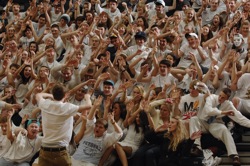
Petoskey was the fifth and final stop on the Battle of the Fans tour to find Michigan’s top student cheering section. Over the last five weeks, MHSAA staff and members of its Student Advisory Council also visited Frankenmuth, Reese, Grand Rapids Christian and Rockford. MHSAA-produced videos of all five finalists have been posted on the MHSAAsports YouTube page. Online voting will take place Monday-Thursday on the MHSAA Facebook page (you must “like” our page to vote). The winner will be announced Friday.
For most of its basketball history, Petoskey played in its old Central Gymnasium, an arena straight from the movie “Hoosiers” which seats about 1,500 fans and turned into a giant tunnel of cheers and shouts for every home game. But late in the fall of 2002, the newly-built high school opened a much larger gym that not only holds more fans, but also is more cavernous.
A bigger room meant a need for bigger spirit. And that sparked the Blue Crew, the brain child of members of the student council, some of whose names are still thrown around the halls to this day -- although the current seniors were in elementary school when it all began.
About 140 students piled into a “whited out” Blue Crew on Friday, plus 60 more in the jazz band that plays every home game and easily could be confused for one at the college level. To the left of the Crew sat about 50 more students not yet in high school. All sub-high school students are known as “Future Blue Crew,” while teachers are “Old-School Blue Crew.”
The Blue Crew often stands larger than it did Friday -- but on this night, the junior varsity and freshman basketball teams were playing simultaneously at other sites, and the hockey team was on the road. Petoskey’s Big North Conference foes are spread throughout the northern third of the Lower Peninsula, but the Blue Crew is known for making hours-long trips and constant support.
Members of the student council still play a big part. Those 12 students, plus 10 more take a one-hour leadership class taught by former girls varsity coach Matt Tamm. His classroom is a hall of memories itself, with photos of teams going back decades. Taking up center spot on a main wall is the original Blue Crew banner including its mission and three directives for generations to come.
“When I was younger, the older kids always told us, ‘You have to watch how we do this so when you’re older, you can do it how we did it,’ senior Brad Berkau said.
“You begin to learn when you’re younger what we do and how to go about cheering the right away. Not just boasting about our team, but not putting down the other ones too,” senior Nick Godfrey added.
That “right way” includes refusing to cheer negatively. Petoskey athletic director Gary Hice said it’s been four or five years since he’s had to tell the Crew that one of its cheers was crossing the line. Counselor Karen Starkey, who helps by coordinating parents to cheer with the students, said she hasn’t seen the Blue Crew respond to an opposing cheering section’s negative chant in at least two years.
Instead, the Crew pours its energy into more memorable ventures.
Starkey was diagnosed with breast cancer in January 2011, and her first chemotherapy treatment was on a game night.
She showed up in white, anticipating a white out. Instead, she found the entire Blue Crew in pink -- before receiving a group hug from the 200 or so students there supporting her as well.
“Those are the things these guys just jump out and do,” Starkey said. “It’s so not necessary, but it was just so cool.”
PHOTOS courtesy of Larry Tracy and CMA Action Photography.
#BOTF Finalists: Prepare for Battle
January 13, 2014
By Geoff Kimmerly
Second Half editor
Buchanan is back to defend its title. But rival Bridgman would love to be the next to hoist the championship banner. And Beaverton, Frankfort and Traverse City West plan to show the best cheering in Michigan isn't reserved for the state's southwest corner.
Those five finalists have been selected for the Michigan High School Athletic Association’s “Battle of the Fans III,” which will again recognize the top student cheering section from among member schools with the winner crowned in March during Boys Basketball Finals weekend at Michigan State University's Breslin Center.
Buchanan won last season’s Battle of the Fans II. Frankenmuth won the inaugural BOTF in 2012.
 The contest, organized by MHSAA staff and its 16-member Student Advisory Council, will reward the cheering section that best creates the positive and festive atmosphere made possible when students show enthusiasm, togetherness and sportsmanship while rooting for their team.
MHSAA staff and Student Advisory Council members will visit all five finalists for home games during the second half of this regular season, with coverage and video from those visits and the announcement of the winner all to be published on Second Half.
Schools were invited in December to submit short videos, via YouTube, of their cheering sections in action. The winner will be announced Feb. 21, and video of all five sections will be played on the Breslin Center HD scoreboard during the Finals in March. The champion also will be recognized during the Boys Semifinals on March 21.
“The Battle of the Fans continues to influence positive cheering at schools throughout the state, and we were excited to see videos come in both from first-time applicants and schools that were not selected in 2013 but came back with strong efforts again this winter,” said Andy Frushour, MHSAA director of brand management and advisor to the Student Advisory Council. “These student sections create a buzz that takes hold of the entire community. The finalists tour is something MHSAA staff look forward to every January, and we’re excited to see what schools have come up with for 2014.”
Video submissions included explanations on how each section met the following contest criteria: positive sportsmanship, student body participation, school spirit, originality of cheers, organization of the group, student section leadership and overall fun.
Click the links below to see the videos submitted by the finalists:
Beaverton - Bridgman - Buchanan - Frankfort - Traverse City West
The finalists were chosen by the Student Advisory Council, and the winner will be selected by another Advisory Council vote based in part on activity on the MHSAA’s social media sites. All social media postings regarding Battle of the Fans III should include the hashtag #BOTF. The MHSAA will post throughout the finalists tour on its Facebook, Twitter and Instagram sites.
Finalists will be visited for the following home basketball games:
- Jan. 17: Buchanan vs. Niles Brandywine
- Jan. 31: Bridgman vs. Niles Brandywine
- Feb. 3: Frankfort vs. McBain
- Feb. 7: Traverse City West vs. Petoskey
- Feb. 14: Beaverton vs. Houghton Lake
Bridgman and Traverse City West both were applicants in 2012 as well. St. Joseph’s student section was the closest to making the finalist cut this year, just missing with a sixth-place finish in the initial Advisory council balloting. Petoskey, a 2012 finalist, finished seventh.
Other 2013 applicants were Ann Arbor Gabriel Richard, Bay City John Glenn, Big Rapids Crossroads Academy, Marlette and Mancelona. Click to view all applications on YouTube.
The contest is sponsored in part by the United Dairy Industry of Michigan, which promotes Michigan's locally-produced dairy products and nutrition education.
Rules plus links to last year’s coverage of the contest can be found on the BOTF page of the MHSAA site.
The Student Advisory Council is made up of eight seniors and eight juniors, who each serve two-year terms. The Council acts as the voice of Michigan's student-athletes; it serves as a student sounding board for the MHSAA's Representative Council, assists in planning Sportsmanship Summits, Captains Clinics and other student leadership events; participates in a yearly focus group about the state of high schools sports for Michigan State University's Institute for the Study of Youth Sports and assists with medal ceremonies at MHSAA championship events.
The MHSAA is a private, not-for-profit corporation of voluntary membership by more than 1,500 public and private senior high schools and junior high/middle schools which exists to develop common rules for athletic eligibility and competition. No government funds or tax dollars support the MHSAA, which was the first such association nationally to not accept membership dues or tournament entry fees from schools. Member schools which enforce these rules are permitted to participate in MHSAA tournaments, which attract more than 1.4 million spectators each year.
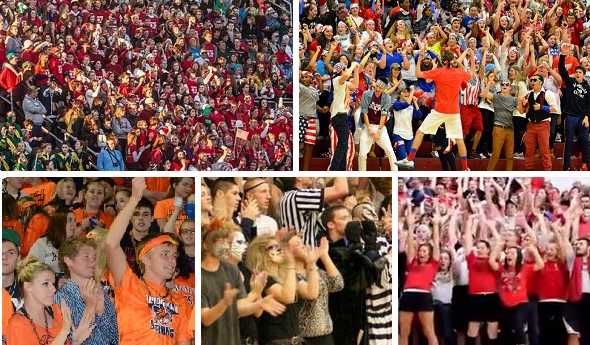
PHOTOS: MHSAA Battle of the Fans finalists cheer on their teams, clockwise from top left: Traverse City West, Buchanan, Beaverton, Frankfort and Bridgman.