

Century of School Sports: Guided by 4 S's of Educational Athletics
By
Geoff Kimmerly
MHSAA.com senior editor
October 8, 2024
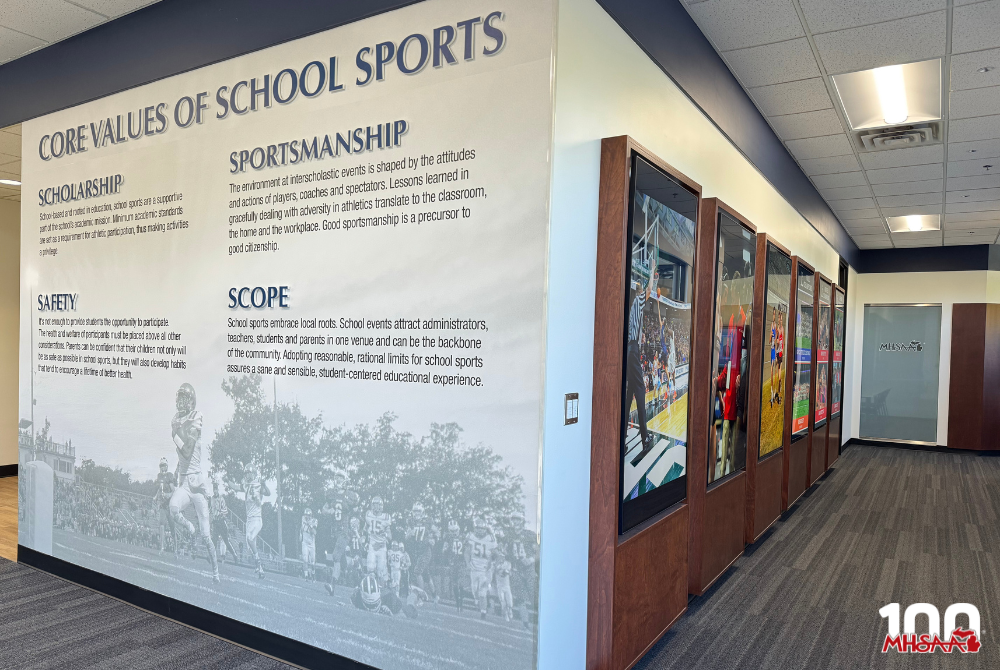
The display above greets visitors at the top of our staircase to the second floor at the MHSAA office in East Lansing – a group of guests that annually numbers well over a 1,000 administrators, student leaders, game officials and several others who are invested in school sports.
We hope these four core values – the MHSAA’s oft-referred to “four S’s” of educational athletics – also lead our guests’ interactions in school sports as they return home to their communities across the state.
They are as follows:
SAFETY
- It's not enough to provide students the opportunity to participate. The health and welfare of participants must be placed above all other considerations. Parents can be confident that their children not only will be as safe as possible in school sports, but they will also develop habits that tend to encourage a lifetime of better health.
SCHOLARSHIP
- School-based and rooted in education, school sports are a supportive part of the school's academic mission. Minimum academic standards are set as a requirement for athletic participation, thus making activities a privilege.
SPORTSMANSHIP
- The environment at interscholastic events is shaped by the attitudes and actions of players, coaches and spectators. Lessons learned in gracefully dealing with adversity in athletics translate to the classroom, the home and the workplace. Good sportsmanship is a precursor to good citizenship.
SCOPE
- School sports embrace local roots. School events attract administrators, teachers, students and parents in one venue and can be the backbone of the community. Adopting reasonable, rational limits for school sports assures a sane and sensible, student-centered educational experience.
These values were coined by John E. “Jack” Roberts, the fourth of now five full-time executive directors who have served the MHSAA during its 100-year history. He introduced them during his first days on the job in 1986 – and as he noted in an installment of his “From the Director” blog in 2015, they’ve stood the test of time.
They drove the Association’s work during his tenure, surely before it, and continue to do so today – and we will delve into all four as we continue our storytelling of a “Century of School Sports” during this 2024-25 school year.
Previous "Century of School Sports" Spotlights
Oct. 1: Michigan Sends 10 to National Hall of Fame - Read
Sept. 25: MHSAA Record Books Filled with 1000s of Achievements - Read
Sept. 18: Why Does the MHSAA Have These Rules? - Read
Sept. 10: Special Medals, Patches to Commemorate Special Year - Read
Sept. 4: Fall to Finish with 50th Football Championships - Read
Aug. 28: Let the Celebration Begin - Read
PHOTO A display on the second floor of the MHSAA office outlines the four core values of educational athletics: safety, scholarship, sportsmanship and scope.
This Week In High School Sports: 12/1/21
By
Jon Ross
MHSAA Director of Broadcast Properties
December 1, 2021
This edition wraps up the final weekend of the 2021 Fall season as eight teams claimed championships in 11-player football.
The 5-minute program each week includes feature stories from around the state from the MHSAA’s Second Half or network affiliates, along with "Be The Referee," a 60-second look at the fine art of officiating.
"This Week in High School Sports" is powered by MI Student Aid, a part of the Office of Postsecondary Financial Planning located within the Michigan Department of Treasury.
Listen to this week's show by Clicking Here.
Previous editions
Nov. 23: Volleyball, LP Girls Swimming & Diving, 8-Player Football Finals review – Listen
Nov. 16: Lower Peninsula Cross Country continued, weekend preview – Listen
Nov. 9: Lower Peninsula Cross Country, Boys Soccer Finals review – Listen
Nov. 2: Title IX at 50 celebration, Fall championship broadcasts – Listen
Oct. 27: Upper Peninsula Cross Country Finals review, soccer/volleyball playoff update – Listen
Oct. 20: Lower Peninsula Girls Golf & Boys Tennis Finals review – Listen
Oct. 13: Middle school/junior high cross country Regionals, football playoff selection – Listen
Oct. 6: Upper Peninsula girls tennis champions, football broadcast update – Listen
Sept. 29: Girls swimming & diving "Meet of Champions," Schoolcraft's star kicker – Listen
Sept. 22: Spartan Invitational "elite" races, John U. Bacon's "Let Them Lead" – Listen
Sept. 15: Volleyball powers face off, Tiger Teusink's tennis legacy – Listen
Sept. 8: Fall sports rules changes, Adrian Lenawee Christian inspiration – Listen
Sept. 1: Boys soccer seeding process, Beaver Island athletics – Listen
Aug. 25: Return of Fall sports, “enhanced strength-of-schedule” football playoff format – Listen