

Century of School Sports: MHSAA Blazes Trail Into Cyberspace
By
Geoff Kimmerly
MHSAA.com senior editor
January 9, 2025
When the MHSAA took its first footsteps into cyberspace in 1996 – and then officially launched MHSAA.com on Aug. 15, 1997 – the jump into the internet revolution was to help characterize the MHSAA’s focus on the future, according to a Muskegon Chronicle report quoting then-executive director Jack Roberts.
Predicting how that future would quickly and continuously unfold may have been anyone’s guess. But over the next nearly three decades, MHSAA.com has grown, evolved, added a companion website and then united them into a single valuable landing spot not just for those who work to make our games happen, but the millions who cheer for them as well.
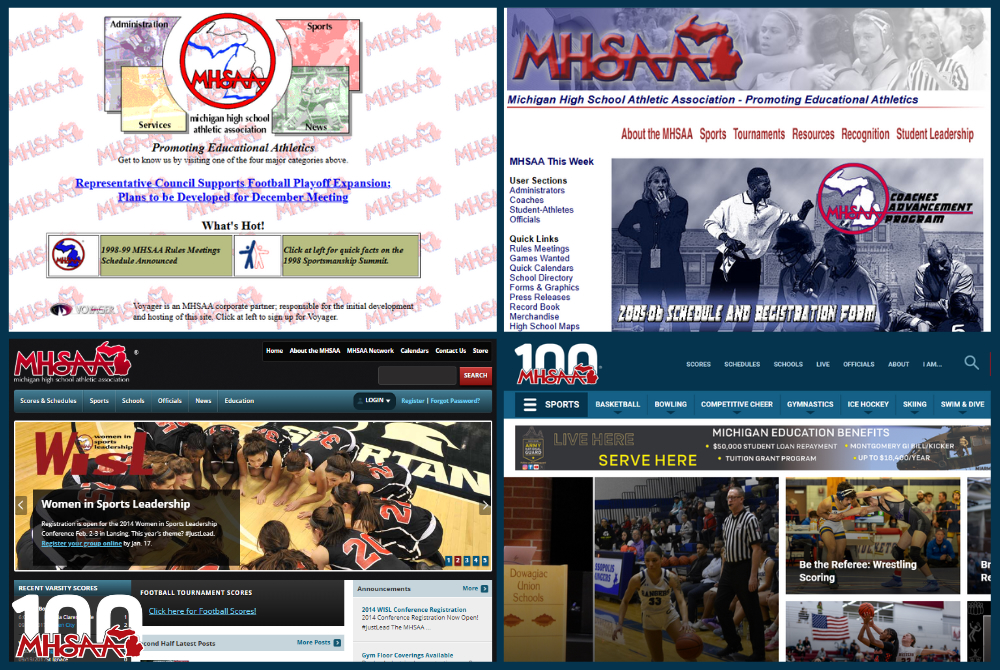
The first rendition of an MHSAA website reached the World Wide Web during Fall 1996 with an American Online (aol.com) URL and included rankings for the MHSAA Football Playoffs. The official version 1.0 of MHSAA.com launched just about a year later, anchored by what would be the website’s priorities for the next 15 years – an area titled “Administration” containing tools primarily for school administrators, a “Services” section highlighting sportsmanship, scholarship and safety; and “The Games” that included sport-by-sport details on rules changes, tournament assignments and historical information.
The MHSAA reported more than 12,000 visitors to its online home during October 1997 – about 400 daily, with the weekly football rankings the largest draw. A little more than a year later, in November 1998, the MHSAA enjoyed its biggest month to date with more than 2,500 visitors daily to climb past 850,000 since the launch of the website. More than 58,000 of those views came during the release of that season’s Football Playoff pairings, and another major draw was the “Games Wanted” page listing teams looking for opponents, which was athletic directors’ biggest ask when surveyed two years earlier on what they wanted most from an MHSAA website.
MHSAA.com already was pushing far ahead of the curve, especially when it came to state school sports associations. But that start was only slightly a sign of things to come. The website has taken on a life that far surpasses any “much has changed, much has stayed the same” scenario.
Truth be told, the goals for the website have not changed in several years – MHSAA.com has provided a place for member school administrators and coaches, and game officials, to do their daily MHSAA-related business. But that mission has been joined by a growing emphasis on telling the story of school sports to the growing number of fans paying us a visit.
 What’s changed is how the MHSAA has delivered on those missions.
The website’s design evolved during the final years of the 1990s and first decade of the 2000s, following the fast-moving progression across the internet. Navigation – getting users where they want to go easily – became the buzzword, and adding more and more information to the site meant adding better avenues to find and organize it.
The MHSAA redesign carried out during the 2009-10 school year – the first built by now-longtime partner Gravity Works Design & Development in Lansing – propelled the website in a big way toward what you see today. Navigation menus now remained a static part of every page as users navigated within the site. A large action photo was placed at the top of the front page to bring it to life, as were feeds from the MHSAA’s well-followed social media accounts and a video player highlighting the growing broadcast and video presence.
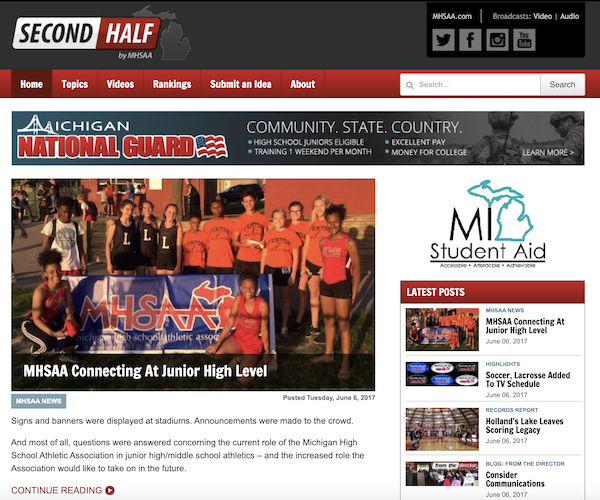
And then came the largest leap. In late 2011, the MHSAA became one of two state associations nationwide at the time (along with Arizona) to begin creating its own fan-focused editorial content. In January 2012, the MHSAA launched its Second Half website as a home for feature stories, blogs, videos and coverage of MHSAA Finals, produced mostly by longtime media members operating as correspondents from their various regions of the state.
For the 2008-09 school year, MHSAA.com had attracted 19.2 million page views. For 2013-14, the count (including both the main and Second Half sites) totaled 22.5 million. That jumped to 27.2 million for 2018-19. And the most defining design change was still ahead.
While the Second Half’s article content had begun to draw nearly 1 million page views annually – a success considering the state has about 170,000 high school athletes – that content remained separated from an already-robust amount of schedules, scores, results and records data the MHSAA had published on its main site over 25 years, plus all the other postseason promotion and information fans had begun to seek.
So in 2022, the MHSAA made one more big jump to land at the website you’re visiting today.
Paying special attention to not disrupt the work of school people using the site for administrative purposes, the MHSAA closed down Second Half and brought all that content to the front of MHSAA.com – for the first time making the front page of the main website fan-focused. That emphasis on spectator experience continued with new, easier-to-understand navigation, and redesigns of sports pages to better promote MHSAA Tournament events and Michigan Power Ratings (MPR), ticket ordering and record book information fans seek. All of the tools school sports people relied on in the past remain, just flip-flopped with the stories and stats that tell our story to a growing audience.
This new version also is geared differently to better serve an audience that has moved significantly toward viewing on phones. Roughly 70 percent of MHSAA.com page views are coming on mobile devices, and this latest design was built to be responsive and best-serve that visitor preference.
The response to the most recent redesign indeed tells the rest of the story – 38.2 million page views during 2023-24, a 40-percent jump from five years earlier. The largest-drawing single day of the school year was March 1, 2024, with nearly 444,000 views as that year’s Winter tournaments began their final month. Team schedule pages in 2023-24 drew 13 million views, with 2.1 million views of tournament brackets and 1.7 million of the statewide scores page. The site’s editorial content – all of those features, game stories and more – were up to 1.65 million views.
MHSAA.com remains what it’s always been, but now it’s so much more – and no doubt, the best is yet to come.
Previous "Century of School Sports" Spotlights
Dec. 31: State's Storytellers Share Winter Memories - Read
Dec. 17: MHSAA Over Time - Read
Dec. 10: On This Day, December 13, We Will Celebrate - Read
Dec. 3: MHSAA Work Guided by Representative Council - Read
Nov. 26: Finals Provide Future Pros Early Ford Field Glory - Read
Nov. 19: Connection at Heart of Coaches Advancement Program - Read
Nov. 12: Good Sports are Winners Then, Now & Always - Read
Nov. 5: MHSAA's Home Sweet Home - Read
Oct. 29: MHSAA Summits Draw Thousands to Promote Sportsmanship - Read
Oct. 23: Cross Country Finals Among MHSAA's Longest Running - Read
Oct. 15: State's Storytellers Share Fall Memories - Read
Oct. 8: Guided by 4 S's of Educational Athletics - Read
Oct. 1: Michigan Sends 10 to National Hall of Fame - Read
Sept. 25: MHSAA Record Books Filled with 1000s of Achievements - Read
Sept. 18: Why Does the MHSAA Have These Rules? - Read
Sept. 10: Special Medals, Patches to Commemorate Special Year - Read
Sept. 4: Fall to Finish with 50th Football Championships - Read
Aug. 28: Let the Celebration Begin - Read
PHOTOS (Top) Clockwise from top left are images of the front page of MHSAA.com from the years 1998, 2005, this week and 2014. (Middle) This is the front page of the MHSAA's Second Half site from June, 16, 2017.
This Week in High School Sports: 9/24/26
By
Jon Ross
MHSAA Director of Broadcast Properties
September 24, 2026
This week's edition highlights Pontiac Notre Dame Prep girls volleyball coach Betty Wroubel's standing as the second-winningest active coach nationally in her sport and awards Game Balls to high achievers in volleyball, cross country and football.
 The 5-minute program each week includes feature stories from MHSAA.com or network affiliates, along with "Be the Referee," a 60-second look at the fine art of officiating.
"This Week in High School Sports" is powered by MI Student Aid, a division within the Department of Lifelong Education, Advancement, and Potential (MiLEAP).
Listen to this week's show by Clicking Here.
Previous 2026-27 editions
Sept. 17: Mattawan/Battle Creek Central's high-scoring football matchup - Listen
Sept. 10: 2025-26 MHSAA participation national rankings - Listen
Sept. 3: 2025-26 MHSAA postseason attendance - Listen
Aug. 27: Officiate Michigan Day, What's My Why - Listen