

Century of School Sports: MHSAA's Home Sweet Home
By
Rob Kaminski
MHSAA benchmarks editor
November 5, 2024
Visitors to 1661 Ramblewood Drive for the multitude of MHSAA committee meetings, in-services and other functions are sure to see the faces of Michigan’s renowned educational athletics leaders throughout the years on various recognition boards.
Absent from any of those displays is the late East Lansing resident Thomas Reck. Yet, Reck and the long-range vision of Jack Roberts were equally as vital in “restructuring” the MHSAA in the late 1990s; quite physically.
“I really wanted something along US-127 – visible from 127 – and there was a good deal of open land where the building sits now that looked to be about the right size,” recalled Roberts, who at the time was just finishing the first decade of what would be an iconic 32-year run as the executive director of the MHSAA.
There was one potential roadblock to Roberts’ dream location: There was no indication of any kind that the property was for sale; no billboard, no realty listing.
That’s because it wasn’t for sale – yet.
“I contacted a realtor, Martin Property Development, and I suggested one of their employees call upon Mr. Reck,” Roberts said. “He did that, and got a purchase price of $600,000. To me, the excitement really took place before the first shovel went into the ground.”
The deal was then approved by both parties, and development began in 1996, with Reck’s residence remaining in place atop the small hill south of the new road leading to the proposed site of the MHSAA building.
“When we bought the land, there was no road,” Roberts said. “One of the reasons it curves is that Mr. Reck was given a life lease, so we had to go around his house. It also had to navigate some protected wetland areas.”
As for the name of the road, that was the MHSAA’s choice, one which actually came quite easily. The city of East Lansing had some concerns with the new development, and expanding on an existing name for the road was the first show of good faith by the newest tenants. Keeping the name Ramblewood made sense as there was already a Ramblewood Drive at the exact intersection to the east of Coolidge Road.
“We didn’t want to come in and change a lot of things, or inconvenience the residents in that area,” Roberts said. “We kept development back from the road and kept as much nature intact as possible. Even the signs that are there now are off the road and relatively small.”
Roberts and staff needed no signs to find their way to the new digs just more than three miles north of the previous offices on Trowbridge Road.
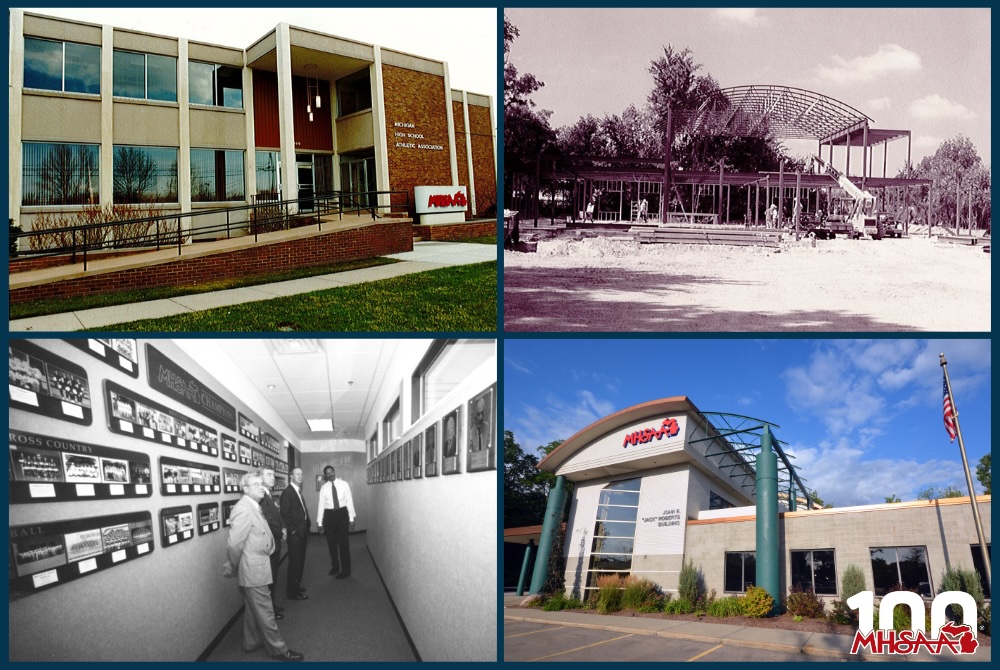
 Led by Roberts and former assistant director Tom Minter, much of the moving occurred during Christmas break of 1996. Doors to the new building were opened in January 1997, roughly seven years after Roberts first began dreaming of a new home.
The building on Trowbridge was formerly a credit union, and its structure provided some unique problems.
“In the late 1980s, around ‘88 or ‘89, we bought our first major computer, an IBM mainframe, and put it upstairs in the old building,” Roberts said. “It was about five feet high and eight feet wide and had its own room. We had to drill through concrete to wire it. I began to realize that we were going to have a hard time keeping up with things in a building that was so difficult to modernize.”
John Johnson, the MHSAA’s first communications director and a pioneer in that position among state high school associations, also reflected on the early days.
“Anything which was data-driven was jobbed out for awhile,” Johnson said. “Football playoff rankings were delivered to us once a week from a third party. We were doing everything outside the building: school databases, officials databases, penalty databases. The only thing we had inside the walls was word processing. I had the first PC in 1987.”
And, he recalled, the beast of a mainframe that took up an entire room at the expense of personnel. “Yep, it took up the whole room,” Johnson confirmed. “I was in what was called the library, which had historical books, but also old T-shirts left over from previous years’ champions.”
That lack of storage was also motivation for Roberts to find new real estate, and addressing that shortcoming was paramount in the plans.
“We had no storage, and no efficient way to receive shipments like rules books, paper, and the basic supplies we needed to run our business,” Roberts said. “That’s also why we have the lift in its current location at the new building; shipping and receiving were really important to us, along with our drop ceiling which made it much easier to run wiring as needed.”
As sparkling and expansive as the new facilities were, perhaps the best feature of all was its cost. The structure only took up a portion of the land purchased by the association, per Roberts’ vision. That left four parcels on the property for sale by the MHSAA, and with the road and utilities in place, those sections became even more valuable and enticing.
The MHSAA’s expenditures totaled roughly $1 million for the purchase of the land, road construction and utility installations. The parcels then sold for approximately $300,000 apiece.
“In the end, we had our space free of charge, and had $200,000 for furnishings,” Roberts said. The lone cost would then be the actual construction of the building, financed through a bond. And, the MHSAA could choose their neighbors, which was also part of the grand plan.
“We were going to be particular about who moved in, and that they’d be further back; not right on the road,” Roberts said. “Above all, we wanted to be good neighbors to the residents in the area and choose businesses that would be good neighbors as well.”
The other four parcels are occupied by medical practices, and the area remains a somewhat sleepy and hidden subdivision to this day.
Interestingly, and unknown to most, the MHSAA nearly held on to the parcel closest to its front door as a rental venture. That prospect led to spirited but friendly debate among Representative Council members at the time, leading to a vote on the matter of whether to sell the land or construct another building and rent space in that structure.
“There was good-natured discussion on the topic with arguments both in favor of selling and for building and renting on that last parcel,” Roberts said. “I remember on the morning of the vote, I offered the Council this to think about: We were really good at rules, really good at interpretations and administration of school sports. None of us were landlords or experts in that field.”
By a 10-9 vote, the Association would sell the final plot. “We didn’t get greedy, and history showed it was the right decision, what with the housing market landscape years later,” Roberts said. “We’d already won the lottery in a sense. Why enter into an area in which we knew little about?”
The timing of this new gem couldn’t have been any better, as the MHSAA was hosting the Section 4 meeting of state high school associations in September 1997. It was the perfect opportunity to showcase the facility with an open house attended by those in town for the meeting as well as current and former MHSAA staff and dignitaries.
Met with the now-recognizable and unique high-arching “roof” – half copper and half green, open frame – visitors were impressed. “The architect was on vacation in Florida and saw a similar building with the copper roof. When she assured me that it wouldn’t turn green over time, I agreed to do it,” Roberts said. “The design is actually still trendy, so it’s held up over time.”
Indeed it has, as verified by builders and designers currently giving the MHSAA’s home its first facelift.
“When I told people how old the building was, they couldn’t believe it, because its design has held up so well,” said MHSAA Assistant Director Dan Hutcheson, who has worked closely with contractors on building renovations during the last several months.
Even prior to this expansion and cosmetic overhaul, the MHSAA and its technology, staff were looking to the future.
 “Ironically, we upgraded projectors and cameras to delve into Zoom and virtual meetings before we really even knew what they were or how valuable they could be,” Hutcheson said. “This was winter of 2020, and a couple months later, Covid hits and by luck we’re kind of prepared, at least communication-wise.”
Following the Covid-19 pandemic, once the MHSAA was back on solid footing, Executive Director Mark Uyl began to outline and identify areas for expansion and updating inside the building.
Roberts’ foresight in the initial storage and expansion areas have paid huge dividends, as plenty of space existed for new offices.
The first meeting with architects post-pandemic was in September 2022, with renovations beginning in September 2023. Now, two years later, the project is near completion.
New color schemes, video boards, LCD displays and touchscreens serve to keep the facility in stride with those to which the MHSAA’s constituents have become accustomed.
There was plenty of work behind the scenes, too, such as fixtures and plumbing which simply had exceeded their lifespan or needed to be brought up to current codes. The overall mission for the changes, as always, was to better serve the membership.
“We serve 750 member schools, with so many from those schools coming here for training, teaching and educational sessions,” Hutcheson said. “As our staff members visit schools around the state, we see video boards, electronic message boards. We needed to keep in step with the schools, and in doing so, better assist our ADs, coaches and officials with their work.”
For two people who didn’t know one another, Reck and Roberts brought countless people together since 1997 to help them do their work.
Previous "Century of School Sports" Spotlights
Oct. 29: MHSAA Summits Draw Thousands to Promote Sportsmanship - Read
Oct. 23: Cross Country Finals Among MHSAA's Longest Running - Read
Oct. 15: State's Storytellers Share Fall Memories - Read
Oct. 8: Guided by 4 S's of Educational Athletics - Read
Oct. 1: Michigan Sends 10 to National Hall of Fame - Read
Sept. 25: MHSAA Record Books Filled with 1000s of Achievements - Read
Sept. 18: Why Does the MHSAA Have These Rules? - Read
Sept. 10: Special Medals, Patches to Commemorate Special Year - Read
Sept. 4: Fall to Finish with 50th Football Championships - Read
Aug. 28: Let the Celebration Begin - Read
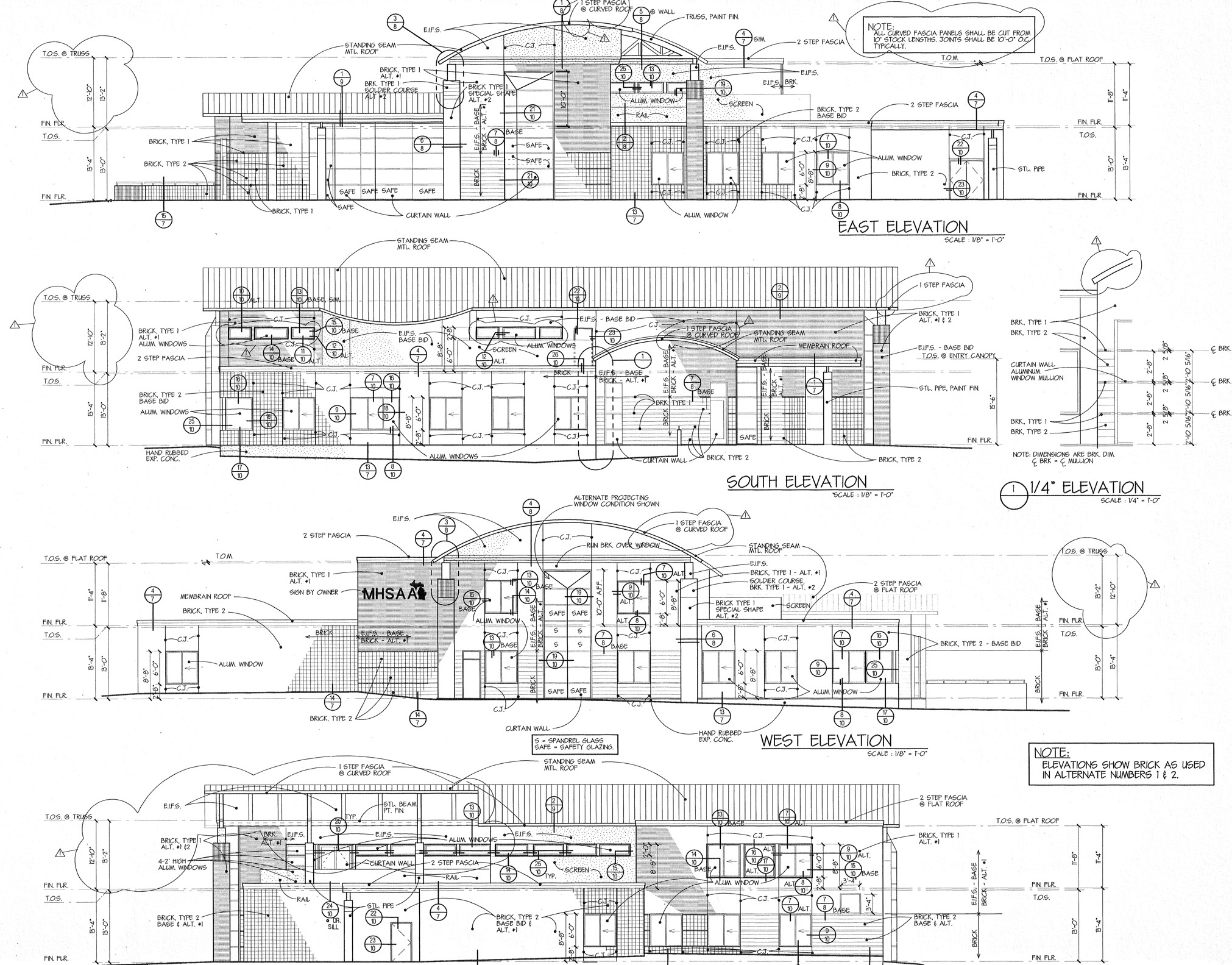
PHOTOS (Top) Clockwise from top left: The former MHSAA office on Trowbridge Road. (2) Work is underway on the new MHSAA building on Ramblewood Drive. (3) The MHSAA office on Ramblewood before recent updates that included a switch from green to gray on the exterior. (4) Now-retired assistant director Nate Hampton, far right, and others walk the upstairs hallway of the recently-built Ramblewood building. (Middle) Blueprints for the Ramblewood office exterior. (Below) Past Executive Director Al Bush (right) and his wife, Lois, were on hand for the 1997 open house hosted by then-Executive Director Jack Roberts (left) and staff. (MHSAA file photos.)

This Week in High School Sports: 3/12/26
By
Jon Ross
MHSAA Director of Broadcast Properties
March 12, 2026
This week's edition recaps the Individual Wrestling and Competitive Cheer Finals, presents Game Balls to standouts in gymnastics and newly-announced NFHS Hall of Fame selection Alisha Glass Childress from Leland; and closes with a recap of Jackson cross country coach Nathan Martin's comeback win at the Los Angeles Marathon.
 The 5-minute program each week includes feature stories from MHSAA.com or network affiliates, along with "Be the Referee," a 60-second look at the fine art of officiating.
"This Week in High School Sports" is powered by MI Student Aid, a division within the Department of Lifelong Education, Advancement, and Potential (MiLEAP).
Listen to this week's show by Clicking Here.
Previous 2025-26 editions
March 5: Team Wrestling Finals review, Mio basketball's Mia McGregor - Listen
Feb. 26: Upper Peninsula Swimming & Diving Finals review, Brian Gordon Receives Hampton Award - Listen
Feb. 19: Boyne City's Exemplary Program Award, MHSAA Basketball Tournament Schedules - Listen
Feb. 12: MHSAA connections to this year's Winter Olympics & Super Bowl - Listen
Feb. 5: MHSAA personal branding activities rule, Bear Lake's Harless twins - Listen
Jan. 29: Women in Sports Leadership Conference, WISL Award winner Anika McEvans - Listen
Jan. 22: Multi-sport participation, MHSAA/Farm Bureau Insurance Scholar-Athlete Awards - Listen
Jan. 15: Genesee's Averie Zinn & Mio's Mia McGregor, MHSAA Winter Finals schedule - Listen
Jan. 8: 2024-25 MHSAA Tournament attendance, tribute to Vic Michaels - Listen
Dec. 11: MHSAA 2024-25 participation's national ranking, 2026 Wrestling Tournament - Listen
Dec. 4: 11-Player Football Finals review - Listen
Nov. 26: Girls Volleyball, 8-Player Football, Lower Peninsula Girls Swimming & Diving Finals review - Listen
Nov. 20: NFHS Network championship schedule, Sportsmanship Summits - Listen
Nov. 13: Performance of the Week, Shelby football - Listen
Nov. 6: Lower Peninsula Cross Country Finals, Boys Soccer Finals review - Listen
Oct. 30: Mendon football's Owen Gorham, MHSAA Girls Volleyball Tournament primer - Listen
Oct. 23: Lower Peninsula Girls Golf Finals review, LP Boys Tennis Finals - Listen
Oct. 16: MHSAA Football Playoff selection, Field Hockey Finals week primer - Listen
Oct. 9: Upper Peninsula Girls Tennis Finals review, 2025 Sportsmanship Summits - Listen
Oct. 2: 2026 MHSAA/Farm Bureau Insurance Scholar-Athlete Awards, Boys Soccer Tournament - Listen
Sept. 25: Saline's record-approaching performance, SAC sportsmanship statement - Listen
Sept. 18: Athletic director training, "Block Party" volleyball report - Listen
Sept. 11: Football coaching legend Al Fracassa, MHSAA Student Advisory Council - Listen
Sept. 4: MHSAA participation rising, Harbor Springs soccer's Henry Juneau - Listen
Aug. 28: Field hockey's first season, changes to Football Playoffs, Tennis Finals - Listen