


Coaches Must Set the Example

October 15, 2012

By Scott Westfall
MSU Institute for the Study of Youth Sports
 

NOTE: This is part one of a two-part viewpoint explaining the importance of coaches and parents setting proper examples for young athletes in their treatment of game officials.

In light of the recent uproar over NFL replacement officials, it seems that never before has it been so common and socially accepted to yell disgust at referees.

While this trend is prevalent in both professional and college football, it has unfortunately trickled down into the high school ranks. What is actually accomplished when a coach or fan yells at an official? Do people really believe that if they become irate, a ‘bad call’ will be erased? In all of my years watching, playing, and coaching athletics, not once have I seen a referee change his or her ruling because a coach or a fan yelled at him or her.

When adults lose control and scream at referees, who does this bad behavior really affect? Since youth learn their emotional control from adult leaders, I believe the true damage is done to the young minds that are witnessing their mentors lose their cool. After their display of anger, how can these same adults hope for kids to stay calm when things do not go their way in life? It is pure hypocrisy to expect otherwise.

Whether we like it or not, referees are the absolute authority in athletic contests; they control the game from start to finish, make the tough calls on the playing surface, and even decide who gets to stay and who is sent to the locker room. Yet, it is baffling how often their authority is disrespected.

It is the coach’s responsibility to establish his or her program as one that respects authority. Since players watch all of the moves their coaches make, it is imperative that coaches respect the officials – especially when the calls do not go their way. If a player sees his or her coach going berserk due to a ‘bad call,’ the same player will think it is OK to act like this down the road when upset or faced with adversity. Even more detrimental to these kids is hearing their coach preach a message but contradict it by not backing it up with actions.

Great high school coaches will use the playing surface as an extension of their classroom. In my years as a head coach, I tried my hardest to set a good example for my players and told them to never question, back-talk, or disrespect an official. However, I made the mistake of breaking my own rule on one occasion by questioning the referee’s judgment.

When I was a younger coach, I may have attributed my actions to the heat of the moment, or defended myself on the criteria that I was trying to stick up for my team. However, being a veteran leader who wanted to practice what I preached, I saw my mistake as a teaching moment.

The next practice, when we conducted team discipline conditioning, “Reminders” (usually reserved for players with unacceptable school behavior or poor grades), I asked my players what I had taught them about respecting authority and if I had broken my own rule. The players agreed that I had broken my rule and had not respected the referee.

I let them know that this rule applied to me as much as them. I then lined-up on the goal line and ran my own set of wind sprints as the players, assistant coaches, and managers watched in disbelief. Afterward, to even my surprise, several players thanked me for holding myself accountable.

One kid even had tears in his eyes, and said that after watching my self-imposed discipline, he wanted more than ever to be a man of his word and do the right thing.

Scott Westfall has spent the last 10 years as a teacher, coach, and athletic director in Fort Collins, Colo. He currently is working on his Doctorate at Michigan State University, with an emphasis in Sport Psychology and Athletic Administration, and assisting the MHSAA with its student leadership programs. Westfall is a former athlete who participated in football, wrestling, tennis and cross country at the high school level, and rugby at the collegiate level. He can be reached at [email protected].
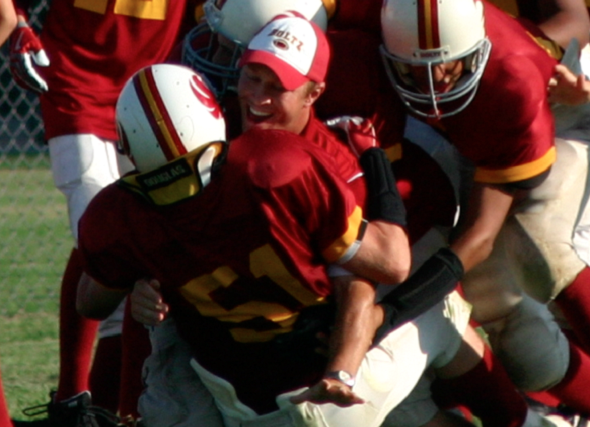

PHOTO: Scott Westfall celebrates with his football team while serving as a coach at Boltz Middle School in Fort Collins, Colo.

Leadership: A Skill that can be Taught

January 30, 2013

By Jed Blanton
MSU Institute for the Study of Youth Sports

At the MHSAA and the ISYS, in the milieu of work we conduct centered on understanding and developing leadership in young athletes, there is one definition that seems to govern our approach and serve as a foundation for the research questions and training clinics that follow it.

Penned by Peter Northouse, that definition states “leadership is a process, whereby an individual influences a group of individuals to achieve a common goal.”

Choosing to frame ‘leadership’ as a process, rather than as some personality characteristic destined only for those naturally-born leaders, allows the concept of leadership to be utilized and taught as a skill, or set of skills. If a coach can agree with the philosophy that leadership can be learned, we can begin to design a series of strategies to enhance leadership in our young athletes.  

First, I’m going to discuss what most coaches already know about teaching skills. Teaching skills is essentially an effort of behavior modification. A coach sometimes is able to choose athletes who already possess a certain level of competency within the skills necessary for their sport; sometimes coaches must work with whoever shows up on the first day of practice.

In either case, coaches tend to conduct a subconscious assessment of skills that must be learned (that they must teach), whether complex strategies or mere fundamentals. When teaching athletic skills to young people, coaches must break down the multitude of steps involved.

Think about a lay-up in basketball or the high jump in track & field. Either skill itself is actually a combination of several skills, and the ability to pay attention to very specific cues in the environment. Coaches teach the approach, the proper hand/arm placement, the essential cues to focus on, and the follow-through. Coaches can devote segments or entire practices to particular skills – breaking down all the steps, creating drills to practice the steps, and offering the full practice of the skill in a competition-like environment.

During this episode of developing a skill in our athletes, to get them to perform in a very specific way, our interactions often mirror what behavioral psychology has known for decades: People respond to reinforcements and punishments. Coaches positively reinforce their athletes with compliments, clapping hands, and congratulations. Our words and actions shape how the individual learning the skill makes adjustments to receive more praise.

These shifts of their body and miniscule changes in their actions to get to the desired behavior of their instructor are “learning.” Similarly, coaches often threaten punishment of extra sprints or difficult drills to give athletes a clue as to what behaviors they should avoid. Often, something as simple as a disapproving glance can be reinforcing enough to change whatever behavior the athlete shouldn’t be practicing. The simple “good job” or the threat of sprints essentially shapes how our athletes behave athletically.

This same approach can work toward leadership development.

What would it look like for a coach to reinforce and punish athletes toward leadership development in the same vein they develop athletic skills? If coaches could determine what three or four behaviors they’d like their athlete leaders to showcase, and then positively reinforce those skills with compliments and thanks, and potentially punish athletes with disapproving glances or even lectures after practice, leadership can be learned like any other athletic skill.

Phil Jackson, the multiple championship-winning NBA coach, has been quoted saying he would try to give two compliments for every criticism with his professional teams. The Positive Coaching Alliance – a national nonprofit organization that strives to educate coaches on ways to enhance the youth sport experience – suggests a ratio of five positive comments to every negative criticism. Research has consistently shown that people respond better and more rapidly to positive reinforcement than to punishment.

All too often, coaches wait for leaders to emerge, rather than teach the leadership they desire. Imagine if coaches waited for players to figure out the offensive plays and strategies instead of teaching players where to move, how to move, and why they are moving there. Adopting a similar approach with your athlete has the potential to expedite the behaviors you’d most ideally want them to possess. Using tactics of positive reinforcement can help these young players to become excellent leaders in a shorter period of time than merely hoping someone steps up.

I’ll leave you with a simple list of suggestions of how coaches can teach leadership, just like they teach any other necessary athletic skill.

  1. Develop goals with your athletes regarding leadership. What kinds of things do your athletes value or feel would help the team? How can they practice leading their teammates in that way?
  2. Develop your own goals toward teaching leadership. What would it look like if a coach made it a goal to compliment three players on specific leadership behaviors each practice? Think about the ultimate team captain for your team, and develop strategies to teach your players how to be that captain.
  3. Break down leadership skills into smaller and easier to practice chunks, just like an athletic skill. Then create an environment where the athletes can practice these skills. By organizing your team into smaller groups, or even partners, you can assign leadership roles within each group. Asking certain players to lead various parts of practice (stretches, lay-ups, circuit training), you are giving them a sense of ownership over their athletic experiences and responsibility over their teammates.
  4. Positively reinforce the desired behaviors. How would it make a player feel if their coach pulled them aside and thanked them for their specific leadership behavior after a practice or game? A “job well done” or an approving thank you can go a long way in making a young athlete feel they are developing into the leader you desire them to be.


Blanton is a doctoral candidate at Michigan State University in the department of Kinesiology, specializing in the PsychoSocial Aspects of Sport and Physical Activity, and a research assistant for MSU's Institute for the Study of Youth Sports. He has served as a facilitator at MHSAA Captains Clinics the last three years and currently is assisting the association with its student leadership programs.