

Getting Smart but Acting Foolishly
April 25, 2019


By Karissa Niehoff, NFHS Executive Director
and Mark Uyl, MHSAA Executive Director
We communicate on smart phones, drive smart cars, make purchases using smart cards and even drink smart water. But, really, how smart are we?
Between college admission and internet privacy scandals, sexual misconduct investigations, stolen trade secrets and the growing concern about how we communicate and connect with each other, technology seems to be outpacing our capacity to understand the most responsible way to use it.
In other words, how are tomorrow’s leaders being prepared to make decisions that provide the perspective, balance and strength of character that today’s advanced world needs?
The answer is by participating in high school sports like the ones offered by the high schools in Michigan.
Most researchers agree that leaders are made, not born, through relationships with others. Human interaction and life experiences enable young men and women to develop leadership characteristics such as trust, mutual respect, integrity and accountability. These are the same values that are learned as a result of playing on a high school sports team.
And while club sports often have only a singular focus (the participant’s athletic abilities), research documents that high school sports programs have an unparalleled positive effect on the physical, academic and emotional growth of teens, including a more mature level of character development.
In other words, high school sports have a more profound role to play in society today than you may realize.
The high school sports and activity programs in Michigan—including music, speech, theatre and debate—typically account for only about 1 to 3 percent of a school’s overall budget, making them one of the wisest investments your community makes. You can help by attending as many games and events as possible, donating to the booster club and volunteering to work in the concession stand.
Most of all, encourage your children to participate in as many sports and activities as they can. Because when they do, they will be joining a new generation of leaders who are both technologically smart and ethically responsible.
And that’s exactly the kind of leadership our hyper-intelligent world needs.
The Michigan High School Athletic Association (MHSAA) is one of 51 members of the National Federation of State High School Associations (NFHS).
Did you lose this medal?
By
Geoff Kimmerly
MHSAA.com senior editor
August 19, 2013
It’s not quite a needle in a haystack. But it could turn into a great story.
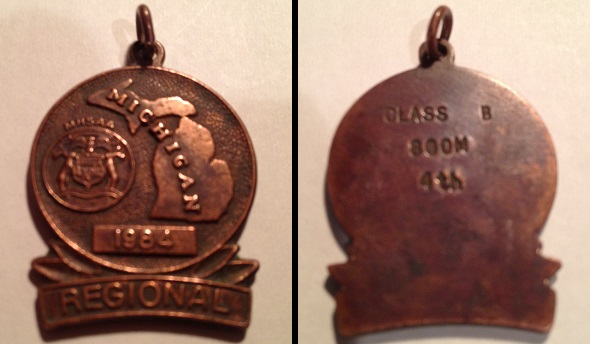
This 1984 MHSAA Regional medal, pictured above, was found recently in Massachusetts with a metal detector. The finder, coincidentally a former collegiate track and field coach, hopes to return the medal to its rightful owner.
 Doing so might not be as difficult as it sounds, but we’ll need help from our friends in the track and field community.
Here’s what we know:
- The medal was received for finishing fourth in the 800 meters at a Class B Regional in 1984.
- The Regional had to be in the Lower Peninsula, because Class A and Class B were and continue to be combined in the Upper Peninsula.
- There were 10 Class B Regionals during the 1984 season, hosted by Sturgis, Parma Jackson County Western, Chelsea, Warren Fitzgerald, Linden, Corunna, Ovid-Elsie, Fremont, Greenville and Gaylord.
- So that means the medal could have only 20 possible owners.
Unfortunately, we do not have Regional results from the 1980s on file in our office. That’s where our helpers come in.
If you have results, or any idea who won this medal, please contact me at [email protected]. If we can connect medal with owner, we’ll tell much more of this story – including that of the coach who found it and made the call to start its return trip home.