


Involvement vs. Meaningful Involvement
November 27, 2012
 By Jed Blanton
MSU Institute for the Study of Youth Sports
As I've worked with the MHSAA in student leadership development and through my role in performance consulting and mental training, a number of coaches and athletes have asked me how to “get kids to buy in” or see the vision of their coach/captain, etc.
Particularly in high school sports, rosters consist of players with reasons for participating in their sport that range from pure enjoyment and social life, all the way to kids with aspirations and ability to play in the highest level of college athletics.
Having a range of talent, and then a range of desire and commitment can be a difficult load to balance as a coach.
Based on the questions I've been posed over the years, it seems that the magic answer lies somewhere in this notion of “buy-in” and if, just if, the coach could trigger that “buy-in” everything would work out. A winning season or at least a more successful season would be a certainty, and all the athletes would be emotionally involved, or more so, emotionally invested, as well as completely and fully physically and mentally committed to THE GAME.
This almost sounds like the ideal ending of a Disney sports movie … but that doesn't mean it isn't a possibility, and we can find some ways to make your reality closer to this vision.
The trick is … there is no trick; there is no magic formula. The ability to create “buy-in” means giving up something that might make a coach shudder and cringe just a bit. My challenge to coaches is this: Give up control. SHARE some of the duties and tasks you feel are your job, with … your players.
DON’T hit the back button or close your browser just yet. Let me explain.
The first thing to understand here is how people learn. If we want our athletes to “buy in,” we may have to teach “buy-in” first, which involves understanding how people learn behaviors and adopt a mentality, as the state of “buy-in” would be considered.
Psychologically, we know that people can learn merely from watching and modeling others. But in the short-term, this tends to include only behaviors, not the more abstract notions of passion or commitment which is seemingly what coaches desire more of in their players when we talk about “buy-in.”
However, it is important. So the first thing a coach needs to do is behave in such ways that indicate they are “bought in,” more so than just telling kids to be more committed. Have you ever stopped to think about what it looks like when someone has “bought in” to an athletic team’s vision? Do you have a team vision statement to guide behaviors and goals?
The next step in how people learn new behaviors upon watching others is having those behaviors they are attempting to mimic reinforced. Encouraging players and showing gratitude to those who demonstrate the desired mentality will help foster the expectations you have for your players. I must point out here that punishing or dismissing players and behaviors that stray from this desired state won’t help the learning process.
Next, and here is where the challenge lies, is sacrificing some control and sharing some responsibilities with your players. This entails involving them in the process of the sport. So often our high school athletes experience sport very passively. They are told what to do, how to do it, and when to do it. Then critiqued, sometimes put down and constantly judged on their abilities to do very little else than act in the ways they are told to act.
There is no option for personal investment here. Trust is the guiding factor. And while trust is extremely important, it’s not what may ultimately create “buy-in.”
Involvement fosters ownership. Meaningful involvement requires an emotional investment because the amount of responsibility increases. So what does being meaningfully involved look like? Being meaningfully involved in the sport as an athlete would mean being able to make decisions that are then actually carried out before they are critiqued. If you ask a player what they think about any given decision, then tell them what you think (which is also what they’ll do), you are merely seeking input rather than allowing them to be involved. What would it look like if the captain or senior players were able to set the starting line-up or batting order? Or what if the athletes were in charge of running a two-hour practice once a week? How about letting one or two of the athletes decide what play is going to be run in the final minutes of a close game? I mentioned the word “trust” earlier, and the key in these examples is coaches are showing athletes “trust.” This just might be what fosters the all important “buy-in.”
The hardest part on the coaches’ end is letting the decision play out, and then talking about why it may have failed. Discussing it rationally, debriefing the decision, and allowing them to process where the mistake was made without placing blame on them is where athletes can really learn about their sport, their role on the team, and how to make tough decisions while sharing in the full experience of the competition and preparation.
There is always a chance they’ll make the same decision you would make as the coach. After all, they have been practicing in your system. This is a great way to assess if you are having an impact and if your athletes are learning rather than just passively participating.
As a former athlete, I can honestly say I never truly understood my sport (distance running) until I was asked to serve as a race director or create training programs for younger athletes and people interested in taking their running to a more competitive level. I’m sure for most first-time coaches, the number of decisions you have to make humbles your former-athlete self rather quickly.
Watching the student leadership program participants I work with struggle with projects and presentations they are asked to design is tough, and I want nothing more than to help them and make sure that it’s “right.” But I can also say that in those times when I've been able to see the end result in those instances when they made the decisions, they created something on their own, they are happier, more knowledgeable, and certainly “bought in,” as they have control for the first time.
Blanton is a doctoral candidate at Michigan State University in the department of Kinesiology, specializing in the PsychoSocial Aspects of Sport and Physical Activity, and a research assistant for MSU's Institute for the Study of Youth Sports. He has served as a facilitator at MHSAA Captains Clinics the last three years and currently is assisting the association with its student leadership programs.
Mason, Okemos Score for a Cure
By
Geoff Kimmerly
MHSAA.com senior editor
November 11, 2014
Three weeks remain in the MHSAA’s 2014 fall season, and we’ve collected a few notes to pass along as we wind down the final three sports before moving inside (except for skiing) for the winter.
 Below are an update on a fundraising game we previewed earlier, plus recognition for perfection at our Girls Golf Finals and another high honor for one of the top players in MHSAA volleyball history.
Score for a cure
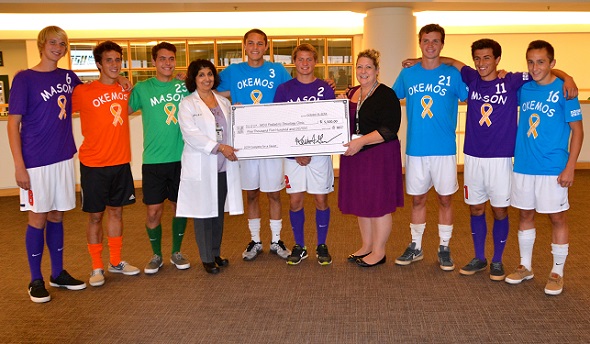
We wrote in September about an upcoming soccer game between Lansing-area powers that would raise money for pediatric cancer research. The “Compete for a Cause” game between Okemos and Mason on Sept. 13 was the third of what has become an annual event started by Mason’s team and coaching staff.
Attendance for this season’s game was nearly double the year before, and funds raised increased more than 500 percent.
The final tally: Roughly 1,400 fans attended the game, which raised $11,000 that was split between the CureSearch for Children’s Cancer national foundation and the Michigan State University Pediatric Oncology Clinic.
The first “Compete” game in 2012 raised $1,000, and the 2013 game drew 800 fans and raised about $2,000. This fall, Okemos was ranked No. 1 in Division 1 and Mason No. 7 in Division 2 when the game was played; it ended in a 1-1 tie. Both went on to postseason success – Okemos advanced to a Regional Final, and Mason fell to eventual Division 2 champion East Lansing in overtime in their Semifinal.
Only one shot needed
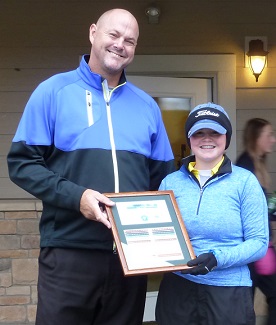 It’s a rarity – most of the time. But for the second straight season, a player at the MHSAA Lower Peninsula Girls Golf Finals sunk a hole-in-one.
Grosse Pointe South’s Lucy Buzolitz aced the par-3 No. 12 at Bedford Valley in Battle Creek, dropping the shot from 97 yards out during the first round of Division 1 play. Buzolitz was one of two individual qualifiers from her team and shot a 92-97-189 for the two-day tournament.
At the 2013 Division 2 Final, Fenton then-sophomore Madison Shegos aced the par-3 18th hole at Michigan State University’s Forest Akers East.
Sportswoman of the Year
Former Leland and Penn State University volleyball standout and current U.S. national team setter Alisha Glass was a finalist for 2014 Team Sportswoman of the Year at the 35th Salute to Women in Sports gala in October in New York City.
The event, put on by the Women’s Sports Foundation, annually recognizes a Sportswoman of the Year for both individual and team sports based on nominations by sport governing bodies and the public. Glass was one of 10 candidates this year for the team award after being named USA Volleyball Indoor Female Athlete of the Year in 2013. She also was named International Federation of Volleyball’s best setter at the 2014 World Championship in Italy after helping the United States to the title.
Olympic gold medal-winning ice dancer Meryl Davis received the Sportswoman of the Year team award, while the individual award when to gymnastics all-around world champion Simone Biles.
PHOTOS: (Top) Members of the Mason and Okemos boys soccer teams present a check for $5,500 to the MSU Pediatric Oncology Clinic and Dr. Renuka Gera last month. (Middle) Lucy Buzolitz receives a plaque recognizing her hole-in-one at the Division 2 Golf Final from Bedford Valley head pro Dean Kolstad.