

Mason, Okemos Score for a Cure
By
Geoff Kimmerly
MHSAA.com senior editor
November 11, 2014
Three weeks remain in the MHSAA’s 2014 fall season, and we’ve collected a few notes to pass along as we wind down the final three sports before moving inside (except for skiing) for the winter.
 Below are an update on a fundraising game we previewed earlier, plus recognition for perfection at our Girls Golf Finals and another high honor for one of the top players in MHSAA volleyball history.
Score for a cure
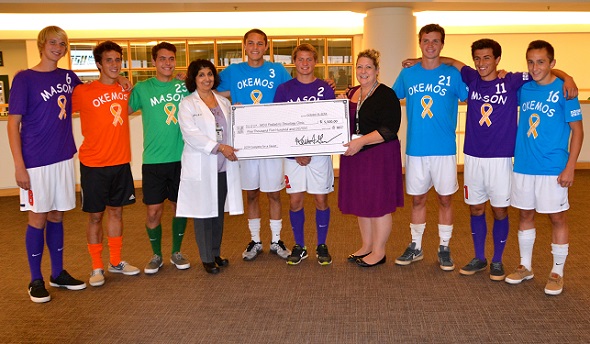
We wrote in September about an upcoming soccer game between Lansing-area powers that would raise money for pediatric cancer research. The “Compete for a Cause” game between Okemos and Mason on Sept. 13 was the third of what has become an annual event started by Mason’s team and coaching staff.
Attendance for this season’s game was nearly double the year before, and funds raised increased more than 500 percent.
The final tally: Roughly 1,400 fans attended the game, which raised $11,000 that was split between the CureSearch for Children’s Cancer national foundation and the Michigan State University Pediatric Oncology Clinic.
The first “Compete” game in 2012 raised $1,000, and the 2013 game drew 800 fans and raised about $2,000. This fall, Okemos was ranked No. 1 in Division 1 and Mason No. 7 in Division 2 when the game was played; it ended in a 1-1 tie. Both went on to postseason success – Okemos advanced to a Regional Final, and Mason fell to eventual Division 2 champion East Lansing in overtime in their Semifinal.
Only one shot needed
 It’s a rarity – most of the time. But for the second straight season, a player at the MHSAA Lower Peninsula Girls Golf Finals sunk a hole-in-one.
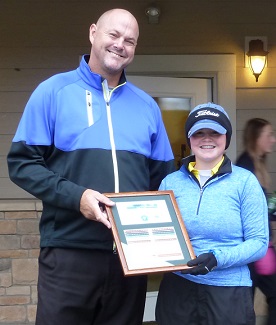
Grosse Pointe South’s Lucy Buzolitz aced the par-3 No. 12 at Bedford Valley in Battle Creek, dropping the shot from 97 yards out during the first round of Division 1 play. Buzolitz was one of two individual qualifiers from her team and shot a 92-97-189 for the two-day tournament.
At the 2013 Division 2 Final, Fenton then-sophomore Madison Shegos aced the par-3 18th hole at Michigan State University’s Forest Akers East.
Sportswoman of the Year
Former Leland and Penn State University volleyball standout and current U.S. national team setter Alisha Glass was a finalist for 2014 Team Sportswoman of the Year at the 35th Salute to Women in Sports gala in October in New York City.
The event, put on by the Women’s Sports Foundation, annually recognizes a Sportswoman of the Year for both individual and team sports based on nominations by sport governing bodies and the public. Glass was one of 10 candidates this year for the team award after being named USA Volleyball Indoor Female Athlete of the Year in 2013. She also was named International Federation of Volleyball’s best setter at the 2014 World Championship in Italy after helping the United States to the title.
Olympic gold medal-winning ice dancer Meryl Davis received the Sportswoman of the Year team award, while the individual award when to gymnastics all-around world champion Simone Biles.
PHOTOS: (Top) Members of the Mason and Okemos boys soccer teams present a check for $5,500 to the MSU Pediatric Oncology Clinic and Dr. Renuka Gera last month. (Middle) Lucy Buzolitz receives a plaque recognizing her hole-in-one at the Division 2 Golf Final from Bedford Valley head pro Dean Kolstad.

NFHS Voice: MLK Provides Reminder
January 22, 2020
By Karissa Niehoff
NFHS Executive Director
On Monday, the nation observed Martin Luther King Jr. Day for the 35th time. This annual remembrance of the civil rights leader and his remarkable efforts in the 1950s and 1960s to combat racism in the United States continues as one of the most significant days on the calendar every year.
King’s “I Have a Dream” speech in Washington, D.C. in 1963 – one of the most iconic speeches in history – was the defining moment of the civil rights movement and led to the Civil Rights Act of 1964, which made desegregation a prerequisite to school funding and further strengthened the Supreme Court’s 1954 ruling in Brown v. Board of Education of Topeka.
As a result, separate schools for African Americans ended and King’s dream of equality for everyone began to occur.
Thanks, in part, to the efforts of King, who was a member of his school’s debate team at Booker T. Washington High School in Atlanta, blacks and whites were assimilated in schools and in athletics and other activities such as speech and debate.
A few years later in the early 1970s with the passage of Title IX, girls – both white and black – were provided the opportunity to participate in high school sports. With this landmark legislation on the heels of the civil rights movement, high school sports and activities were for EVERYONE.
Amazingly, participation in high school sports increased from 3.9 million to 6.4 million in seven years between 1971-72 and 1977-78 – a jump of about 2.5 million. Why? The opportunity to participate was now available to all.
High school athletes – male and female, black and white and other races – began to work together and excel both individually and as teams. Many have seized these opportunities and had a profound impact within their communities and nationally.
In the past five classes of the NFHS National High School Hall of Fame, 13 of the 22 athletes were minority males and females, including the likes of Derrick Brooks, Dusty Baker, Seimone Augustus, Nicole Powell, Lisa Fernandez, Nikki McCray and Marlin Briscoe. Other females were Tracey Fuchs, Carrie Tollefson, Missy West, Joni Huntley, Jackie Stiles and Cindy Brogdon.
In previous classes, there were Ozzie Newsome, Chauncey Billups, Kevin Johnson, Janet Evans, Sean Elliott, Cheryl Miller, Archie Griffin, Jackie Joyner-Kersee and Kim Mulkey.
Can you imagine the storied history of high school sports without these individuals?
Thanks to the efforts of many people in the 1960s and 1970s, there are more women and minorities in leadership positions today. Nine of our member state high school associations are led by minorities, including three females – Que Tucker of North Carolina, Sally Marquez of New Mexico and Rhonda Blanford-Green of Colorado.
Despite these advances in opportunities the past 50-plus years, the late Dr. King would be disappointed to hear about some of the disrespectful behavior in and around high school sports the past few years. Since our column in late October, we have heard of other racially-related incidents. Indeed, pain still occurs.
As we reflect on the tremendous efforts of Dr. Martin Luther King Jr. to bring everyone together, let it be a further reminder that all student activity participants – regardless of race, religion, political views or gender identity – should be treated with respect.
Dr. Karissa L. Niehoff is in her second year as executive director of the National Federation of State High School Associations (NFHS) in Indianapolis, Indiana. She is the first female to head the national leadership organization for high school athletics and performing arts activities and the sixth full-time executive director of the NFHS, which celebrated its 100th year of service during the 2018-19 school year. She previously was executive director of the Connecticut Association of Schools-Connecticut Interscholastic Athletic Conference for seven years.