

2018-19 Stacking Up With Best on Records
By
Ron Pesch
MHSAA historian
March 29, 2019
What a sports year.
There certainly have been some amazing athletic feats over the 2018-19 high school season in Michigan, and it’s just two-thirds of the way complete.
This past fall, Kobe Clark of Schoolcraft scored nine touchdowns in a single game. Stunning!
The winter sports season saw Dylan Jergens of Marcellus Howardsville Christian top the MHSAA single season scoring record in boys basketball, finishing with 971 points. Incredible!
Then a freshman, Emoni Bates, hits for 31 points in an MHSAA Semifinal for Ypsilanti Lincoln. Wow!
So, how does that compare to years past?
First, let’s hit the pool!
SWIMMING
Across the world, as well as in Michigan, record performances seem to fall regularly in swimming. I’m certainly no expert on the sport, but research seems to indicate that optimization of stroke count, kicks and other body positioning (and not a change in the density of H2O) impact the lowering of recorded times in the water. The continued synchronization and optimization of movement may mean we’ll see regular improvement for years to come.
It’s telling that MHSAA all class/division records in eight of the 12 events that make up a girls meet have been set this decade. The remaining four marks date to 2002 or 2007, and are held by Kara Lynn Joyce of Ann Arbor Pioneer or Allison Schmitt of Canton. Joyce, of course, went on to post 18 NCAA championships and four silver medals won during three Olympic competitions. A freestyle specialist, Schmitt won eight Olympic medals across the 2008, 2012 and 2016 games.
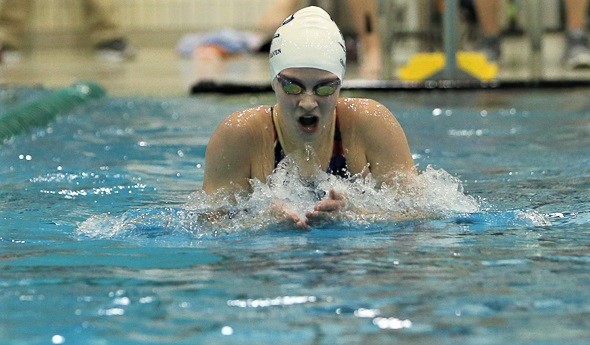
 This past fall, the triumphs of three athletes, in particular, stand out. Kathryn Ackerman set a new state mark in the 200 individual medley with a time of 1:57:25. A junior, Ackerman’s time should place nationally in the top 15 all-time. With the 2018 season complete, she now holds the top four times in the event according to the MHSAA record book.
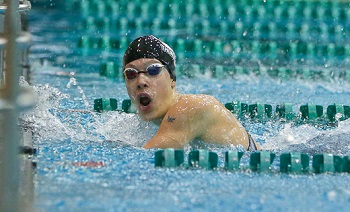
Senior Ashley Turak sprinted to a new Division I record of 22.10 in the 50 freestyle for Harrison/Farmington on the first leg of the 200 freestyle relay, as well as a time of 22.20 in the 50 freestyle. Both those times also rank in the national record books within the top 15. The MHSAA All-Class/Division Final Meet mark still belongs to Joyce, who posted a time of 22.04, set while leading off the 200 freestyle relay team in the Class A 2002 preliminaries.
Turak again mesmerized the crowd, this time in the 100-yard freestyle, posting a time of 48.72 seconds to win the event. Again, Joyce holds the Michigan All-Class/Division mark with a then-national record time of 48:59 set in 2002.
This November, Grand Ledge junior Lola Mull fell less than a half-second short of her own state mark in the 500-yard freestyle, set in the 2017 preliminaries. Mull owns the state’s top three times in the event, while Schmitt ranks fourth on the list.
Sub 20
A winter sport in Michigan, boys swimming is no different, with records in 10 of the 12 events set in the 2010s. Cam Peel of Spring Lake became the first in state history to break 20 seconds in the 50-yard freestyle, accomplishing the milestone twice this March, first in the prelim race with a record time of 19.86 and again in the finals at 19.91. The marks surpassed the previous best, set by Henry Schutte of Grand Rapids Forest Hills Central one year ago, and also rank among the “Best of the Best” in the National Federation record book.
FOOTBALL
Clark’s nine touchdowns came in Schoolcraft’s 63-27 victory over previously undefeated Constantine in a Southwestern Athletic Conference contest. Thanks to steady rain in the first half, Schoolcraft stuck to the ground game, opening a 21-0 first quarter lead on three Clark touchdowns, one of eight yards, the second of 24, and the third of 10 yards. Constantine battled back to within eight points, 21-13 late in the second quarter, but Clark would score for Schoolcraft twice more during the final three minutes before halftime.
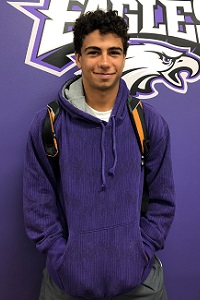 Following a 24-yard scamper, a partially blocked punt would set up Clark’s fifth rushing TD from two yards out with under a minute remaining before the break. (This appears to be a great moment to note that five players have scored five touchdowns in a single quarter). Clark added two TDs in the third quarter and two in the fourth.
Amazingly, Clark’s nine touchdowns and 54 points scored are not state records. In fact, two others have matched the touchdown and point count, while three others have exceeded the accomplishment in each category. Of course, each of those events occurred at least 90 years ago, decades before the introduction of the mercy rule in high school football.
For many years, Herb Dunphy was listed as the state’s record holder for a pair of seemingly untouchable records: touchdowns in a single game and points scored in a game. In 1917 he scored 10 TDs for Lansing Central and stood alone at the top.
But as time has proven again and again, the work of historians and researchers can alter what we believe. In 1986, research by Tom Pellow of Gwinn uncovered that Marmaduke “Duke” Christie of Escanaba had also scored 10 touchdowns, matching Dunphy’s output. In addition, Christie added six point-after-touchdowns that day, totaling 66 points, as Escanaba defeated Ishpeming 102-0 in November 1920.
“In my humble opinion, Escanaba high school in 1920 had one of the greatest football teams that ever misunderstood a signal in any language,” wrote Cy DeLynes, recalling the exploits of Christie and his teammates in the Escanaba Daily Press in 1929. “Christie was its captain. The Duke had a pair of collapsible ankles and he was able to play in only a part of four games. That, however, was just enough time to permit him to score 21 touchdowns and 38 out of a possible 50 points after touchdown – a total of 164 points. He led a backfield that made Knute Rockne’s Four Horsemen look like a quartet of super-annuated milk wagon drivers turning off the alarm clocks at 4 o’clock in the morning.”
A few years later, additional study of yearbooks and newspapers revealed the exploits of Cecil Hardy of Flint Central, again reshaping the scoring entries in the MHSAA record book.
In the 1914 season opener – a 106-0 blasting of Lapeer – Hardy carried for more than 300 yards. Within the first two minutes of play, the captain of the Flint squad had scored the first of 11 touchdowns – a “new” state mark.
“His end running was the feature of the game, his longest run being one for 50 yards and a touchdown on the first play after the kickoff. Time after time as he was making his long runs he appeared to be tackled and would wriggle out of the grasp of his opponent and run 15 or 20 yards further,” was the report of the day.
“How Is This For Football?”
Muskegon 216, Hastings 0
The Boston Globe paired the question with the football score from a Michigan high school game to readers in their Sunday edition back on September 29, 1912.
“Most of Muskegon’s touchdowns were scored on the kick-off,” stated the Globe, “and few required more than one down.”
The score was believed to be a “world’s record” for points scored in a game, at the time. Indeed, the total ranks as the tops in Michigan. Indeed, it was a record nationally, but would be surpassed on three occasions in the coming years, first in 1923, again in 1924 and finally in 1927. With today’s employment of the running clock, the scoring totals will never again be approached.
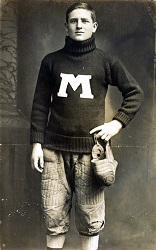
The score was 40-0 at the end of the first quarter, 102-0 following the second, and 150-0 after three quarters. Touchdowns were scored by nine different players, with six scoring multiple times. As byproducts, captain Fred Jacks finished with nine touchdowns, while Muskegon’s Nelson Stuit booted 24 of 30 extra points in the contest (another state mark that also will never be equaled).
“Although world’s records fell in the game it is not anything to be particularly proud of …” stated the Muskegon Chronicle in the prose of the time. “The visitors had about three men that knew a football from an eff, and those three could not make the Muskegon second team.”
One of the best, as it turned out, was Fred Rehor, Hastings’ “big 220 pound fullback” who would later play for Michigan, then professional ball in Ohio for the 1917 Massillon Tigers, coached by Knute Rockne.
 As a result of the Muskegon-Hastings game, “at least three of the football elevens which contracted this year to meet Muskegon high school have begun to make excuses in line with those usually offered before a team quits such an engagement,” wrote the Lansing State Journal. Muskegon rolled up 499 points on the year, but ended a flawless season in defeat, 13-12 against rival Grand Rapids Central in the finale. The loss was blamed on overconfidence.
The aptly named Francis Tallent of Menominee, became the next player to score nine TDs in a game.
Tallent’s skills on the gridiron had been spotted in 1928.
“Standing out like a missing tooth in a front row of the chorus … (Tallent) revealed as speedy a pair of heels as one could ever hope to cast his optics on in a high school game,” wrote one reporter after witnessing the left halfback’s performance in the annual twin cities battle between Menominee and Marinette, Wis., then played on Armistice day. Tallent scored twice in that “M & M” game, a 26-0 win by Menominee.
After thumping Green Bay in its 1929 season opener and a “helpless” Oshkosh Normal (now known as the University of Wisconsin-Oshkosh) freshmen team, 46-6, Menominee squared off for its game against “a light and green squad” from Kingsford.
According to the Milwaukee Journal Sentinel, Tallent scored nine touchdowns that day on runs of 46, 72, 90, 64, 50, 37, 90, 85 and 63 yards. In total, the paper noted that Tallent gained 597 yards rushing in the 150-0 thrashing of Kingsford. Other sources noted that it was likely more, as the sum of only the TD runs equaled the 597 yard total. Kingsford would finish its seven-game season without scoring a point. According to the Kingsfordian, the school’s high school annual, the Kingsford players “were no match for the heavier and more experienced teams on the range” that school year.
Menominee’s success and Tallent’s football exploits prompted the Journal-Sentinel to send a reporter to the U.P. to cover the 1929 M & M game between the border schools later that fall. “Mr. Tallent, who runs like the well-known hare and who slips out of tacklers’ arms and hands like a piece of wet soap, scored four touchdowns in the course of the afternoon,” wrote the staffer. “All told, this Mr. Tallent rolled up 284 yards,” as the “pride of the peninsula walloped Marinette,” 49-0, before a crowd of 10,000. The score was “the highest ever piled up in 45 years of bitter rivalry between the two cities.”
Menominee ended the 1929 season undefeated and untied in eight games, scoring over a point-a-minute while claiming the Upper Peninsula championship and demanding statewide consideration for Michigan’s mythical crown. Tallent finished the season with 27 touchdowns.
BASKETBALL
After 35 years, one began to wonder if Mark Brown’s single-season scoring mark, set in 1984-85 during his days at Hastings, would ever be surpassed. Brad Redford, named Michigan’s Mr. Basketball, came close as a senior in 2007-08, falling 17 points shy of exceeding Brown’s total of 969. Prior to that, only Drew Neitzel of Wyoming Park had come within reasonable striking distance, but that happened a decade and a half ago.
This year, Jergens of Howardsville Christian finally topped the total, finishing with 971 points. Jergens accomplished the task in 24 games, two games fewer than Brown, but with the advantage of the 3-point shot. The three was implemented after Brown had headed to college. According to press reports, Jergens had four games of at least 50 points during the season.
Still standing, 40 years later, is Jay Smith’s high school career scoring mark of 2,841 points, set at Mio between 1976 and 1979. Jergens finished third on the list with 2,782 career points, including 320 career 3-pointers – second most in state history. Brown ranks second with 2,789 points scored between 1982 and 1985.
 Freshmen
Few followers of prep basketball in Michigan could avoid coming across the name Emoni Bates, especially after the freshman phenom from Ypsilanti Lincoln knocked down 17 points in the Quarterfinals, 31 points in the Semifinal round of the Division 1 tournament, then 23 in the championship game. The immediate question on press row was, “Had another ninth grader ever exceeded his totals in a MHSAA final-rounds contests?” There was nothing to exceed it that I could recall.
While we’ve kept final round records, including single-game scoring marks, the website minimum is 40 points, and we’ve never captured a list that’s broken down by year in school.
So, I decided to dig.
Quarterfinals
The state has certainly seen some talented freshmen pass through the last rounds of the tournament. Monte Morris scored 20 points in the Quarterfinals for Flint Beecher during its Class C run in 2010. Saginaw Buena Vista played two freshmen, Mark Macon and Shawn Randolph, along its route to the Finals in 1984. Macon, at the age of 14, scored 22 points in a Quarterfinal win over Menominee that season. Two players scored 24 points in the quarters as freshmen: Flint Beecher’s Roy Marble, Jr. in 1982 in a loss to Okemos and Manton’s Matt Stuck, who scored 24 in defeat against Mio in 1989. But, according to Detroit Free Press accounts, it appears Michael Payton from Detroit St. Leo is the leading freshman point-getter in the Quarterfinal round. Payton netted 26 in a 74-62 loss to Flint St. Redeemer in the 1970 tournament.
Semifinals
Macon in 1984 and perhaps the most famous of freshmen in MHSAA Tournament history, Willie Betts of River Rouge in 1961, both scored 14 in Semifinal victories. Clyde Corley from Pontiac Central tossed in 16 points during a heartbreaking Semifinal defeat, 53-52, to Saginaw in 1976. Kelvin Torbert posted 17 points (and 10 rebounds) in a 65-62 Semifinal loss to Belleville in 1998. Morris tallied 18 in a loss to Melvindale Academy for Business & Technology in the Class C semis in 2010. So, Bates’ total of 31 certainly appears to top the list.
Finals
Only one freshman prior to Bates has hit for double digits in a state final. In 1992, Saginaw Buena Vista’s Terrance Roberson went 3 for 7 from the field and 4 for 7 from the free throw line to finish with 10 points as the Knights grabbed a 54-44 win over Grandville Calvin Christian.
Please, let me know if I missed a top performer.
 Ron Pesch has taken an active role in researching the history of MHSAA events since 1985 and began writing for MHSAA Finals programs in 1986, adding additional features and "flashbacks" in 1992. He inherited the title of MHSAA historian from the late Dick Kishpaugh following the 1993-94 school year, and resides in Muskegon. Contact him at [email protected] with ideas for historical articles.
PHOTOS: (Top) Grand Haven’s Kathryn Ackerman swims the breaststroke portion of her record-setting 200-yard individual medley this past fall. (Top middle) Harrison-Farmington’s Ashley Turak looks to the clock after her 100 freestyle at the Lower Peninsula Division 1 Finals. (Middle) Schoolcraft’s Kobe Clark. (Middle below) Muskegon's Fred Jacks. (Below) Ypsilanti Lincoln’s Emoni Bates fires a jumper during his team’s Division 1 Semifinal win over Howell
Energy, Competition, Moments & More Continue to Spark Unity Coach Soodsma
By
Steve Vedder
Special for MHSAA.com
February 15, 2023
HUDSONVILLE – The pep band is blaring the school fight song, the boisterous crowd of a couple of thousand fans has long grown weary waiting for the opening tip-off, and the antsy players are crowded behind the locker room doors ready to spring like a pack of lions.
It's like the scene from the epic basketball movie "Hoosiers" where coach Norman Dale pauses before entering a rollicking and packed Friday night gymnasium to mutter to himself, "Welcome to Indiana basketball."
Scott Soodsma not only grasps the significance of that scene firsthand, it's why after four decades he still loves coaching.
"The fierce competition, the band, your heart pounding like a dog – it's still like it was 30 years ago," said Soodsma, the Hudsonville Unity Christian coach and dean of West Michigan basketball coaches in his 41st season of a run that’s included two states and three schools.
"How does it get any better than that? I'm always telling the kids to live for the moment. You can't replace all that; I still get the shivers. I've had so many moments like that."
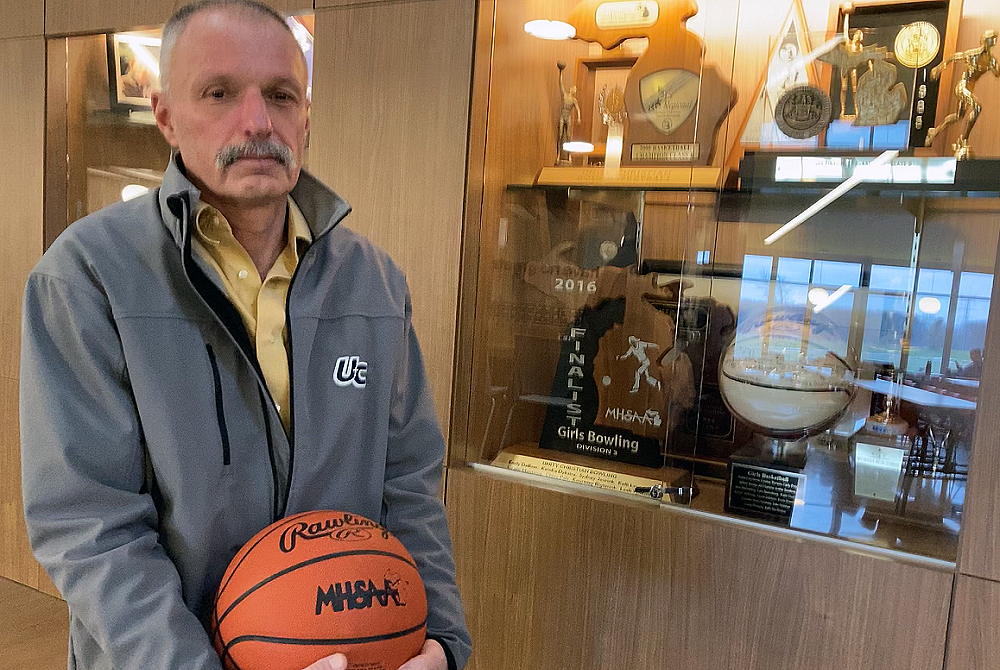
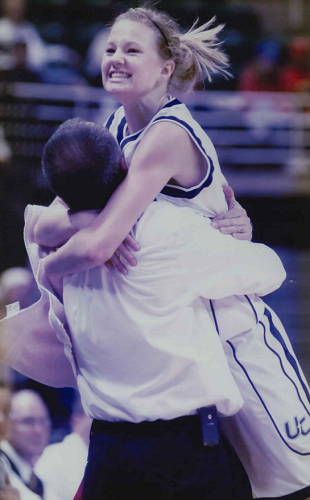
Among those highlight moments are being one of just three Michigan coaches to win both girls and boys MHSAA Finals championships (Paul Cook of Lansing Eastern boys/Lansing Catholic girls and Johnny Jones of Lansing Everett were the others), and the moment he claims is easily No. 1 on his all-time personal list: coaching his daughter Amber as part of the 2006 Class B champ. Unity Christian also won a 2019 boys state title. He also won a third Finals championship with the boys at McBain Northern Michigan Christian.
Soodsma, 63, admits there have been myriad changes in coaching basketball since his first season at North Dakota's James Valley Christian High School in 1983 and coming to Unity Christian in 1993. For starters, players are bigger and stronger and are more schooled in the game through AAU and offseason programs. In addition, the influence of parents – for better or worse – has increased dramatically. As for the on-court game, Soodsma unabashedly admits he at first fought the institution of the 3-point shot. And the emphasis on winning has definitely only increased pressure on many coaches.
Soodsma, a member of the Basketball Coaches Association of Michigan Hall of Fame who ranks ninth on the state's all-time boys wins list with 635, said he's adapted to the times. He wants to win as much as he ever has, still broods for days after losses and still considers himself receptive to the changing Xs and Os aspect of coaching.
But where his booming voice routinely used to resonate loudly into the middle sections of the Unity Christian bleachers, most of those comments now are only audible to fans perched in the first couple rows of the stands. Which is probably a good thing, Soodsma adds sheepishly.
 Coaching, he readily contends, is still coaching – and winning still heads the list of priorities. He does add one disclaimer, however, in terms of winning. Whereas it used to be about a young coach building a resume through wins, it's now about what winning can do for today's teenager athlete. An old-school coach? Yeah, probably. But one who has learned much about himself, players and parents after 41 years.
"I've learned to enjoy the kids more; I'm definitely a different kind of person in the ’90s as opposed to now in the 2000s," he said. "I am a stubborn man, and it took a long time (to change). But winning? Oh, yeah. I've never backed down. The winning and losing hasn't changed, and I make no excuses that I still want to win."
Which is then strange, perhaps, that he doesn't list being just one of two coaches to win Finals titles in both girls and boys basketball as the zenith of coaching for 41 seasons. That honor goes to having his daughter, who went on to a stellar career at Dort College, on the state championship club.
"It's not that big of a deal," he said of being on the bench for what likely will never happen again as boys and girls basketball are now in the same season. "To me it's not an accomplishment I would rank (at the top). I'm just being honest. Winning a state title with Amber, and the picture I have of her and me in my office, that's the best."
How well has Soodsma adapted his coaching style over the years? Two people in a position to know offer their own opinions on the topic, including 22-year assistant Bruce Capel and Randy Oosterheert, who with son Rylan are the only father/son combination that Soodsma has coached.
"Scott has always been vocal on the sidelines as a coach. As I sit in the stands and watch as a spectator, same Scott," said Randy Oosterheert who played for Soodsma in 1992-93 and 1993-94 and whose son is a current Unity Christian player. "I will say that my son and I agree, if you do something wrong on the floor, he is the first person to greet you on the sidelines and point out your failure. However, if you do good, he is the first person to greet you on the sidelines and tell you good job.
"The latter is done at a little lower decibel level than the offense, and those with a watchful eye from up in the stands unfortunately (don’t) get to hear the praise, only the punishment. Scott is obviously very competitive, then and now. He expects a lot but gives a lot."
As far as the competitive side, Capel hasn’t seen much of a difference over their two decades together.
"Certainly, coaching is a lot different in how you approach kids from more than 20 years ago," he said. "There's a difference in society and you have to change with it, and he's done that. I don't think it's as much life and death with Scott anymore. But in terms of winning, I haven't seen that go away."
It's a coin flip as for how much longer Soodsma will be directing traffic from the sidelines. He broke into the top 10 among the all-time winningest boys coaches in Michigan history by passing Warren De La Salle's Bernie Holowicki and Ray Lauwers of Morley Stanwood last season. Next on the list is Big Rapids' Kent Ingles (644). When you factor in Soodsma's win total as both boys and girls coach, the 742-and-counting combined wins rank eighth in state history.
He does admit the desire to spend more time with wife Mary, the longtime away scorekeeper for the program, and 11 grandkids scattered from Denver to Seattle to San Diego. Retirement could strike when this season ends in March, or it could still be several Marches away. But when the end comes he anticipates making a contented transition from arguing with officials, coming to an "understanding" with parents and devising new Xs and Os. Soon, he mused, will come time for much-anticipated passions such as hunting, fishing and pickleball.
"For the first time I've contemplated it," he said. "There are a lot of things I'd like to do. I'm not a basketball junkie."
That may be true. But it'll still be tough to surrender those noisy pep bands, bright gymnasium lights and the din of Friday night crowds.
PHOTOS (Top) Hudsonville Unity Christian boys basketball coach Scott Soodsma stands in front of a portion of the school’s trophy case, which he’s helped fill over decades coaching basketball. (Middle) Soodsma and daughter Amber embrace during their team’s 2006 Class B Final victory. (Top photo by Steve Vedder. Middle photo courtesy of the Soodsma family.)