

Breslin Bound: Boys A-B Semis Preview
March 20, 2013
By Geoff Kimmerly
Second Half editor
Some semi-ancient history is at risk of being updated during the Class A and B Finals this weekend at Michigan State University's Breslin Center.
Detroit Southeastern is seeking is first title since 1926 and Grand Rapids Christian since 1938. Wyoming Godwin Heights will play for its first championship game berth since 1960, but also as one of three Class B Semifinalists looking to win it all for the first time.
Standing in the way? In Class A, it's reigning champion Saginaw and heavy favorite Romulus. In Class B, one of the state's most successful programs ever, Detroit Country Day.
Below is the schedule for all four Friday Semifinals and Saturday Finals, plus broadcast information and a look at all eight A and B Semifinalists.
Semifinals - Friiday
Class A
Romulus (25-1) vs Grand Rapids Christian (20-6), 1 p.m.
Detroit Southeastern (20-5) vs Saginaw (23-3), 2:50 p.m.
Class B
Cadillac (21-4) vs Detroit Country Day (23-3), 6 p.m.
Detroit Community (17-9) vs Wyoming Godwin Heights (23-2), 7:50 p.m.
Finals - Saturday
Class A - Noon
Class B - 6:30 pm
Class C - 4:30 pm
Class D - 10 am
Tickets cost $8 per pair of Semifinals and $10 per two-game Finals session. All Semifinals will be streamed live on MHSAA.tv and available on a pay-per-view basis for $3.95 per day or $6.95 for the weekend. Saturday's first three Finals will be broadcast live on Fox Sports Detroit, with the Class B game on Fox Sports Plus and then re-broadcast on Fox Sports Detroit at 10:30 p.m.. Free radio broadcasts of all weekend games will be available on MHSAANetwork.com.
And now, a look at the Semifinalists in Class A and B.
Class A
DETROIT SOUTHEASTERN
Record/rank: 20-5, honorable mention
League finish: Second in Detroit Public School League East
Coach: George Ward, fourth season (82-15)
Championship history: Two MHSAA titles (most recently 1926), one runner-up finish.
Best wins: 54-49 (OT) over honorable mention Macomb L’Anse Creuse North (Regional Final), 54-49 over Rochester (Quarterfinal), 71-52 over Class B No. 4 Harper Woods Chandler Park, 48-44 over Class B No. 10 Detroit Douglass.
Players to watch: Jovone Haynes, 6-0 sr. G; Kenyatta Singleton, 6-0 sr. G. (Statistics not submitted.)
Outlook: Although Southeastern’s championships came in 1925 and 1926, they finished Class A runner-up only two seasons ago and with Singleton a prominent player off the bench. That Southeastern was likely the third-best Detroit PSL team during the regular season speaks to the league’s strength again this winter, and the Jungaleers lost to reigning Class A champion Saginaw and No. 8 Detroit Cass Tech by one point apiece and Ann Arbor Pioneer and River Rouge by only two each.
GRAND RAPIDS CHRISTIAN
Record/rank: 20-6, honorable mention
League finish: First in O-K White
Coach: Steve Majerle, first season (20-6)
Championship history: Lower Peninsula Class B champion 1938, one runner-up finish.
Best wins: 72-69 over No. 9 East Kentwood (District Semifinal), 64-61 over honorable mention Lansing Waverly (Regional Semifinal), 78-70 over honorable mention Holt (Regional Final), 64-61 over Muskegon, 70-59 over Class B No. 6 Wyoming Godwin Heights.
Players to watch: Drake Harris, 6-4 jr. G; Wuoi Mach, 6-4 sr. C. (Statistics not submitted.)
Outlook: Grand Rapids Christian has been surging with 10 straight wins and avenged a previous 24-point loss by beating Muskegon in the Quarterfinal. Harris is the catalyst and will try to add a basketball championship to the football title in which he played a large role at the end of November. Majerle previously coached Rockford to the 2003 Class A championship.
ROMULUS
Record/rank: 25-1, No. 2
League finish: First in Western Wayne Athletic Conference Blue
Coach: Nate Oats, 11th season (220-52)
Championship history: Class A champion 1986, one runner-up finish.
Best wins: 93-91 over No. 1 Detroit Pershing (Quarterfinal), 82-71 over No. 4 Saginaw Arthur Hill, 93-63 over No. 6 Saginaw, 75-65 over Class B No. 1 Detroit Country Day.
Players to watch: E.C. Matthews, 6-4 sr. G (16.2 ppg, 6.0 rpg); Leonardo Edwards, 6-8 sr. C (11 ppg, 7.0 rpg, 2.1 bpg), Wes Clark, 6-0 sr. G (11.8 ppg, 5.7 apg).
Outlook: Throw in wins over Lansing Sexton, Detroit Community, Detroit Douglass, Detroit Consortium, Chicago Seton and Indianapolis Cathedral, and no team in Michigan has defeated as impressive a slate. The Eagles’ lone loss was to Pershing by six in their second game this season, and Romulus avenged that Tuesday. Senior forward Jalon Plummer (11.2 ppg, 47 3-pointers) also adds double-digit scoring. Matthews has signed with Rhode Island, Clark with Missouri and Edwards with Louisiana Tech.
SAGINAW
Record/rank: 23-3, No. 6
League finish: Second in Saginaw Valley Association North
Coach: Julian Taylor, second season (48-5)
Championship history: Six MHSAA titles (most recently 2012), four runner-up finishes.
Best wins: 75-64 and 86-76 (District Final) over No. 4 Saginaw Arthur Hill, 57-56 over honorable mention Detroit Southeastern, 86-61 over Class B No. 4 Harper Woods Chandler Park.
Players to watch: Julian Henderson, 6-2 sr. G; Keyon Addison, 6-1 jr. G. (Statistics not submitted.)
Outlook: The Trojans have won three of the last six Class A championships, and Henderson was the second-leading scorer in last season’s title game win over Rockford. Saginaw already avenged its early loss to Arthur Hill, and no doubt would like to face Romulus again after falling to the Eagles in the regular-season finale.
Class B
CADILLAC
Record/rank: 21-4, unranked
League finish: Tied for first in Big North Conference
Coach: Jeff McDonald, 19th season (303-124)
Championship history: Has not played in an MHSAA Final.
Best wins: 41-29 over No. 8 Big Rapids (Semifinal), 47-46 over Petoskey, 56-53 over Traverse City West.
Players to watch: Nick Paquet, 5-9 sr. G (15 ppg, 45 3-pointers); Jalen Brooks, 6-4 jr. F (12.9 ppg, 5.5 rpg).
Outlook: Cadillac is 63-11 over the last three seasons with Regional championships to cap off each. The Vikings also won a share of their league title this season by avenging early losses against other sharers Petoskey and Traverse City West. They have good size, with five players 6-4 or taller, and plenty of balance; four more join Paquet and Brooks to average between four and seven points per game.
DETROIT COMMUNITY
Record/rank: 17-9, unranked
League finish: Second in Michigan Metro Athletic Conference
Coach: Venias Jordan, Jr., first season (17-9)
Championship history: Has not played in an MHSAA Final.
Best wins: 50-47 over honorable mention Jackson Lumen Christi (Quarterfinal), 61-48 over Class C No. 8 Melvindale Academy for Business & Technology,
Player to watch: Byron Zeigler, 6-6 sr. F (statistics not submitted).
Outlook: Don’t be fooled by Community’s nine losses. Instead, consider some of the teams they came against: Class A top-10 teams Detroit Pershing (by two), Cass Tech and Romulus, honorable mention Detroit Southeastern, ranked Class C Detroit Consortium and reigning Class D champion Southfield Christian, among others. Zeigler has signed with South Florida.
DETROIT COUNTRY DAY
Record/rank: 23-3, No. 1
League finish: Does not play in a league.
Coach: Kurt Keener, 35th season (676-180)
Championship history: Eight MHSAA titles (most recently 2010), one runner-up finish.
Best wins: 75-57 over No. 4 Harper Woods Chandler Park (Regional Semifinal), 73-51 over No. 10 Detroit Douglass (Regional Final), 68-48 over Class A honorable mention Macomb L’Anse Creuse North, 86-61 over Class A No. 4 Saginaw Arthur Hill.
Players to watch: Edmond Sumner, 6-3 jr. G (16.1 ppg, 6.2 apg); Austin Price, 6-3 sr. G (12.4 ppg, 4.2 rpg, 63 3-pointers, 3.2 spg); Mory Diane, 6-2 sr. G (12.1 ppg).
Outlook: A few fun Country Day facts: The last time the Yellowjackets didn’t make it to Breslin was 2009; the last time they finished a season with fewer than 20 wins was 2004. Country Day starts out small (relatively speaking; no player is shorter than 5-11) but can get big with future Texas Tech offensive lineman Poet Thomas (6-7, 285 pounds) off the bench. Price has signed with Lehigh and makes nearly 40 percent of his 3-point shots.
WYOMING GODWIN HEIGHTS
Record/rank: 23-2, No. 6
League finish: First in O-K Silver
Coach: Chad Conklin, sixth season (98-39)
Championship history: Two runner-up finishes (most recently 1960).
Best wins: 79-72 over No. 7 Comstock Park (Regional Semifinal), 56-52 over No. 2 Stevensville Lakeshore (Quarterfinal), 60-58 over Class D No. 1 Wyoming Tri-unity Christian
Players to watch: Jamal Bland, 5-10 sr. G (14.9 ppg, 3.2 apg); Quantrell Hastings, 6-1 sr. F (15.9 ppg, 7.3 rpg).
Outlook: One more win and Godwin Heights will have improved on or tied the previous season’s win total in all six of Conklin’s winters running the program. Senior guard Braima Hai (10.9 ppg, 5.2 apg) runs the show, and sophomore guard Delaney Blaylock (11.2 ppg) also scores in double figures.
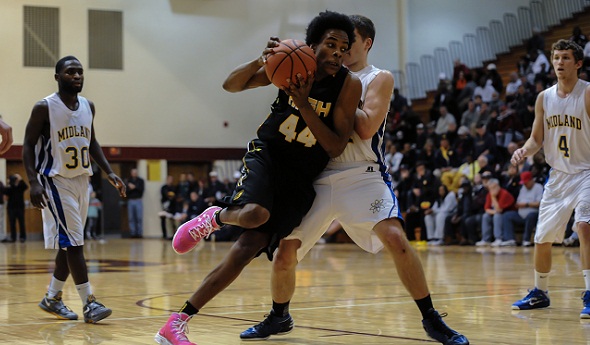
PHOTO: Saginaw junior Joseph Williams-Powell (44) drives against a Midland defender during the Trojans' Regional Semifinal win last week. (Click to see more at HighSchoolSportsScene.com.)
Breslin Bound: Boys Report Week 1
December 12, 2012
By Geoff Kimmerly
Second Half editor
Michigan’s top boys basketball teams traditionally waste little time each December seeing how they match up against the rest of the elite.
And last week proved no different, as major matchups and a few upsets in the Detroit and Grand Rapids areas no doubt caused some re-ranking in those regional pecking orders.
Below is a look at 10 teams who stuck out with their play last week. It isn't a state ranking – merely one of the week's notable performances.
Records and results are based on what has been reported to the MHSAA.com Score Center.
1. Detroit Pershing (2-0) – The Doughboys have been considered by most one of the top two teams heading into the season, along with Romulus. Pershing beat Romulus 83-76 and also downed River Rouge – another elite team – 68-48 during opening week.
2. Muskegon Heights (2-0) – Heights may have gone through a number of changes over the last year, but it remains elite on the court. The Tigers opened with a 74-50 win over Way Point, then defeated reigning Class A runner-up Rockford 60-59.
3. Grand Rapids South Christian (2-0) – The Sailors opened with a 54-42 win over Wyoming before notching a solid upset of 2012 Class A Quarterfinalist Grand Rapids Christian, 69-63.
4. Romulus (1-1) – The Eagles may have fallen to Pershing already. But they also opened with a 69-67 win over Dearborn Heights Robichaud – which earlier in the week beat Westland John Glenn, another considered among the elite heading into the season.
5. Holt (2-0) – The Rams have been more spoiler than contender of late in the powerful Capital Area Activities Conference Blue, but they could be back in the hunt. Holt opened with a 54-51 win over Lansing Waverly and followed by beating Lansing Eastern 69-60.
6. St. Joseph (2-0) – The Bears were a middling 11-10 last season, but opened this winter with two solid victories. They beat usual power Kalamazoo Central 73-65 and followed with a 53-37 win over Portage Northern.
7. Brown City (2-0) – Dan Blemaster was the point guard on the DeWitt team that made a surprise run to the 2004 Class B Final, and he has opened his coaching career with a pair of wins. Brown City beat Peck 37-33 and Armada 70-56.
8. Bloomfield Hills Andover (2-0) – Andover is playing its final season before merging with Lahser next fall. And after finishing 10-11 last season, the Barons got it going right last week with a 51-46 win over Farmington and a 78-48 victory over Cranbrook-Kingswood.
9. Muskegon (2-0) – The Big Reds are expected to do big things under coach Keith Guy, who came over from Heights this fall. So far, so good, with a 60-45 win over Holland West Ottawa and a 70-67 victory over Benton Harbor.
10. Grand Rapids Catholic Central (1-1) – The Eagles lost a tough one at the end of the week, 69-66 to Zeeland West. But they opened with a 77-67 win over Grand Rapids Christian.
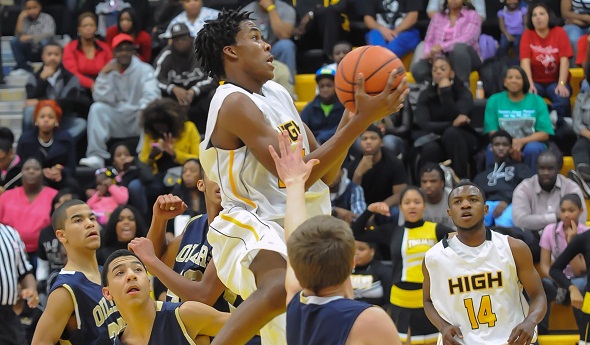
PHOTO: Saginaw, last season’s Class A champion, opened last week with a 78-60 win over Mount Pleasant. (Click to see more at HighSchoolSportsScene.com.)