

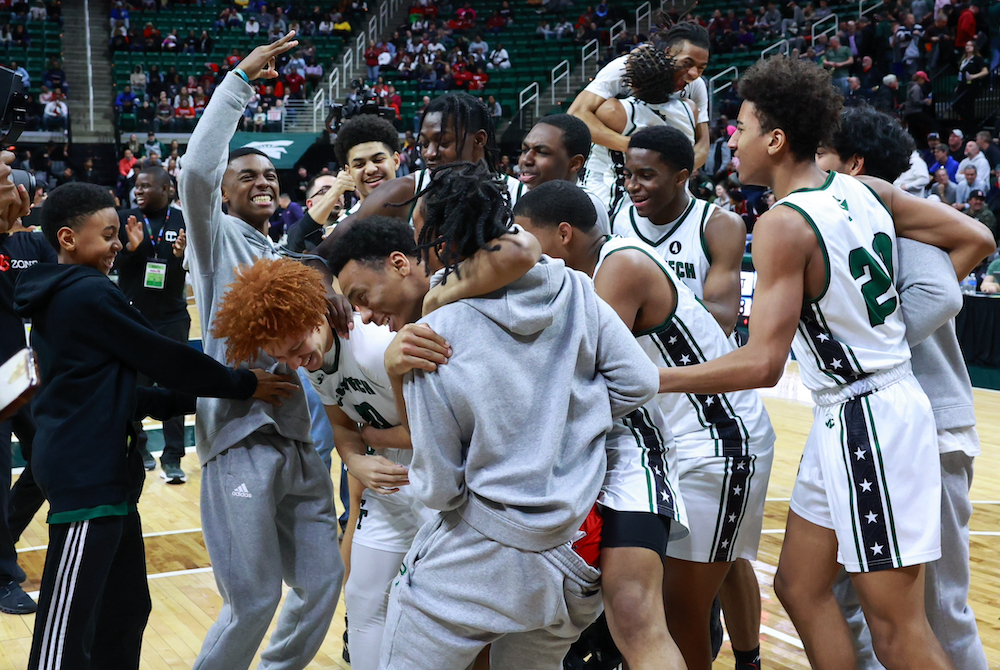
Cass Tech's Time Arrives as Technicians Claim Most Memorable Win
By
Keith Dunlap
Special for MHSAA.com
March 25, 2023
EAST LANSING — The Detroit Cass Tech boys basketball program no longer will have to look at all the state championship trophies and banners won by the football team in the school's halls and wonder when its time will be.
That time finally came Saturday.
After years of building toward this moment, the Technicians claimed to their first championship in boys basketball with a 78-63 win over Muskegon in the Division 1 Final at Breslin Center.
Cass Tech was in control throughout the game and for much of the season, finishing with a 27-1 record. The only loss was a one-point overtime defeat to Bloomfield Hills Brother Rice in the Operation Friendship title game.
Cass Tech’s previous best season was a Class A runner-up finish in 1974.
 “We had established that as a goal,” said Cass Tech head coach Steve Hall, who won three-straight Class D championships from 2003-05 coaching Detroit Rogers. “It looks good on paper, but to carry it out and pursue it, it is unbelievable what we’ve been able to do.”
Cass Tech led most of the way, but then had to deal with some adversity after Muskegon took a 47-46 lead with 1:46 left in the third quarter.
The Technicians responded beautifully, first closing the third quarter with four straight points to take a 50-47 lead. Cass Tech then opened the fourth with a 9-1 run to take a 59-48 lead on a layup by Sean Hodges with 3:54 remaining.
Muskegon never threatened the rest of the way as Cass Tech broke defensive pressure for layups and hit free throws in the final minutes.
Sophomore Darius Acuff, who banked in a tying 3-pointer in the final seconds to force overtime in Friday’s Semifinal win over Grand Blanc, and senior Travon Cooper both scored 19 points to lead the way for Cass Tech.
Cooper also pulled down eight rebounds, and senior Kenneth Robertson added 15 points for Cass Tech.
The Technicians dominated along the interior, collecting 40 points in the paint to just eight for Muskegon.
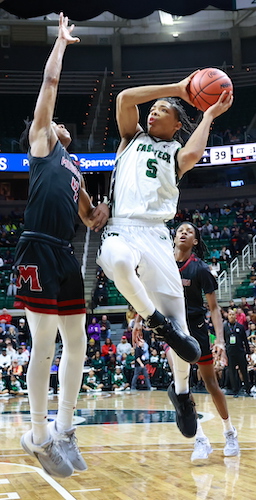 “In the fourth quarter, we had to come together and talk to each other as a team,” Acuff said. “Just talk to each other and listen to Coach, and just respond. We didn’t want to go out like that. We had to make a run, and everyone contributed.”
Senior Jordan Briggs scored 19 points, and senior David Day added 15 to lead Muskegon (26-3).
“There was no flow to the game,” Muskegon head coach Keith Guy said. “But in these games there is going to be adversity, and the teams that handle it best are going to win.”
After Cass Tech took a 45-36 lead with 6:15 left in the third quarter, Muskegon made a charge, going on an 11-1 run to grab a 47-46 advantage with 1:46 remaining in the third after a 3-pointer by Justin Watson.
Cass Tech held a 14-11 lead after the first quarter, and then the second quarter was a high-octane period more reminiscent of an NBA game.
Muskegon scored 20 points in the second, but Cass Tech was even better, scoring 27 in the frame to take a 41-31 lead at halftime.
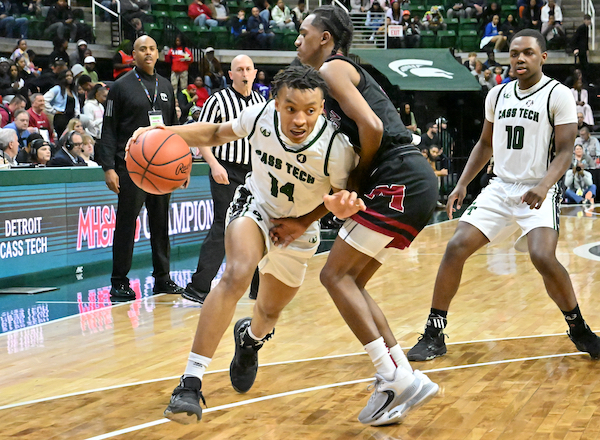
PHOTOS (Top) Detroit Cass Tech players celebrate their Division 1 championship win Saturday along with a last-second 3-pointer by teammate Mathieu Collins (30). (Middle) The Technicians’ Kenneth Robertson (14) makes his move toward the basket. (Below) Cass Tech’s Darius Acuff (5) works to get a shot up over Muskegon’s Anthony Sydnor III.
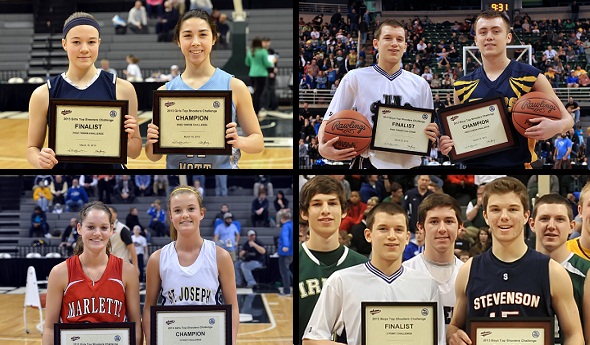
Shooters Rain Supreme at Breslin Center
March 28, 2013
The Basketball Coaches Association of Michigan awarded its top 3-point and free-throw shooters at the championship game halftimes during the Boys and Girls Basketball Finals over the last two weekends.
Four champions were crowned, while the same player finished runner-up for both boys contests.
All four shooting championship matches were broadcast on MHSAA.tv and can be watched by clicking the links below.
Girls free throw: Waterford Mott junior Lauren Hung defended her "Top Shooters" title by winning this competition for the second straight season, this time over Lincoln Alcona junior Karina Cole. Click to watch.
Girls 3-point: St. Joseph senior Lauren Brower defeated Marlette senior Jenna Hirsch for the championship. Click to watch.
Boys free throw: Carsonville-Port Sanilac senior Matt Falls edged Shelby junior Jason Beckman. Click to watch.
Boys 3-point: Sterling Heights Stevenson junior Brandon Hughes finished ahead of Beckman. Click to watch.
PHOTO: (In clockwise order) Top Shooters champions for girls free throw, boys free throw, boys 3-point and girls 3-point contests pose with their finalists certificates at the Breslin Center.