

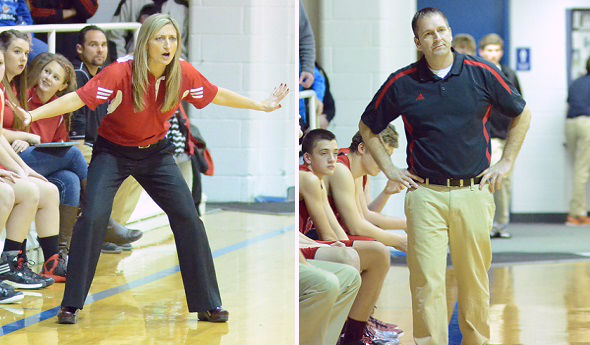
Coaching Couple Guide Rising Cardinals
By
Dennis Chase
Special for MHSAA.com
January 21, 2016
By Dennis Chase
Special for Second Half
JOHANNESBURG – It's Thursday – game day in the Huff household.
 Nothing unusual about that. Most winter days are game days for Heather and Troy Huff, the head varsity basketball coaches at Johannesburg-Lewiston High School.
"Monday is usually the only night we eat at home as a family," said Heather, who is in her 15th season as the girls coach.
This week's schedule is as hectic as ever – the boys hosted Bellaire on Tuesday, the girls entertained Onaway on Wednesday, the boys travel to Pellston tonight and the girls head to Mancelona on Friday.
On Saturday, the Huffs will be in Houghton Lake to watch their 12-year-old son Sheldon play.
Sunday? It's back to practice.
"We get a lot of basketball this time of year," said Troy, now in his fourth season as boys coach.
Winning basketball, too. Propelled by a strong senior class, the Cardinals are off to a combined 14-2 start – the boys are 6-1 and the girls 8-1.
The girls record is not a surprise. The Cardinals are averaging 16 wins a season under Heather Huff, who is 234-89 since she took over from her mentor, Rick Guild, who won 443 varsity games during his Basketball Coaches Association of Michigan Hall of Fame career.
The boys, though, are reaching for new heights. Troy Huff inherited a struggling program when he took over in 2012. The Cardinals finished with 10 victories that first season, and then jumped to 16 wins a year ago.
"It's amazing how far the team has come in four years," Troy said. "We had five coaches in 10 years (previously). You can't build a program like that."
Coaching stability has been a key to success at Johannesburg-Lewiston. The football program, which has won 61 percent of its games since starting the sport in 1969, has had just three head coaches since 1983. Girls basketball has had two since 1975. Kevin Kennedy will be starting his 30th season in the spring with girls track & field, a program he's led to seven league and six Regional titles. Guild is gearing up for his 41st season as baseball coach for the Cardinals, who have won 15 Districts and three Regionals in that span.
"We've been able to keep that continuity (in those programs), and that's huge," athletic director and football coach Joe Smokevitch said. "Year after year after year, the kids know the expectations."
The Huffs set the bar high in basketball.
"Troy and I were raised to work hard and set high expectations for ourselves," said Heather, who teaches math and health at the middle school. "We (ask) that from the kids that we coach, too. We hold them to a high level of accountability. I think when you do that, you get out of them what you expect out of them."
Troy agrees.
"I don't accept that 'I can't do it' type attitude," he said. "You have to push yourself to that next level."
On the court, the results are apparent.
The girls, led by four-year veterans Madison Showerman and Kelsey Cherwinski, are in contention for another Ski Valley Conference crown. The 5-foot-11 Showerman is averaging 25.3 points, 11 rebounds and 4.3 steals per game. She just went over the 1,000-career point mark. The 5-5 Cherwinski is averaging 16.2 points, 5.2 steals and 4.4 assists. The Cardinals also are getting strong play from two other seniors, Kate Heidman and Sarah Korff.
As in the past, Johannesburg-Lewiston likes to pressure the ball on defense, creating scoring opportunities off turnovers. And when the Cardinals clear a defensive rebound off the glass, they like to get out in transition.
If the fast break is not there, the Cardinals can turn to an improved halfcourt offense, Heather Huff said, that features Showerman's developing skills inside.
Another four-year varsity veteran, Logan Huff – Heather and Troy's middle son – is a key cog on the boys team. The 5-11 point guard, who carries a 3.99 grade-point average, also is averaging 18 points a game and surpassed the career 1,000-point mark earlier in the season. Troy's nephew, Brandon Huff, is a 6-3 forward who averages better than 15 points per contest. Seniors Nathan Fox, Brent Carpenter and Ori Kierczynski add to the attack. The 6-7 Carpenter, who is averaging close to 10 points, suffered a bone bruise four games into the season, so Tyson Claeys, a 6-3 freshman, stepped up, and is averaging nearly a double-double.
Troy Huff said that balance is the strength of his team.
"We have (multiple) guys that can score," he said. "It's not unusual to have three to four guys in double figures."
The Cardinals are pursuing their first boys league title since 1981. But it just got more challenging. They suffered their first loss Tuesday to Bellaire. The girls lost to Bellaire last week.
“That will be a great motivator for us,” Heather said.
Now, it will be for the boys, too.
For the Huffs, coaching at Johannesburg-Lewiston completes a circle. It’s where they went to school, where their sports journeys began.
Heather was a standout player under Guild, scoring 1,216 points during her career. She played at Alma College for a couple seasons before turning to coaching, starting at the middle school level in Alma, Breckenridge and Gaylord before returning home. She spent six years as an assistant and junior varsity coach before succeeding Guild. Her 2009 team reached the Class D MHSAA Semifinals.
Troy was a captain on the football and baseball teams in high school, but did not play basketball.
"That's one of my regrets," he said.
Troy Huff went on to spend 25 years in law enforcement, retiring from the Gaylord Police Department in 2013.
With three sons active in sports, he took on a second job during those years, coaching youth sports.
“It was in my blood,” he said.
Huff was still working in the police department when he accepted the boys varsity basketball job. Not long after, he agreed to be an assistant to Guild in baseball.
Smokevitch said Huff's personality is what stood out when he took over the basketball program.
"He's a take-charge guy," said Smokevitch. "He has that no non-sense (attitude) about him, similar to the way I coach (football)."
Huff also knew the kids. He coached most of them in youth sports.
Huff has had the joy of coaching two sons on varsity – Coalton and Logan. Sheldon, the team manager, is coming up through the ranks.
The Huffs agree the best part of their jobs is simply working with their players and “helping them be the best they can be.”
"Just watching each player develop, watching them work together as a team, and having some influence on that, is rewarding," said Heather.
That's not lost on Smokevitch. He’s seen Heather teach her craft on the court for all 15 years as head coach.
"She's constantly working with the kids, constantly teaching," he said. "I read a quote from John Wooden the other day. He said, 'It's not coaching, it's teaching.' That's what Heather does."
Smokevitch said this is a special time at the school. Teams are doing well across the board.
"We have great kids," he said.
Not just in talent, but character, he added.
Take Logan Huff, Brandon Huff and Fox, for example. They were three-year starters for Smokevitch n football. The Cardinals finished 9-2 in the fall, losing by six and eight points to St. Ignace, an eventual Division 8 semifinalist.
Brandon was the pass-run threat at quarterback, Logan was a 1,000-yard rusher and became the school's all-time leading tackler, while Fox was an all-state punter.
They visited Finlandia University in Hancock late last week and then returned home in time to attend a birthday party for Smokevitch's 7-year-old son, Joey.
"He invited those three to come to his bowling party," said Smokevitch. "They all showed up, bowled, brought presents, had pizza and cake, and hung out with a bunch of 7-year-olds. That shows you what kind of kids they are, the upbringings they've had.
"It's that small-town school atmosphere. Our school is one building, K through 12. The younger kids see the (high school) kids all the time. My son idolizes those kids, and they accept him right back."
In another month or so, those three boys, along with their teammates, would like to be accepting a league championship basketball trophy. The girls would like to be celebrating a title, too.
But there are still a lot of game days ahead. Just ask the Huffs.
 Dennis Chase worked 32 years as a sportswriter at the Traverse City Record-Eagle, including as sports editor from 2000-14. He can be reached at [email protected] with story ideas for Manistee, Wexford, Missaukee, Roscommon, Ogemaw, Iosco, Alcona, Oscoda, Crawford, Kalkaska, Grand Traverse, Benzie, Leelanau, Antrim, Otsego, Montmorency, Alpena, Presque Isle, Cheboygan, Charlevoix and Emmet counties.
PHOTOS: Heather Huff, left, and husband Troy coach the girls and boys varsity basketball teams, respectively, at Johannesburg-Lewiston. (Photos courtesy of Brandon Folsom/Gaylord Herald Times.)
All-Time Leading Scorer Allen Ready to Set Pace for Wayne Memorial's Title Pursuit
By
Keith Dunlap
Special for MHSAA.com
February 20, 2026
WAYNE — Jaylohn Allen insisted making such history wasn’t one of his goals when he started his varsity basketball career as a freshman.
 Given that, it made the moment all the more special last week.
During a game against Harvey Thornton (Ill.) on Valentine’s Day, Allen and the Wayne Memorial community loved seeing a 30-year-old record broken by Allen, who became the boys basketball program’s all-time leading scorer.
Allen surpassed the 1,748 career points scored by former Michigan State player Lorenzo Guess, who finished his career in 1996.
“To be the all-time leading scorer at Wayne Memorial High actually wasn’t one of my goals coming in as a freshman,” Allen said. “And honestly I didn’t really think I was going to pass it because 1,700 points is a lot of points, per se. To do that as a kid who grew up with many accomplishments and dreams I wanted to have was a joy. I thought 1,000 points was surreal, but the record meant so much more.”
Signed to play in college for Toledo, Allen certainly has meant a lot to Wayne Memorial over the past four years, and he hopes to make even more history for the Zebras over the next few weeks.
Allen is averaging nearly 23 points a game this season and is determined to try and get Wayne Memorial back to the Division 1 championship game, where it loss last year to East Lansing.
When the Zebras accepted the Finals runner-up trophy, they obviously had immediate reason for optimism given Allen and fellow backcourt mate Carlos Medlock – a Michigan State signee – were only juniors.
But Medlock threw a major wrinkle into Wayne Memorial’s title ambitions when he decided over the offseason to transfer to a prep school in Missouri.
“I found out maybe a week before he posted on social media,” Allen said of Medlock’s decision. “There were rumors about it, but I didn’t really think he was going to leave. It was a shock, but I was still ready to attack the senior season regardless of what happened and look forward to the senior season with or without him.”
Allen has certainly done that and more.
 Instead of pouting or looking to leave himself, Allen treated Medlock’s departure as a chance to prove he was a worthy Mr. Basketball Award candidate this winter.
Over the summer, he worked to get in terrific shape and continued to not only hone his on-court talents, but became an even more vocal leader to younger players coming back.
“It put me into a bigger role and let people see I can score the ball even more than I’ve been doing the past three years,” Allen said. “It put a fire in me and some motivation that I could be more of the man with the ball.”
One person not surprised that Allen adapted so well without Medlock was Wayne Memorial head coach Steve Brooks.
“He’s pretty much always been the man; he just hadn’t been the leading scorer all the time,” Brooks said.
Allen said there were adjustments playing without his running mate of the last three years, especially when trying to get out in transition.
“Being on the floor and not seeing (Medlock) on the other side of the court and being able to swing it to him — it was just a connection in transition or any other core set that we had,” Allen said. “(The adjustments were) just realizing he’s not on the court and having to utilize my other teammates and making sure they are getting everything they need.”
There was a major scare in December, just before the holiday break, when Allen left a game with a knee injury after he took a charge.
“We thought he was lost for the year,” Brooks said.
But the injury was only a bone bruise, and Allen missed just 13 days and has been an unstoppable force since.
To Brooks, it’s obvious who should be Mr. Basketball.
“Mr. Basketball traditionally is for what you’ve done for your career and not just for a season,” Brooks said. “Over his career, he’s at 19 points a game. Him and Medlock both had 1,000 career points before Christmas of their junior year.”
While Mr. Basketball would be nice and the scoring record is an honor, there is one main purpose for Allen, and that is to get another shot at the Division 1 title that eluded Wayne Memorial last year.
The Zebras enter tonight’s Kensington Lakes Activities Association championship game 18-3 and carrying a 10-game winning streak.
“I want them to get there more than me,” Allen said of his teammates. “I want them to show me how much they want to be there so when it comes down to it, we’re ready for it.”
 Keith Dunlap has served in Detroit-area sports media for more than two decades, including as a sportswriter at the Oakland Press from 2001-16 primarily covering high school sports but also college and professional teams. His bylines also have appeared in USA Today, the Washington Post, the Detroit Free Press, the Houston Chronicle and the Boston Globe. He served as the administrator for the Oakland Activities Association’s website from 2017-2020. Contact him at [email protected] with story ideas for Oakland, Macomb and Wayne counties.
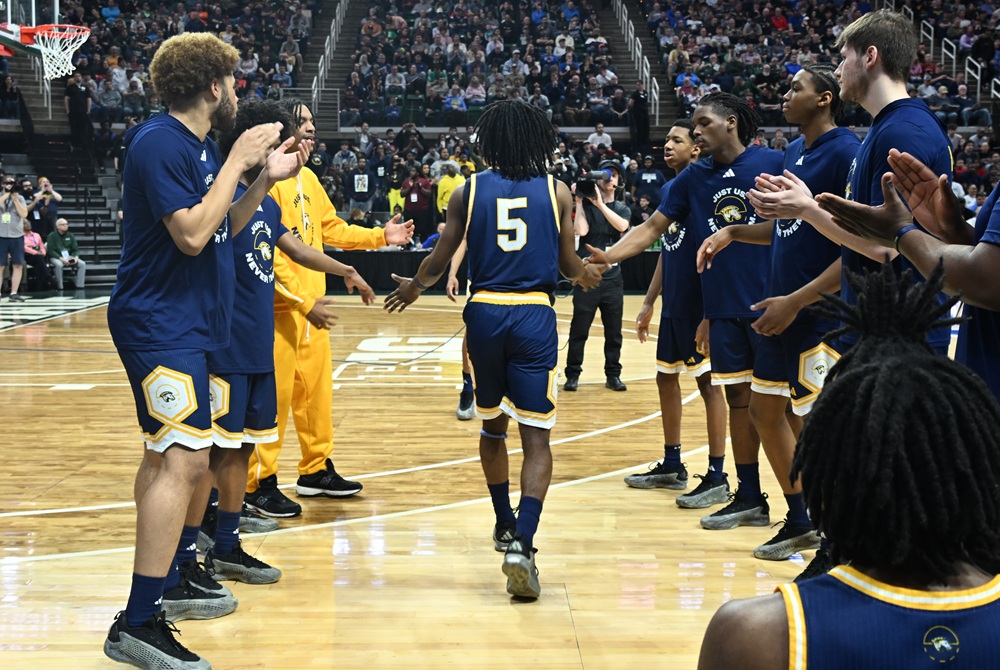
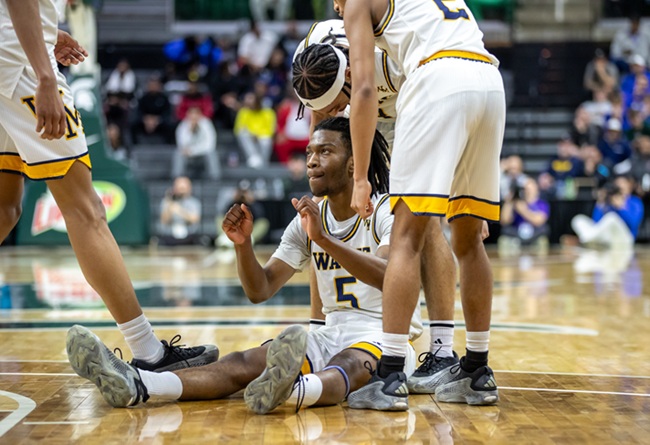
PHOTOS (Top) Wayne Memorial’s Jaylohn Allen (5) makes his way through his teammates during introductions before last season’s Division 1 Final at Breslin Center. (Middle) Teammates help Allen up from the floor during the Zebras’ Semifinal win.