

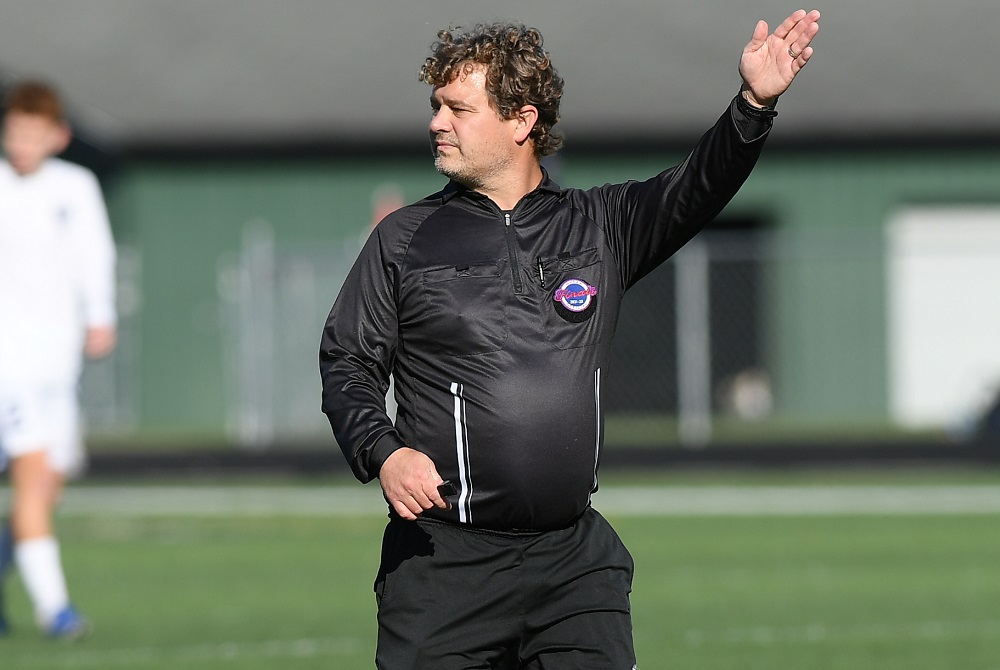
Be the Referee: Soccer Timing
By
Sam Davis
MHSAA Director of Officials
September 20, 2022
Be The Referee is a series of short messages designed to help educate people on the rules of different sports, to help them better understand the art of officiating, and to recruit officials.
Below is this week's segment – Soccer Timing - Listen
One of the biggest complaints people make about professional soccer is never knowing how much time is really left in the game. The clock counts up from zero, and the referee can add time at their discretion.
But that’s not the case in high school soccer.
To start with, halves are 40 minutes, not 45. The clock starts at 40 and counts down. And when players are injured and the ball is not in play, the clock will stop and then restart when action is ready to continue.
In the last five minutes of the game, the clock stops for substitutions by the leading team, so a coach can’t stall by sending in a new player. When the clock hits zero and the buzzer sounds … the game is over. There’s no guessing how much added time there is – the end of the game is the end of the game.
Previous Editions:
Sept. 13: Volleyball Replays - Listen
Sept. 6: Switching Sides - Listen
Aug. 30: Play Clock - Listen
Aug. 23: Intentional Grounding Change - Listen
Boyne Mountain Invitational Welcomes 29 Teams, Multiple 2025 Finals Champions
By
Tom Spencer
Special for MHSAA.com
August 28, 2026
Boyne Mountain has provided memorable championship experiences over several years as a regular host of the MHSAA’s Girls & Boys Ski Finals.
 Now it’s become the field of dreams for boys soccer as well.
Since 2023, some of the state’s top soccer programs have started the season at Boyne, participating in the Boyne Mountain Invitational. This year’s event featured 29 teams, including two 2025 Finals champions.
“It's a massive state – from Marquette to Monroe, Leland to Hartford – we spanned all of it, and undoubtedly we had a 2026 state champion in attendance … or four,” said Jeff Suffolk, tournament director and boys soccer coach of Harbor Springs, the official tournament host. “I have this innate desire as a coach to teach kids how to believe in themselves. A lot of these kids that live this far north never get to see those teams that they may see in the Finals in November.”
Boyne first hosted soccer in 2022 as preseason scrimmages. Twenty-two teams competed last August, including Leland and Warren De La Salle Collegiate, the eventual champions of Divisions 4 and 2, respectively.
“I think we had 12 teams up there for it,” Suffolk recalled of the first soccer played at the Boyne Mountain Sports Complex. “It's a really nice venue to host everybody, and the legend of the of the kids' experience kept growing and parents wanted to be a part of it. So that was kind of how we got to where we're at now.”
Leland is one of the many programs benefiting from the tournament’s popularity. The Comets, also Division 4 champions in 2018, have been a part of it the past two years.
“We actively go off and always try to find the best teams to play,” Leland coach Rob Sirrine said. “I think it's just a fun event, and the teams keep coming back. Special thanks to Jeff Suffolk, because it takes a tremendous effort to pull this off.”
 This year Leland sandwiched a 2-0 loss to Detroit Country Day, last year’s Division 3 champ, between ties with Bloomfield Hills Cranbrook Kingswood and Plymouth Christian Academy.
“You have to score goals to win, and I think we learned we don’t have to get the perfect shot to score,” Sirrine said of the Comets’ games at Boyne. “And I do think defensively we’re solid.”
Leland will now move on to the Elk Rapids Cherry-Kee tournament this weekend playing Muskegon Western Michigan Christian. Elk Rapids also will play WMC along with Williamston.
The Elks, who fell 3-2 to Pontiac Notre Dame Prep in the 2024 Division 3 Final and ended last season in the Regionals, played Grand Rapids South Christian, Eaton Rapids, and Country Day at Boyne this time. They tied Country Day and won their other two matches.
Host Harbor Springs, having capped last season with a 4-1 Regional loss, got off to a rough start at the tournament – but it didn’t discourage Suffolk.
The Rams tied 2001 Division 3 champ Ludington, 0-0, dropped a 3-0 decision to Country Day and fell 4-0 to Cranbrook.
Harbor was playing without senior all-stater Henry Juneau, who broke his shoulder during preseason football while planning to dual-sport this fall. Also, standout sophomore center back and captain Alex Marquardt left the Rams’ first game early with a broken nose after being accidentally kicked in the face. Marquardt and Juneau are expected to miss a good portion of the fall season.
Juneau scored 48 goals last year for the Rams and added 16 assists. With 141 career goals, he ranks among the MHSAA’s all-time leading scorers.
“The boys learned how to play low block, and they did it really, really well,” Suffolk said of the Rams’ adjusting to the losses of Marquardt and Juneau. “By the end of the weekend, they were phenomenal at it, and they held Notre Dame to zero, and we even actually had chances to beat Notre Dame. I thought Notre Dame was one of the better teams there, … They beat Country Day. They beat De La Salle. They beat Marquette.”
Suffolk, who quickly added Romeo or Birmingham Seaholm also were among the best in the tournament, if not the best, received considerable positive feedback on Northern Michigan also offering tremendous team-building activities for teams with its rivers, lakes and campgrounds.
 Those extra activities will be available next year, even if the tournament ends up being played right in Harbor Springs, home of Ottawa Stadium.
“This is six years of the making, and we look forward to next year,” Suffolk said. “I kind of want to move into Harbor Springs because I think the experience would be cooler … having the town right there would be great for the parents and Ottawa Stadium is such a cool venue. A lot of people have never seen that place before. I'd like to expose them to that as well. too.”
More credit, too, goes to the school district’s administration, especially athletic director Chris Gallagher.
“I give the administration a lot of credit for being brave and trusting me to produce something like this,” Suffolk said. “There has been tons of support from the administration.”
 Tom Spencer is a longtime MHSAA-registered basketball and soccer official, and former softball and baseball official, and he also has coached in the northern Lower Peninsula area. He previously has written for the Saginaw News, Bay County Sports Page and Midland Daily News. He can be reached at [email protected] with story ideas for Manistee, Wexford, Missaukee, Roscommon, Ogemaw, Iosco, Alcona, Oscoda, Crawford, Kalkaska, Grand Traverse, Benzie, Leelanau, Antrim, Otsego, Montmorency, Alpena, Presque Isle, Cheboygan, Charlevoix and Emmet counties.
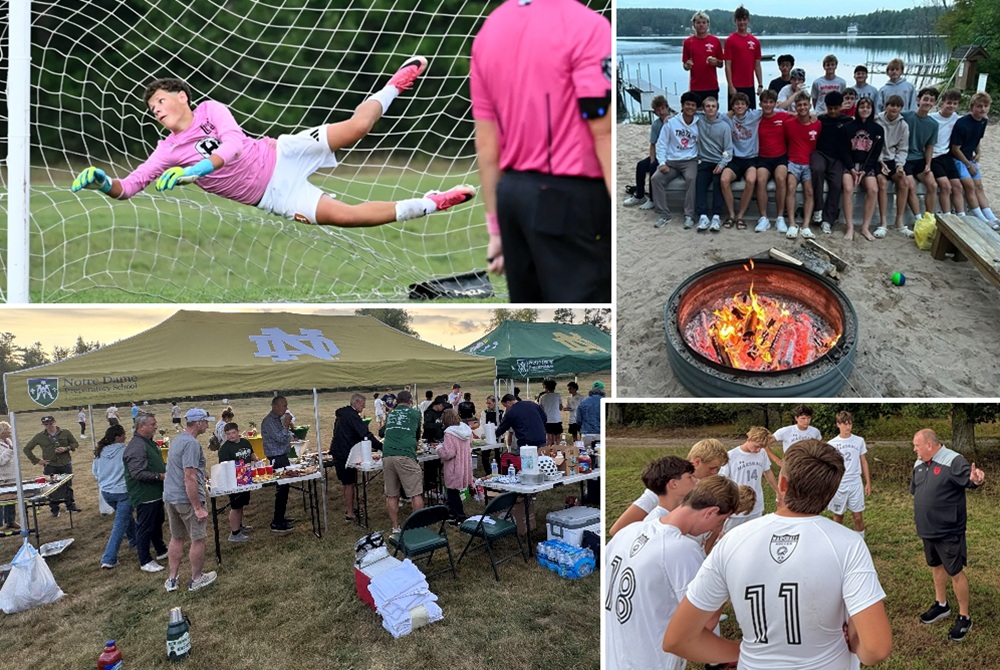
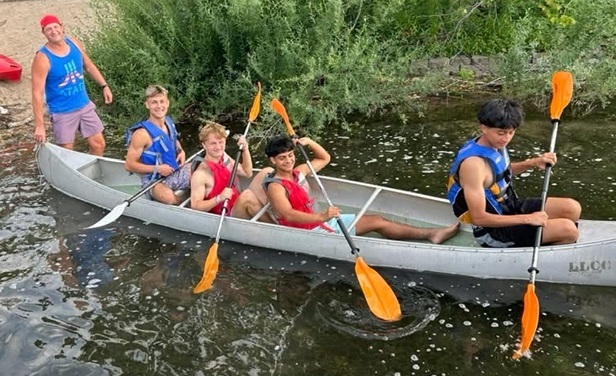
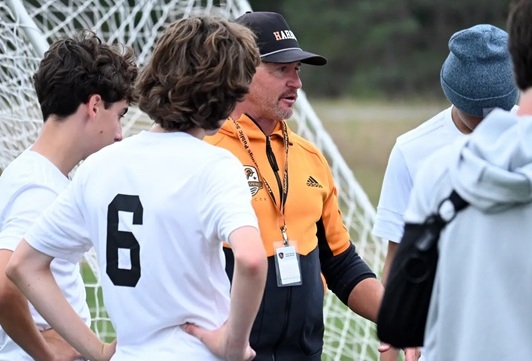
PHOTOS (Top) Clockwise from top left: Harbor Springs keeper Turner Schultz dives to his right to stop a shot. Monroe players enjoy some time by the fire. Marshall players and their coach huddle during a break in their tournament schedule. Pontiac Notre Dame Prep supporters tailgate. (Middle) Visiting players take advantage of a chance to go canoeing. (Below) Harbor Springs coach Jeff Suffolk talks things over with his team. (Harbor Springs photos by Drew Kochanny/Petoskey News-Review. All other photos courtesy of Jeff Suffolk.)