

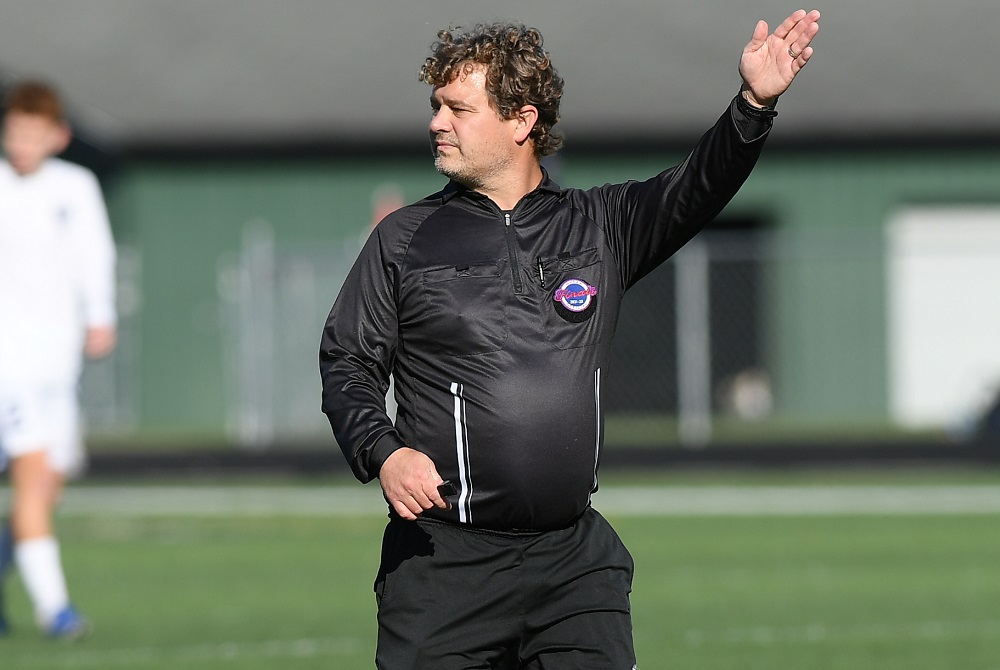
Be the Referee: Soccer Timing
By
Sam Davis
MHSAA Director of Officials
September 20, 2022
Be The Referee is a series of short messages designed to help educate people on the rules of different sports, to help them better understand the art of officiating, and to recruit officials.
Below is this week's segment – Soccer Timing - Listen
One of the biggest complaints people make about professional soccer is never knowing how much time is really left in the game. The clock counts up from zero, and the referee can add time at their discretion.
But that’s not the case in high school soccer.
To start with, halves are 40 minutes, not 45. The clock starts at 40 and counts down. And when players are injured and the ball is not in play, the clock will stop and then restart when action is ready to continue.
In the last five minutes of the game, the clock stops for substitutions by the leading team, so a coach can’t stall by sending in a new player. When the clock hits zero and the buzzer sounds … the game is over. There’s no guessing how much added time there is – the end of the game is the end of the game.
Previous Editions:
Sept. 13: Volleyball Replays - Listen
Sept. 6: Switching Sides - Listen
Aug. 30: Play Clock - Listen
Aug. 23: Intentional Grounding Change - Listen

Be the Referee: Fumble Out of Bounds
By
Paige Winne
MHSAA Director of Brand Management
August 25, 2026
Be The Referee is a series of short messages designed to help educate people on the rules of different sports, to help them better understand the art of officiating, and to recruit officials.
Below is this week's segment – Fumble Out of Bounds - Listen
We are on the football field today, where the offense has the ball on their own 20-yard line. It’s 3rd-and 10. They run a draw play, with the running back gaining nine yards before fumbling at the 29 yard-line.
The fumbled ball goes forward to the 35-yard line before another offensive player recovers. Where should the ball be marked?
Because the ball was recovered in-bounds, it’s first down for the offense at the point of recovery, the 35-yard line.
If the ball had rolled out of bounds at the 35-yard line, before anyone could recover it, it would have been brought back to the spot of the fumble – the 29-yard line – making it 4th-and-1 for the offense.
(Photo by Larry Arreguin/Team Arreguin Photos.)