

Roscommon Star Keeper Home Again, Providing Expertise as TC West Team Doctor
By
Tom Spencer
Special for MHSAA.com
November 20, 2026
Jason Carmien was coaching Traverse City West when he first saw Grant Carey on the pitch two decades ago as a star goalkeeper for Roscommon High School and his travel soccer team.
 West and Roscommon both reached the MHSAA Finals in 2006. West won 1-0 over Livonia Stevenson in Division 1, and Roscommon fell 6-4 to Richmond in Division 3.
Today, Carmien and Carey are on the same team. Carmien is the Traverse City West athletic director, and Carey is the Titans’ first-year team physician.
They’ve seen a lot of changes in high school sports since they crossed paths initially nearly 20 years ago. And all for the better, they say, especially in player safety when it comes to returning to play from head injuries.
“Concussion protocols certainly weren't a thing in the late 90s when I began coaching at West. … The evolution of care for our student athletes and how we address these types of injuries has been a key step in student safety,” said Carmien. “Munson (Medical Center) has been a key partner in developing our baseline concussion testing and protocols over the years. Grant was a great soccer player at Roscommon, and I would imagine he didn't have the support in place like we do today for athletes and these types of injuries.”
Carey was on the sidelines for all West football game this fall and provided support for certified athletic trainer Mikayla Scholts as she took care of soccer, golf, tennis, volleyball and cross country athletes. They’re now moving into wrestling, swimming & diving, bowling, hockey, skiing and basketball as winter sports commence.
West administration was happy to have Carey come on board along with Scholts, who is also in her first year with the Titans.
“Tom O'Hagen worked with West students for many years and had tons of professional experience with the Philadelphia pro teams like the Eagles and Phillies,” Carmien said of the medical support West has received over the years. “Having Dr. Carey step in has been seamless. Mikayla and Grant have been a big value add for us as our students and families get top level care. We have been lucky to have folks like John McDougall, Anthony Cillufo, Taylor Chaulk in the past and now Mikayla Scholts.”
The services of Scholts and Carey are provided through a partnership with Munson orthopedic and sports medicine and Mary Free Bed. They’re providing medical services, offering advanced treatment options, specialized surgical expertise and rehabilitation services.
Carey, who went on to play soccer for Kalamazoo College before med school, was happy to have the opportunity to return to Northern Michigan and be around high school sports again. He came home with extensive professional sports team physician experiences. He earned his medical degree from the University of Michigan and completed his orthopedic surgery residency at the renowned Hospital for Special Surgery in New York City, where he worked with the New York Giants, New York Mets and New York Knicks. He then completed advanced fellowship training in sports medicine, shoulder and elbow surgery at OrthoCarolina in Charlotte, N.C. During his fellowship, he served as an associate team physician for the Carolina Panthers, Charlotte FC, and the Charlotte Knights, a minor league professional baseball team.
“Now we're in Traverse City, and I’m covering West,” he said, recalling memories of his NorthStorm club teammates playing for the Titans. “It's this crazy full circle moment of life, seeing totally different environments of sports medicine, from all over the country, and then now I'm back to where I played club soccer and it's kind of just turned out to be a dream come true. I didn't grow up in Traverse City but a lot of my athletics took place here. It was so much fun.”
Carey believes treatments of professional athletes’ injuries has led to improvements for high school athletes.
“I think what kind of led the charge on that front is the NFL, truthfully,” Carey said. “Now if a kid comes to the sideline and Mikala evaluates them, and they any symptoms at all, it’s now concussion protocol. The timer starts and once you stop having symptoms, it's one week mandatory out before a return. Concussions aren't necessarily something I routinely treat, but I do see them a lot. But what's nice is Munson has a ton of neurologists that we can get them plugged into.”
Carey works closely on a daily basis with Scholts.
“We text every day and we talk on the phone about all the kids so it’s better coordination of care,” Carey said. “It’s Mikayla that I would consider the captain of the whole show on the sideline.”
If surgery of any sort is necessary, the team physician can help navigate the way through the health system for the athlete and his or her family.
“I view my role as I'm there for support and expertise if they need it, but really where the partnership kind of provides value is access for the kids,” Carey said. “We have streamlined their ability to get into clinic to see us even with same-day appointments. If there's a football game on a Friday and a kid gets hurt, they're first on my schedule on Monday. And we have ways that we streamline their ability to get imaging done. We want to get the kids in, get them diagnosed, and come up with a game plan so they can get back on the fields.”
Carey, who also collaborates to facilitate services for athletes with Northern MI Hand Surgery, was thrilled to report no surgeries were needed resulting from injury to West athletes this fall.
“We do our best to mimic what the DI college and professional athletes get,” Carey said. “Ideally world class care essentially immediately.”
In addition to concussion protocols coming into place in high school sports, Carey has seen an increase in anterior cruciate ligament (ACL) injuries. Research is connecting the increase to kids playing one high school sport year-round.
“What seems to continue popping up is playing one sport from a really young age,” Carey said. “They don't play any other sport, starting in elementary school, and it seems to have a pretty strong relationship of ACL ruptures.”
High schools providing strength and conditioning coaching is helping to prevent ACL and all kinds of other injuries though, Carey is quick to note.
“Maybe it's because I went to a small school, but now schools have a strength and conditioning coach,” Carey pointed out as a change from his playing days. “It is awesome they have guidance in the weight room for all the teams all week. If single sports specialization is a bad thing, I think the focus on strength and conditioning is huge to keep the kids healthy.”

Tom Spencer is a longtime MHSAA-registered basketball and soccer official, and former softball and baseball official, and he also has coached in the northern Lower Peninsula area. He previously has written for the Saginaw News, Bay County Sports Page and Midland Daily News. He can be reached at [email protected] with story ideas for Manistee, Wexford, Missaukee, Roscommon, Ogemaw, Iosco, Alcona, Oscoda, Crawford, Kalkaska, Grand Traverse, Benzie, Leelanau, Antrim, Otsego, Montmorency, Alpena, Presque Isle, Cheboygan, Charlevoix and Emmet counties.
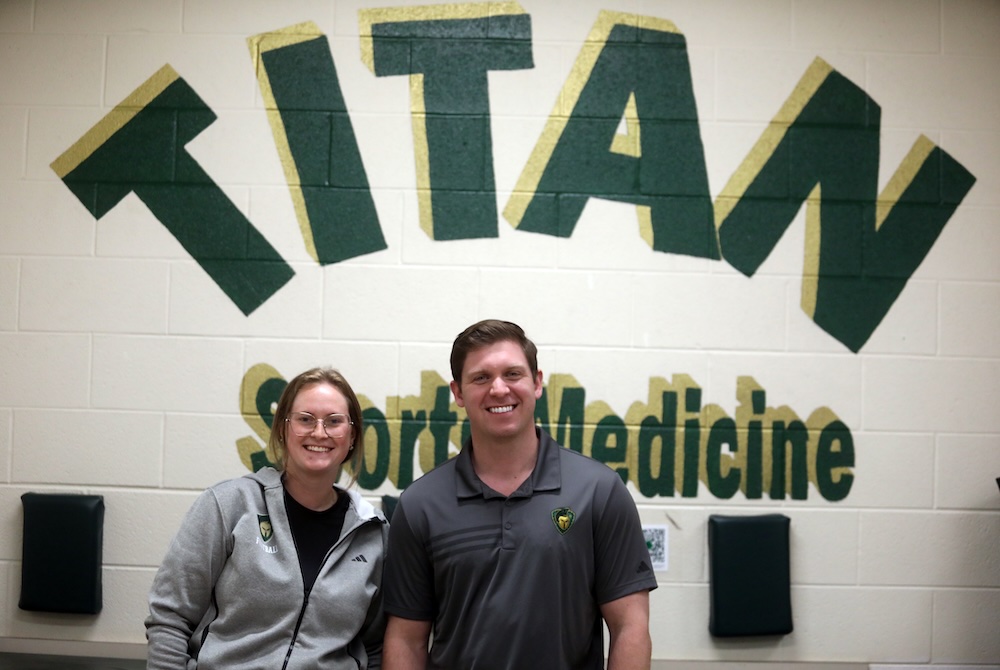
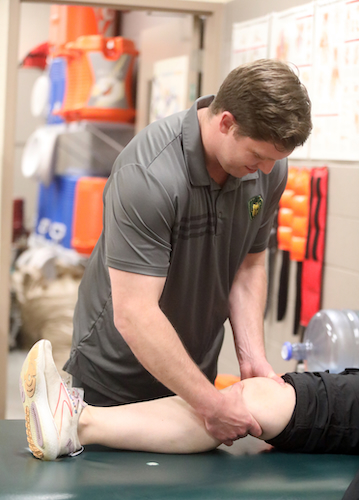
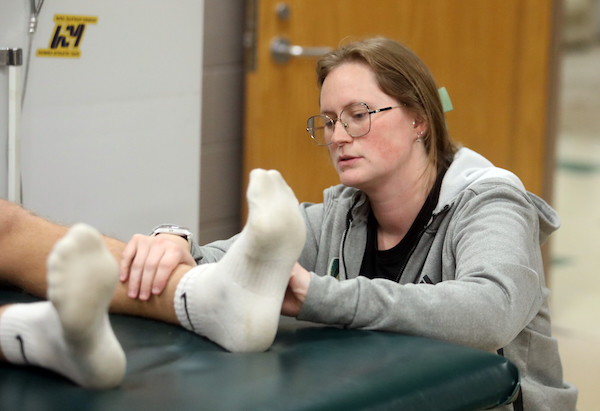
PHOTOS (Top) Traverse City West certified athletic trainer Mikayla Scholts, left, and Dr. Grant Carey stand for a photo together in the school’s athletic training room. (Middle) Carey examines an athlete’s knee in the training room. (Below) Scholts examines an athlete’s foot. (Photos by James Cook/Traverse City Record-Eagle.)
Century of School Sports: MHSAA Programs Prioritize Health & Safety
By
Geoff Kimmerly
MHSAA.com senior editor
April 29, 2025
Rank the top 10 conversations anyone would choose to have when it comes to school sports – be it talking up top teams, the latest stars, past champs, etc. – and advances in health & safety probably come in somewhere around No. 27.
But no topic has been or will remain more important to generating and maintaining successful athletic programs at every level of sport – including the high school and junior high/middle school levels administered by the MHSAA.
From the start of organized school athletics in Michigan more than 100 years ago, health and safety have been priorities. Sports safety concerns – especially in football – helped drive the creation of organized sport administration. Longtime policies – like the one ceasing activity for 30 minutes for lightning or thunder – have become part of daily life in athletics. Other measures, like MHSAA-provided insurance coverage to assist families who experience catastrophic injuries in school practices and competitions, aren’t even known by most – but can be life-altering for those who require those benefits.
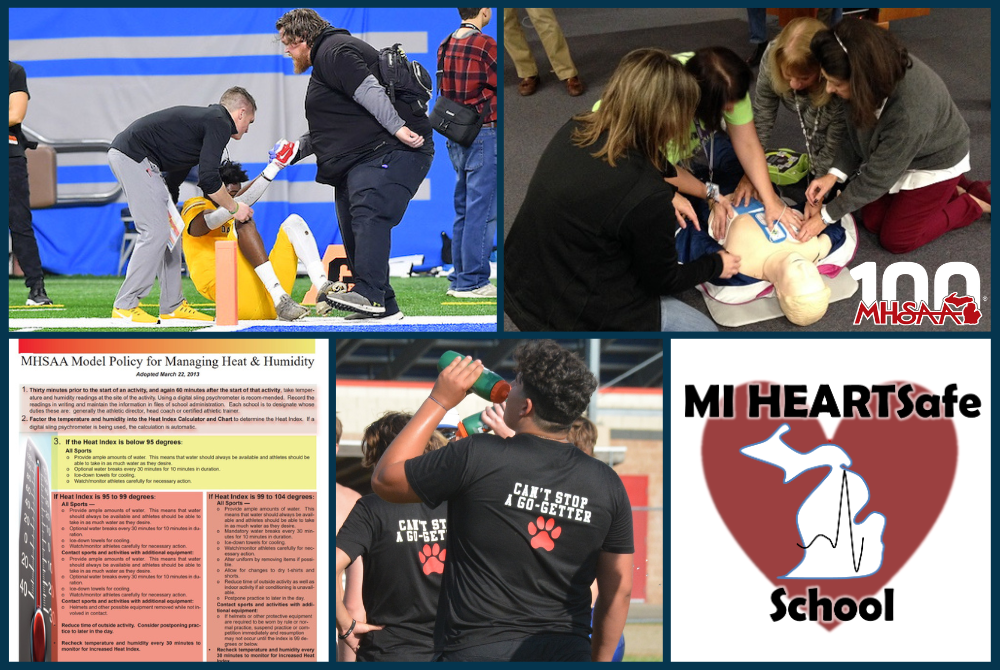
For most of this century, the MHSAA’s health & safety initiatives have focused on the “4 Hs” coined by retired executive director Jack Roberts – Health Histories, Heads, Heat and Hearts. Those were the drive of much of his work especially over the final decade of his tenure before he retired in 2018 after 32 years.
Current executive director Mark Uyl’s time leading the association has seen the MHSAA begin work in mental health and create a Sports Medicine Advisory Committee (SMAC) during the 2019-20 school year. He also led the MHSAA through its successfully safe return to play amid COVID-19 and the pandemic’s aftermath.
Health and safety information is contained in every preseason coaches meeting, which all coaches (head and assistant) are required to take. The MHSAA also has a strong relationship with the Michigan Athletic Trainer’s Society (MATS), who have a representative serving on every MHSAA sport committee along with the SMAC.
Along the lines of major initiatives, here are highlights:
Histories: Although pre-participation physicals long have been required, the MHSAA took a significant step incorporating student and family history with the introduction of new physical forms in 2011. The current form includes several questions not only about the participant receiving the physical, but also heart-related questions about family members.
Heads: The MHSAA was among the first states to adopt a return-to-play protocol requiring an athlete to be cleared by a doctor, physician’s assistant or nurse practitioner, with that protocol also not allowing the athlete to return to participation until at least the next day after a possible head injury. At the start of the 2015-16 school year, the MHSAA launched the largest state-led sideline testing pilot program for concussions, providing a pair of screening tests so those injuries could be detected during practice and competition. Also since 2015-16, the MHSAA has required member high schools to report all potential head injuries and several details including when they took place (practice or competition) and how long students were treated before returning to activity – another first-of-its-kind initiative nationally. The MHSAA currently works with the University of Michigan Concussion Center to provide the most up-to-date information on the subject.
Heat: Long a megaphone for hydration and other best practices for preventing heat-related illnesses, the MHSAA took a major step with the creation of its “Model Policy for Heat and Humidity” for the 2013-14 school year that designates limits to activities (including a complete stop) based on heat index. While the policy is mandated for MHSAA Tournament activity, several schools have adopted the policy for the regular season as well. The MHSAA continues annually to renew awareness of heat management with its “Heat Ways” preseason guide for fall sports.
Hearts: The MHSAA has focused on providing tools so that as many people as possible are prepared to help during a cardiac event. Beginning with the 2015-16 school year, all varsity head coaches have been required to have CPR certification – and that requirement has been extended to head coaches at all high school and junior/middle school levels, ensuring that at least one person on site for every game and practice is trained in this life-saving technique. The MHSAA also has worked with MI HEARTSafe to in part get more AEDs into schools. Beginning this school year, the MHSAA required schools to build emergency action plans (EAPs) specific to sport and venue. And, as noted above, the preparticipation physical also asks questions about an athlete’s family history of heart health, so medical professionals can identify early situations that may require further investigation.
Mental Health: Annual rules meetings include required training in the be nice. program provided by the Mental Health Foundation of West Michigan. The MHSAA also has worked with Ithaca athletic director Terry Hessbrook to promote his B#4 Foundation and its work in suicide prevention and mental health awareness.
Sports Medicine Advisory Committee: The SMAC, made up of experts from the medical and educational communities, meets twice a year to consider topics and make recommendations relevant to health and safety in school sports.
Insurance: All the way back in 1940-41, the MHSAA became one of the first state associations nationally to provide accident benefit insurance to its constituents. The insurance provided over the years has evolved into a catastrophic claims policy beginning with the 1970-71 school year, and then in 2015-16 to include benefits specific to head injuries. The MHSAA’s insurance policy continues to cover deductibles and co-pays left unpaid by other policies for head injuries resulting during school practices or competitions, and at no cost to either schools or families.
There have been other notable moments over the years. Often, the MHSAA has taken action on health and safety issues before other governing bodies have produced mandates – for example, during the 1999-2000 season, MHSAA ice hockey players were required for the first time to wear neck guards that did not become mandatory nationally until this past winter.
More recently, the MHSAA instituted acclimatization rules specific to football and also limits on the amount of practice contact – to the minute – allowed per week. The MHSAA also has chimed in on air pollution created by wildfires, mosquito-borne eastern equine encephalitis and other situations that could potentially impact school sports, and partners with the United Dairy Industry of Michigan to provide nutrition information and awareness at events and on the MHSAA website.
These aren’t the first subjects that come to mind when fans talk about school sports – and that’s fine. But it’s our job, with school administrators, coaches and officials, to always have them front of mind – and we gladly do so to keep sports as safe as possible for hundreds of thousands of athletes whose achievements remain our favorite topics of conversation as well.
Previous "Century of School Sports" Spotlights
April 23: Patches Signify Registered Officials' Role in MHSAA Story - Read
April 16: Student Advisory Council Gives Voice to Athletes - Read
April 9: State's Storytellers Share Spring Memories - Read
April 2: Sharp Leadership Synonymous with MHSAA Success - Read
March 25: Athletic Directors Indispensable to Mission of School Sports - Read
March 18: 2025 Finals Begin Next Half-Century of Girls Hoops Championships - Read
March 11: Boys Basketball's Best 1st to Earn MHSAA Finals Titles - Read
March 5: Everything We Do Begins with Participation - Read
Feb. 25: Slogans & Logos Remain Unforgettable Parts of MHSAA History - Read
Feb. 19: MHSAA Tickets Continue to Provide Fan-Friendly Value - Read
Feb. 11: We Recognize Those Who Make Our Games Go - Read
Feb. 4: WISL Conference Continues to Inspire Aspiring Leaders - Read
Jan. 28: Michigan's National Impact Begins at NFHS' Start - Read
Jan. 21: Awards Celebrate Well-Rounded Educational Experience - Read
Jan. 14: Predecessors Laid Foundation for MHSAA's Formation - Read
Jan. 9: MHSAA Blazes Trail Into Cyberspace - Read
Dec. 31: State's Storytellers Share Winter Memories - Read
Dec. 17: MHSAA Over Time - Read
Dec. 10: On This Day, December 13, We Will Celebrate - Read
Dec. 3: MHSAA Work Guided by Representative Council - Read
Nov. 26: Finals Provide Future Pros Early Ford Field Glory - Read
Nov. 19: Connection at Heart of Coaches Advancement Program - Read
Nov. 12: Good Sports are Winners Then, Now & Always - Read
Nov. 5: MHSAA's Home Sweet Home - Read
Oct. 29: MHSAA Summits Draw Thousands to Promote Sportsmanship - Read
Oct. 23: Cross Country Finals Among MHSAA's Longest Running - Read
Oct. 15: State's Storytellers Share Fall Memories - Read
Oct. 8: Guided by 4 S's of Educational Athletics - Read
Oct. 1: Michigan Sends 10 to National Hall of Fame - Read
Sept. 25: MHSAA Record Books Filled with 1000s of Achievements - Read
Sept. 18: Why Does the MHSAA Have These Rules? - Read
Sept. 10: Special Medals, Patches to Commemorate Special Year - Read
Sept. 4: Fall to Finish with 50th Football Championships - Read
Aug. 28: Let the Celebration Begin - Read