

McNeill Regaining Finals Form, Aiming to Best Last Season's Close Seconds
By
Keith Dunlap
Special for MHSAA.com
May 21, 2026
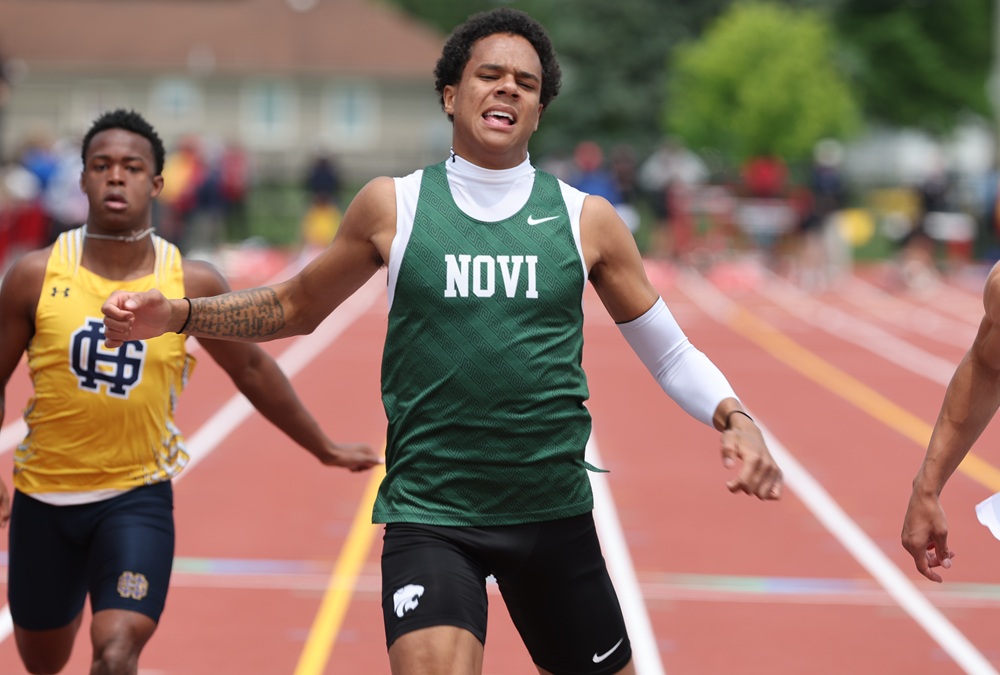
The number 0.01 might be as miniscule as there is in sports, but it certainly was way more gigantic for Novi High School track sprinter Chance McNeill at last year’s Lower Peninsula Division 1 Finals.
 First, McNeill nearly won the 100-meter dash but finished 0.01 -- one hundredth of a second -- back of Detroit Catholic Central’s Samson Gash (10.41).
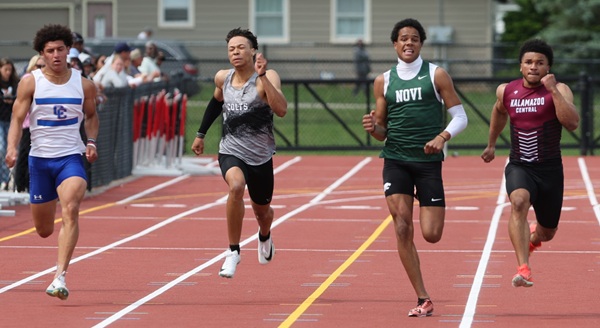
As hard as it was to shake off, McNeill quickly did so and was right in the thick of the 200-meter dash. Ultimately, he finished second in that race as well to Jeremy Dixon of Kalamazoo Central (21.11), once again by 0.01.
Losing out on one Finals title by such a thin margin is tough enough. But falling short by that time twice in a matter of a couple hours? It probably felt like getting kicked in the gut by someone wearing track shoes with all the spikes on the bottom.
“Definitely the first few months after (the Finals), it was crazy,” McNeill said. “I’ve kind of gotten over it by now. But it’s been my motivation for sure.”
Indeed, McNeill is using that experience as fuel for the remaining days of his senior year and as he prepares to compete once again in those events at next week’s Division 1 Finals at Rockford.
Headed to run track next at Alabama, McNeill is actually just ramping back into peak form this spring.
He has been battling a lower leg injury suffered after running a 6.75 in the 60-meter dash during indoor season, saying he sprinted again about three weeks ago for the first time this outdoor season.
McNeill certainly looked to be getting back into form during a competitive Regional last week hosted by Novi.
He won the 100-meter dash with a time of 10.73 and then claimed the 200 meters in a time 21.84. Yes, he and the Novi coaches know he’ll have to be faster to win at the Finals, but it was a great sign of progress given where he has come from – and there is definitely another gear in him.
“To say that he’s back to form probably wouldn’t be accurate,” Novi boys track & field head coach Danny Taylor said. “What I mean by that is given all the personal training that he’s done, given the way in which he’s worked back, I think he’s poised to do great things at the state meet.”
 Taylor said that he didn’t know anything about McNeill and his track prowess until he arrived at the high school for his freshman year but discovered quickly that McNeill was more than just an athlete running track to get in better shape for another sport. McNeill legitimately prioritized track & field.
“It seemed that when Chance came to us, he already had that love and that passion,” Taylor said. “We just wanted to stoke it further.”
McNeill said he initially ran track “for fun” when he started high school but got more serious about it when he got more involved with a local club and started running more meets outside of high school season.
Going into this spring, he said he was actually more intent on running the 400-meter dash, but his injury changed those plans.
“I’ve always wanted to do the 400,” he said. “Now, I just have to forget about that, just try it in college.”
McNeill will head to Rockford next week a year older and stronger, but then again so are other competitors. In particular, Gash, a Michigan State football signee, is also back in both events as he hopes to repeat in the 100 meters and improve on a third-place finish in the 200 from last year.
McNeill and Gash are the only top-five finishers in those races from last year who didn’t graduate.
McNeill hopes that he can be at least 0.01 seconds faster this time and end his high school career on top of the podium.
“I think whatever it takes, I’ve got it in me already,” McNeill said.
 Keith Dunlap has served in Detroit-area sports media for more than two decades, including as a sportswriter at the Oakland Press from 2001-16 primarily covering high school sports but also college and professional teams. His bylines also have appeared in USA Today, the Washington Post, the Detroit Free Press, the Houston Chronicle and the Boston Globe. He served as the administrator for the Oakland Activities Association’s website from 2017-2020. Contact him at [email protected] with story ideas for Oakland, Macomb and Wayne counties.
PHOTOS (Top) Novi’s Chance McNeill crosses the finish line during last season’s 100-meter championship race at the LPD1 Finals. (Middle) McNeill, second from right, races eventual champion Jeremy Dixon from Kalamazoo Central in last year’s 200, with DCC’s Samson Gash, far left, also among those in the field. (Click for more from RunMichigan.com/Carter Sherline.)
Performance of the Week: Pickford's David Kozisek
June 9, 2023
 David Kozisek ♦ Pickford
Senior ♦ Track & Field
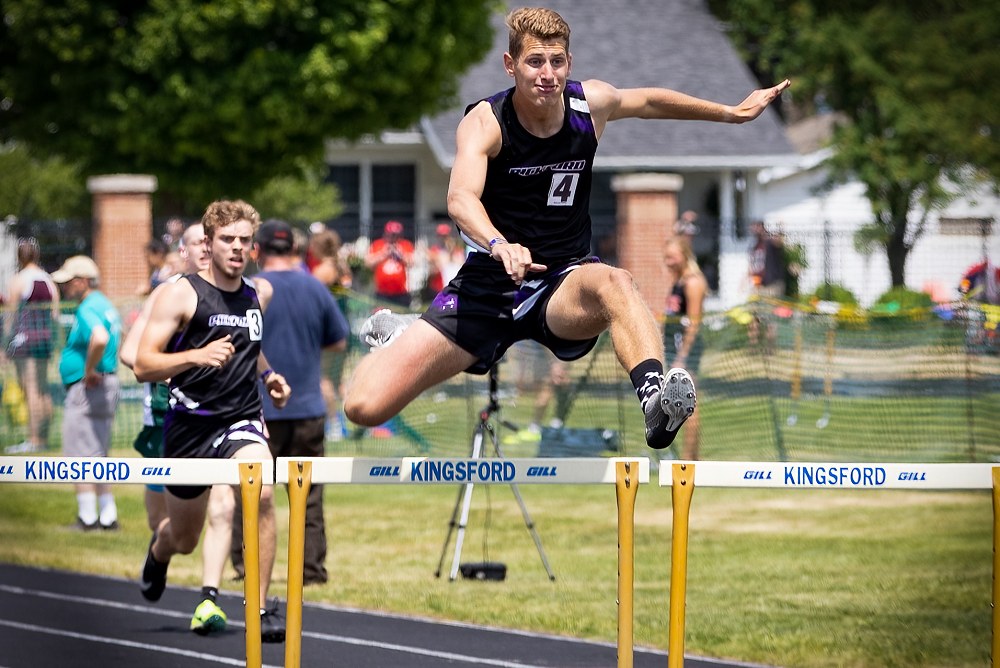
Kozisek was an exchange student from Czech Republic this school year, and when he returns home this week he'll do so having accomplished a rare feat in MHSAA track & field history. On Saturday he became the ninth male athlete to win four individual events at a Finals, taking first in the 110 hurdles (15.40), 300 hurdles (41.39), high jump (6-3) and long jump (20-10) in helping Pickford to the Upper Peninsula Division 2 team championship.
After also playing football and basketball for the Panthers, Kozisek joined the track & field team this spring with plenty of knowledge having competed in that sport over the last six years in his home country. He was incredibly close to leaving an even larger historical imprint last weekend; Kozisek's long jump and high jump both were just one inch off tying UPD2 Finals records, and his 110 time missed that meet record by only six hundredths of a second. He was the first to win four boys events with the combination of two hurdles races and two jumps, and the second four-time individual winner joining Joe Baker, who in 1974 became the first from any school to win four Finals events.
Follow the MHSAA on TikTok.
MHSAA.com's "Performance of the Week" features are powered by MI Student Aid, a part of the Office of Postsecondary Financial Planning located within the Michigan Department of Treasury. MI Student Aid encourages students to pursue postsecondary education by providing access to student financial resources and information. MI Student Aid administers the state’s 529 college savings programs (MET/MESP), as well as scholarship and grant programs that help make college Accessible, Affordable and Attainable for you. Connect with MI Student Aid at www.michigan.gov/mistudentaid and find more information on Facebook and Twitter @mistudentaid.
2022-23 Honorees
June 1: Helena McLellan, Northville soccer - Report
May 25: Mitchel Luck, Linden lacrosse - Report
May 18: Ahava Le Febre, Holland tennis - Report
May 11: Gracie Maloney, Macomb Dakota softball - Report
May 4: Braxton Brann, Ann Arbor Huron track & field - Report
April 27: Owen Patton, Vestaburg track & field - Report
April 20: Lilly Damm, Millington softball - Report
April 13: Larissa Huffman, Mackinaw City track & field - Report
April 6: Darius Acuff, Detroit Cass Tech basketball - Report
March 23: Regan Finkbeiner, Hemlock basketball - Report
March 16: Alaina Yaney, Grand Ledge gymnastics - Report
March 9: Braeden Davis, Dundee wrestling - Report
March 2: Gabriel Sanchez-Burks, Ann Arbor Pioneer swimming - Report
Feb. 23: Grace Sobczak, Marquette swimming - Report
Feb. 16: Kaitlynn Demers, Gibraltar Carlson competitive cheer - Report
Feb. 9: Indya Davis, West Bloomfield basketball - Report
Feb. 2: Braydon Sorenson, Onekama skiing - Report
Jan. 26: Shayna Hruska, Iron Mountain wrestling - Report
Jan. 19: Kayla Tafanelli, Warren Woods-Tower bowling - Report
Dec. 20: Brenden Paden, Riverview Gabriel Richard hockey - Report
Dec. 16: Tuff Scott, Holton bowling - Report
Dec. 9: Macey Fegan, Standish-Sterling basketball - Report
Dec. 2: Treyton Siegert, Gladwin football - Report
Nov. 24: Lily Witte, Dexter diving - Report
Nov. 17: Navea Gauthier, Shelby volleyball - Report
Nov. 10: Derek Huisman, Holland Christian soccer - Report
Nov. 3: Thomas Westphal, New Baltimore Anchor Bay cross country - Report
Oct. 27: Justin Wickey, Colon football - Report
Oct. 20: Owen DeMuth, Bloomfield Hills Cranbrook Kingswood tennis - Report
Oct. 13: Mia Melendez, Ann Arbor Greenhills golf - Report
Oct. 6: Shawn Foster, Grand Ledge football - Report
Sept. 30: Hannah Smith, Temperance Bedford swimming - Report
Sept. 22: Helen Sachs, Holland West Ottawa cross country - Report
Sept. 15: Nina Horning, Lake Orion volleyball - Report
Sept 8: Arturo Romero, Muskegon Oakridge soccer - Report
Sept. 1: Austin King, Midland Dow tennis - Report
Aug. 25: Olivia Hemmila, Troy Athens golf - Report
PHOTOS courtesy of 2BU Photography.