

'22 Game' Lasts 2 Plays, Lives on
By
Ron Pesch
MHSAA historian
October 26, 2015
What would you do with 22 seconds to right a wrong?
In Michigan, the longest football game in high school sports history was played on September 23, 1977 when Detroit Southeastern defeated Detroit Northeastern 42-36 in nine overtimes.
But what is the shortest?
On the evening of Thursday, Nov. 5, 1953, Eaton County foes Bellevue and Vermontville squared off in a Tri-C Conference battle. It was a home contest for Vermontville, but without illumination at its field, the game was staged just west beneath the lights at Nashville High School in Barry County.
The dominant team in Tri-C play over the previous three years, Bellevue’s Broncos had posted three consecutive undefeated seasons from 1950 and 1952. However, graduation took its toll and with only five returning veterans in the fall of 1953, Bellevue lost its nonconference season opener to Homer. The Broncos had also dropped a pair of league contests, to Lake Odessa and Olivet, just prior to the Vermontville game, and entered with a 4-3 record.
Vermontville brought a 4-2 mark into the contest, and was in a four-way tie with Bellevue, Nashville and Lake Odessa for second in the conference.
The Broncos and Wildcats were evenly matched and played to a scoreless tie in the first half. Vermontville opened up a 6-0 lead on a 20-yard end sweep by the Wildcats’ quarterback Pete Benton in the third quarter, but entered the final minutes of the game trailing 12-6 thanks to a TD run by Bellevue’s Jim Smith and an early-fourth quarter scoring pass from Smith to Bob Babbitt.
Coach Dave McDowell’s Wildcats mounted a long final drive, and fans strapped in for a thrilling finish. Pushing deep into Bellevue territory, Vermontville faced a fourth down and eight from the 16-yard line with under a minute to play when Benton launched a desperation pass to the end zone.
The pass fell incomplete, but Bellevue was flagged for pass interference. Officials stepped off the penalty and awarded Vermontville the ball at the one-yard line, but the Wildcats’ plunge into the line fell an inch short on what was called a repeated fourth down play. Vermontville took possession and ran out the clock.
Following the game, Coach McDowell protested the ruling to officials, correctly stating that his team should have been awarded an automatic first down and goal from the 1-yard-line on the penalty, according to high school rules. Appealing the call, the situation was brought to the attention of the league, MHSAA executive director Charles Forsythe and the MHSAA athletic board.
On Wednesday, Nov. 11, the state athletic board agreed an error had been made, but did not order a replay. Instead, they noted three possible solutions:
- Result left as it was.
- Called a no contest.
- Replay it at the point of infraction.
The board moved a final decision back to the league. Because of the possible impact on the final conference standings, and eventually, the awarding of the league’s all-sports trophy, the Tri-C Conference opted to replay the contest from the point of infraction – the 1-yard line – with 22 seconds placed on the clock.
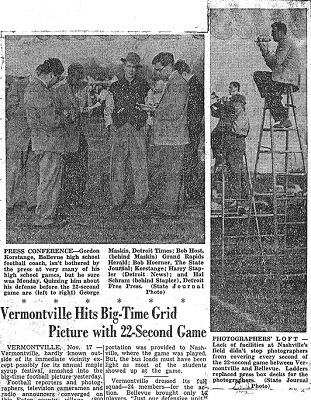 The news of the league’s decision was blasted out by the news services nationwide, and immediately, the pending replay of a small town contest captured the imagination of reporters and sports fans across the United States.
“Shortest ‘Game’ in History?” read the headline in the Lexington, Kentucky Herald. From Biloxi, Mississippi, to Boston, Massachusetts, from Rockford, Illinois to Omaha, Nebraska and Seattle Washington, sports aficionados read the news about the error. Best of all, details flowed forth on the plan to replay critical seconds that might alter the result, fulfilling every fan’s dream.
So began the longest huddle in history.
“What would you do?” was the question on the lips of coaches and followers in barber shops and factories. Detroit Free Press writer George Puscas asked that very question to some of Michigan’s top coaches.
Detroit Lions coach Buddy Parker offered his advice to Vermontville’s coach McDowell.
“The other team will be expecting a run,” noted Parker, “so I would fake a run off tackle then throw a pass in the other direction – with three receivers downfield.”
Michigan State’s legendary Biggie Munn stated the obvious:
“Call a scoring play.”
University of Michigan head coach Bennie Oosterbaan was tied up preparing for the Wolverines’ upcoming contest with MSU, so instead U-M end coach Bill Orwig weighed in with a tongue-in-cheek recommendation:
“Take the time out.”
Earl “Dutch” Clark, in charge at the University of Detroit, suggested that McDowell diagram “two of the most unusual offensive formations … anything to confuse the defense. The first play should be a running play and if it didn’t work, take time out then try again.”
Wayne University’s coach Lou Zarza was the most specific of them all.
“On a goal line stand, the defense usually drifts toward the middle. So I would fake the ball to the right halfback on a slant, then send the fullback with the ball wide to the right, outflanking the defense. It’s a good goal line play on the T formation.”
Suggestions came from all over. A gentleman in Syracuse, New York, even penned a personal letter to McDowell with a sure-fire suggestion.
Three days after the 1953 prep season had officially ended, on the afternoon of Monday, Nov. 16, the same officiating crew and the Vermontville and Bellevue squads emerged and again travelled to Nashville to line up for what can arguably be called the shortest – or perhaps the longest – game in high school football history.
Reporters from Detroit, Grand Rapids, Lansing and Battle Creek converged on the city for 22 seconds of football. High school reporting legends Hal Schram of the Detroit Free Press, Bob Hoerner of the Lansing State Journal, George Maskin of the Detroit Times, Harry Stapler of the Detroit News and writers from the Associated Press and United Press International all descended upon mid-Michigan, “almost as if the Rose Bowl was to be played.”
“That game brought more publicity to coach Gordon Korstange’s 6-3 squad then his teams received for posting three consecutive unbeaten seasons in 1950, 1951 and 1952,” recalled 80-year old Burton H. Brooks, who was the only reporter who had covered the original contest, and one of many covering the replay. A graduate of Bellevue, he was a freshman at Michigan State at the time, earning money as a sports stringer for the Bellevue Gazette and Charlotte Republican Tribune.
Beneath sunny skies, “a crowd of over 500 fans and curiosity seekers, most of them attired in shirt sleeves, lined the field on both sides near the east end of the Nashville gridiron,” wrote Brooks, many years later. “At 5:00 the shrill blast of an official’s whistle split the air, announcing time for the game.”
Attendance was way up from the original contest, and in an unusual move for the time, Kalamazoo television station WKZO announced that they would send a crew to Nashville and then televise the game – (all 22 seconds of it!) – Tuesday evening. In addition, 10 newspaper photographers were on site to capture images from the game.
While the size of the crowd was up, turnout on the football squads had decreased. Vermontville dressed its full squad of 24 for the showdown, but kept out two regular tackles and his first-string quarterback, as all had been on the injured list at the end of the first clash.
Meanwhile, Bellevue brought only 14 players.
“Just our defensive unit and enough to run back the kickoff,” Korstange told the Lansing State Journal, prepared for a situation that could arise if Vermontville scored.
“Three of the defensive starters had decided to go deer hunting instead,” said Brooks discussing the shortened game, “so Bellevue needed to call up some kids for the game from the junior varsity squad.”
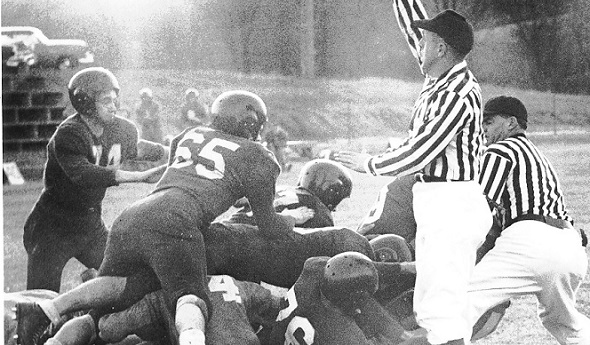
“Bellevue won its sixth game of the year, downing Vermontville in a sensational goal line stand in the famous ‘22’ Game” at Nashville last Monday,” wrote Brooks in the Bellevue Gazette. “Coach Dave McDowell’s Wildcats ran two plays against Bellevue, but couldn’t dent the solid Bronco defense. On the first play the Wildcats sent big Bob Steward up center, but he was driven back a yard by the entire center of the Bellevue line.”
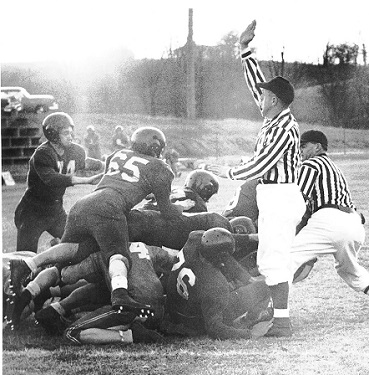 Following a timeout, the Green and White tried to sneak quarterback Pete Benton across the line to the left of center as the ball carrier on the second play, but the hole was quickly plugged by tackle Donald Rogers and guard Jerry Babbitt. Steward had been stopped by Bellevue guard Wayne Lesser. Dale Spotts, Bob Babbitt, Harold Messenger, Ralph Hales, Dick Moon, Jim Smith, Gordon Smith, and Ed Bessemer filled the other defensive spots and ensured the result of the first game went unchanged.
Once again, the wire services blasted their report from sea to shining sea.
“Officials Didn’t Rob Vermontville Team” screamed the headline in the Miami Daily News. Beneath an AP photo, residents of the Florida town were treated to a detailed account of the contest.
“Prep Grid Game Ends Same Way Following 11-Day Break” read the caption in the Dallas Morning News in football-crazed Texas.
“Replayed Grid Game Ends with the Same Result as Before,” read the headline in the Seattle, Washington, Daily Times.
As noted at the time, it certainly wasn’t the first, nor would it be the last, that a refereeing crew made a mistake in a game. Fans then, like now, were reminded officials are only human.
Bellevue ended the extended season in a tie for second with Lake Odessa, with 5-2 marks. For the first time in league history the Tri-C gridiron championship was awarded to Olivet, which, at 8-0, posted its first unbeaten season and, as it turned out, unseated Bellevue for the league’s 1953-54 all-sports trophy.
More than 60 years later, a forgotten showdown between high school football teams, played out before national attention in little Nashville, Michigan, still stands as one of the most entertaining and unusual sports moments in the history of America.
 Ron Pesch has taken an active role in researching the history of MHSAA events since 1985 and began writing for MHSAA Finals programs in 1986, adding additional features and "flashbacks" in 1992. He inherited the title of MHSAA historian from the late Dick Kishpaugh following the 1993-94 school year, and resides in Muskegon. Contact him at [email protected] with ideas for historical articles.
PHOTOS: (Top and below) What's believed to be a Battle Creek Enquirer photo shows one of the goal line stands by the Bellevue defense against Vermontville. (Middle) The Lansing State Journal reported on the nationwide reporting of the "22-second game."
Farewell Silverdome; Our Memories Live On
By
Ron Pesch
MHSAA historian
November 28, 2017
Farewell Pontiac Silverdome.
In early December, more than 15 years after the Detroit Lions played their last game beneath its air-supported Teflon-paneled roof, the “Dome” will take a last breath and then depart.
Finally.
The last few years have been cruel to the stadium that was once a gem and the home of dreams.
The Lions arrived at the newly opened “Pontiac Metropolitan Stadium” (or “Ponmet” as it was called by enthusiasts of the new structure) in August 1975. It was renamed “Pontiac Stadium” later in the year by the city council, and in October of 1976 the Pontiac council again re-christened the building as the “Pontiac Silverdome.”
“We feel the new name better conveys the image of our facility,” said Charles McSwigan, Jr., stadium executive director, at the time. “It certainly lets everyone around the country know we have a modern year-round domed stadium.”
The move was primarily marketing motivated. “The other three giants, Super, Astro and King, get all the publicity,” added McSwigan, further explaining the change. “Promoters call them, but they don’t even come near us.”
Launched in 1975, the MHSAA football championship games were played outdoors at college stadiums that first year on the Saturday before Thanksgiving. While deemed a success, the games were played at two different sites. That had presented challenges.
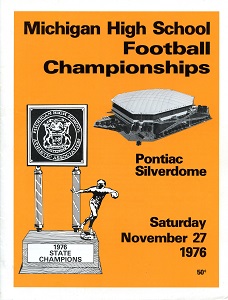 Following that first year, consideration was given to the new structure in Pontiac.
“There are some problems,” remarked Al Bush, MHSAA executive director, explaining the logistics of a possible move to the NFL stadium. “For instance, it would be difficult to play four games on the same day. We would have to start early in the morning, and the last game would have to start late at night.”
Competition for attendance with various events, including deer hunting season, and college football – especially the televised University of Michigan-Ohio State game – were factors to be considered. The high school football playoffs were still a new product without a tradition. Finances also were an area of worry. It was estimated that a crowd of between 20,000 and 25,000 would be needed to make the jump economically feasible.
So, it was with great caution and trepidation that the move was made indoors to Pontiac. Initially, the contract was for a single year. The games would be played on the Saturday following Thanksgiving. By all measures, to the delight of all involved, the 1976 championships were a huge success.
“The four state championship games, which were played in the Silverdome in two sessions on Saturday, drew a paid attendance of 29,423 fans,” said Associated Press writer Harry Atkins in a follow-up piece following the games, “bringing smiles of relief and joy to MHSAA Executive Director Al Bush and his assistant, Vern Norris. The attendance figure was almost double the number of fans who turned out last year in ice box-like weather at two sites – Western Michigan University and Central Michigan University.”
With that, a new contract was signed, and for 29 years the city of Pontiac served as home to the MHSAA 11-player football championships. “Goin’ to the Dome” soon became the goal of every high school in Michigan that offered the sport.
Following a 15-10 victory over the Dallas Cowboys in early January 2002, the Lions departed the Silverdome for Ford Field, located in downtown Detroit. The high school Finals stayed put for three more years before moving to Ford Field.
Twelve seasons after following the Lions from Pontiac to Detroit, countless memories and several MHSAA championship game records still stand from those years under the Dome.
Four championship games were played at the Silverdome to close each season from 1976-90. In 1991, the playoffs were expanded to eight classifications and the Finals expanded to eight games over a two-day showcase.
For many across Michigan, those 176 high school state title games were their first live exposure to the building many had only seen on television. For football fans, the MHSAA Finals provided an affordable and unique chance to visit the stadium and watch the game between the 20-yard-lines at ground level. An NFL game, concert, or in later years a Pistons basketball game at the Silverdome was far from an intimate experience for most. Seating 80,311, it was the largest stadium in the NFL until 1997.
For thousands of athletes and coaches, the playing surface was their first exposure to artificial turf. It was an honor to set foot on the field. After all, who didn’t want to run on the same canvas on which Lions legend Barry Sanders painted?
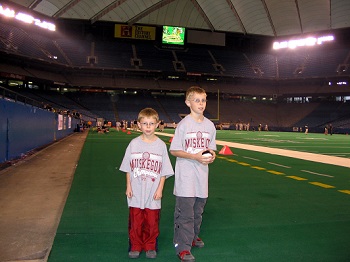 Who can forget the Mill Colemen-led comeback drive to title glory in the final minutes as Farmington Hills Harrison downed DeWitt for the Class B title in 1989, or “The Catch” by Muskegon Reeths-Puffer’s Stacy Starr that broke the hearts of Walled Lake Western players and fans in the final seconds in Class A in 1992? Who remembers the wild 91 points (and 883 yards in total offense) posted in Belding’s 50-41 victory over Detroit Country Day in Class B in 1994, when Belding trailed by 19 points at the half? The combined final score remains the record for most points tallied in a title game by two teams.
Farmington Hills Harrison and coach John Herrington won five consecutive finals in Pontiac (1997, 1998, 1999, 2000, 2001), and 12 of their 13 MHSAA Finals titles at the Silverdome. A total of 12 of Detroit Catholic Central’s 17 trips to the Finals meant a bus ride to Pontiac.
One record performance set in the opening game of the 1976 championships still stands in the MHSAA championship record book. With the evolution of the game, it may never fall.
Despite the climate-controlled environment afforded by moving indoors, Crystal Falls Forest Park threw only three passes against Flint Holy Rosary in the Class D title game, completing one for a net -3 yards. By default, that total established a record for pass defense in a title game. It remains the zenith.
Forest Park had little need for the pass that day. The Trojans rolled up 234 rushing yards on 48 carries, including a 74-yard touchdown run off left tackle by all-state running back Marty Ball with 4:36 to play in the first quarter. Less than two minutes later, a fumble recovery by Forest Park’s Charlie Davis was returned 25 yards for a score, and the Trojans led, 14-0. Holy Rosary passed for 204 yards including an 18-yard pass from Ron Fray to Dan Lehoux in the second quarter, but couldn’t overcome that first quarter deficit, falling 14-6. A crowd of 14,879 attended the day’s first session, comprised of the Class D and Class A games.
Other long-standing record performances at the Dome still can be spotted in the record book.
Josh Wuerfel’s 46-yard field goal in the second quarter gave Traverse City a 10-0 halftime lead and aided the second-ranked Trojans’ 24-14 defeat of top-ranked Detroit Catholic Central in the 1988 Class A contest. The kick stood for 28 years as the title game record before finally being exceeded (twice!) at the 2016 championships played at Ford Field. Liam Putz of Grand Rapids West Catholic shattered the mark with a 47-yarder against Menominee in the Division 5 title game, before Ben Fee of Orchard Lake St. Mary’s topped the kick in the eighth game of the weekend. Fee’s 49-yard field goal late in the fourth quarter helped St. Mary’s down Muskegon 29-28 in the Division 3 thriller. The boot was his third field goal of the game. Combined with two extra points, he finished as the Eaglets’ top scorer.
Paul Gross of Jackson Lumen Christi established a new mark for extra points against Livonia Clarenceville in the 2001 Division 5 game, connecting accurately on all seven of his attempts. The record has been matched twice since the move to downtown Detroit.
Nick Williams’ 90-yard touchdown dash on Farmington Hills Harrison’s first play from scrimmage in the 1994 Class A game, a 17-13 victory over Grand Rapids Forest Hills Central, still tops the record book category for longest run play in a title game. An 89-yard TD run by Constantine’s Jim Schragg sits directly behind the Williams’ mark. Schragg rolled up 307 yards in a 34-13 win over Suttons Bay in the 2004 Division 6 game, during the final year at the Silverdome. His total established the pinnacle for rushing yards in a game.
Ravenna’s Benny Clark carried the ball 49 times (including 29 rushes in the second half) for 212 yards as the Bulldogs topped Morenci 30-14 in the 1996 Class C contest. The total, which exceeded the previous mark of 40 set by Dan Lato of Crystal Falls Forest Park in 1977, has yet to be matched or exceeded.
The fastest championship game passing touchdown came 15 seconds into the 2003 Division 5 Final, when Jackson Lumen Christi‘s Tyler Aldridge found wide-open Matt Russell on a reverse pass on the second play from scrimmage. The Titans defeated Muskegon Oakridge 23-0 for the title.
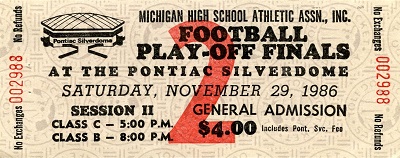 Quarterback Tony Koshar tossed a short pass to Jim Steinman, “who shed a tackler and managed to stay in bounds as he took off for the end zone on a 96-yard scoring play,” as Gobles grabbed a 31-22 upset victory over top-ranked Crystal Falls Forest Park in the 1984 Class D title game. The reception for the longest pass play lasted 24 years before it was finally topped in 2008.
Kirk Williams’ 15 pass receptions for DeWitt against East Grand Rapids in the 2002 Division 3 contest still stand the test of time, as does Brad Johnson’s 87-yard punt return for a touchdown for Schoolcraft against Frankfort in the 1988 Class D championship game.
The 1991 title games saw two defensive marks set, both on the same day. On Saturday, November 30, Rick Marcotte of Lake Linden-Hubbell scooped up a fumble and dashed 79 yards for a touchdown and a new Finals record versus Mendon in Class DD. Less than 16 hours earlier Nate Cierlak of Muskegon Catholic Central had set the mark with a 56-yard return for a TD against Harbor Beach. In that year’s Class CC Final against Negaunee, Jason Livengood of Battle Creek Pennfield set the one mark that statistically can never be topped when he returned a pick-six for 100 yards.
Eight punts by Muskegon’s Jason Crago in the Big Reds’ 16-13 victory over Detroit Martin Luther King in the 1989 Class A title game was unmatched until 2007, when Aaron Hudson of Blissfield equaled the total. On Saturday, Clarkston’s Jermaine Roemer also tied the record in the Division 1 Final.
Between 1976 and 2004, more than 1.5 million fans attended the games in Pontiac, with a peak of attendance of 71,156 in 1995.
Soon the site will be cleared, with plans for redevelopment. Not far down the road, The Palace of Auburn Hills, once home to the MHSAA Basketball Finals and longtime home to the MHSAA Individual Wrestling Finals, will be scrubbed from the earth. Along with them, the structural evidence of the home of countless accomplishments will disappear.
Change is constant, and time moves on. Still those achievements, and several others, live on in the pages of the MHSAA record book, in the memories of those who competed and the recollections of those who played witness.
Ron Pesch has taken an active role in researching the history of MHSAA events since 1985 and began writing for MHSAA Finals programs in 1986, adding additional features and "flashbacks" in 1992. He inherited the title of MHSAA historian from the late Dick Kishpaugh following the 1993-94 school year, and resides in Muskegon. Contact him at [email protected] with ideas for historical articles.
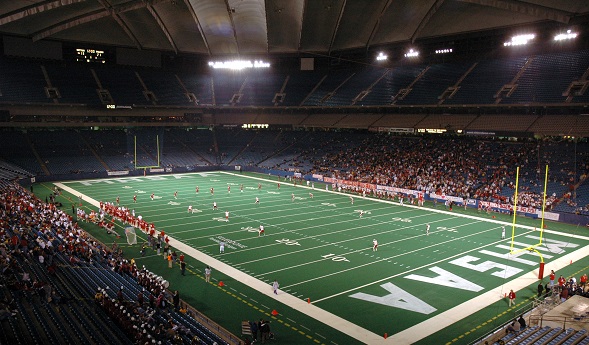
PHOTOS: (Top) Constantine and Suttons Bay played in the Division 6 Final at the Silverdome as part of the last weekend of MHSAA games in the building in 2004. (Top middle) The 1976 program welcomed Finals fans to the Dome for the first time. (Bottom middle) The author's children during a trip to the Silverdome before the Finals moved to Ford Field. (Below) The 1986 Finals ticket got fans into two games at the Silverdome for $4. (Photos courtesy of Ron Pesch and MHSAA files.)