

After Answering Call, MCC's Caughey Finds Football Lessons Pay Off in Priesthood
By
Tom Kendra
Special for MHSAA.com
August 5, 2025
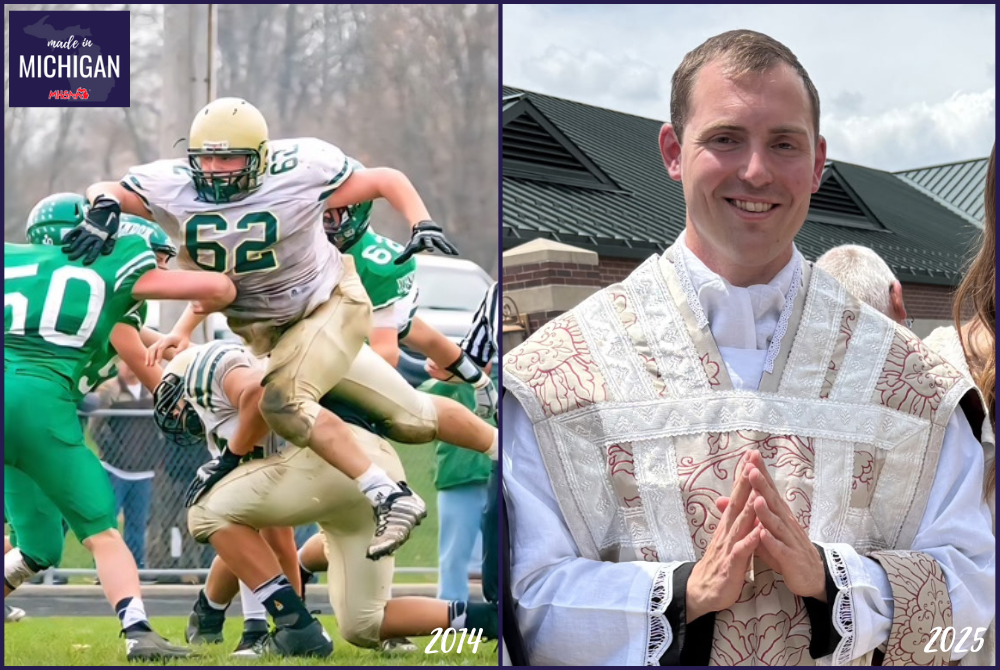
Michael Caughey was known for his brute force and ability to bully opponents as an all-state offensive lineman at Muskegon Catholic Central.
 Today, 10 years after his high school graduation, suffice to say that his life has made a 180-degree turn and he’s using an entirely different skill set in his first “real world” job.
“I’m trying to help people get to heaven,” he said.
The kid that everybody called Mikey is now Father Michael Caughey, FSSP, after completing seven years of training at the Our Lady of Guadalupe Seminary in Nebraska and being ordained as a Catholic priest on May 28 in Lincoln, Neb.
He returned home briefly – basically for a busy month of June, saying Mass at various stops around West Michigan – before leaving in early July and making the nearly 1,700-mile, one-way trip to El Paso, Texas, where he is now serving as one of two assistant pastors at Immaculate Conception Church in downtown El Paso.
Fr. Michael is slowly adjusting to the triple-digit heat (he calls it “Hell Paso”) and also the pressure and responsibility of serving his congregation.
He often relies on the discipline and work ethic he learned as a Crusaders football player, where he was a two-way starting lineman on back-to-back Division 8 championship teams in 2013 and 2014 – the first two of four consecutive Finals winners for MCC.
“I went through seven years of preparation in the seminary but, I tell you what, nothing can totally prepare you for being on the other side of the altar,” said Caughey, 28, who also speaks fluent Spanish.
“My football days at MCC helped get me ready for this. I learned how to stay focused and get the job done under pressure.”
Gridiron dreams
When he was a little kid, Michael dreamed of playing football for MCC, then later for Michigan State and the Detroit Lions.
His biggest role model was his dad, Shawn, who was a member of Muskegon High School’s 1986 Class A championship team, although the two had completely different body types. As a senior, Shawn was a 5-foot-11, 165-pound free safety, while Michael was a 6-1, 270-pound offensive tackle.
 Michael more closely resembled his uncle, Rob Vanderleest, a fellow all-state lineman at Muskegon Catholic who went on to become a 6-4, 270-pound tight end at Michigan.
Caughey was a three-year varsity starter for the Crusaders as a two-way tackle. He made all-state in 2013 and 2014 and was a team captain his senior year.
Muskegon Catholic coach Steve Czerwon, who was in his first season leading the program in 2013, said Caughey was a “dominant drive blocker” who also caught the coaching staff’s attention off the field.
“We noticed he carried a Bible around with him,” said Czerwon. “But he was very sincere about it, and that’s just who he was. I had him in class, and I would put him in the top one percent of students I’ve ever had in intelligence.”
Caughey said one of the first times he felt a calling to do more with his faith was during the first week of Lent during his freshman year, when he made an individual confession.
It wasn’t until his junior year that he contacted the Diocese of Grand Rapids about the priesthood and gathered more information about that possible career path.
“I didn’t really go too far down that road because I had a girlfriend at the time,” Caughey said with a chuckle.
Faith over football
He had opportunities to play college football in Michigan, but he also wanted to explore his faith further, so he chose to play at Benedictine College – a small, Catholic, NAIA school in Atchison, Kan.
He redshirted his first year, then made the travel team and played in every game the following fall as a backup offensive lineman and member of the field goal unit.
But early in his redshirt sophomore year of 2017, his interest in the priesthood, which had been smoldering for about five years, was reignited after being introduced to the Latin Mass.
“All those feelings about the priesthood came back and I knew I needed to pursue them,” said Caughey, whose younger sister, Molly, will be a senior at MCC this year. “I called my parents and told them I wanted to drop out of college and enter the seminary. The calling was so strong.”
Shawn and Sharon Caughey were initially skeptical, but have come to understand that Michael’s calling to the priesthood was a great gift to their family.
 “We are all better people because of Michael and his journey,” said Shawn. “We are a stronger family, and I am a much better person because of him. I know that for a fact.”
Michael spent the past seven years at the Fraternity of St. Peter House of Formation in Denton, Neb., where he not only transformed himself spiritually with intense study of Catholic theology, but also physically – dropping about 60 pounds, and even running a marathon last year.
Even though his football career was done, he was able to satisfy his competitiveness on the basketball court. Michael helped his team to five national championships against other seminaries and is proud to be the leading rebounder in the school’s history.
His time at the seminary culminated and concluded with his ordination ceremony in late May, which was attended by a large group of family and friends, including Czerwon.
Getting to the next level
Caughey admits his life has been something of a whirlwind for the past two months since his ordination day.
He is just now settling in at Immaculate Conception, where English is, essentially, his third language. He delivers all of his Masses and homilies in Latin and a high percentage of the congregation speaks Spanish.
“I just can’t believe how quickly everything happened,” he said during a recent phone interview, taking a break from his parish duties. “I was just a kid at the seminary, and now I’m saying Mass and hearing confessions. I’m responsible for people’s souls.”
While he misses home, he is thankful he was able to return to Muskegon as an ordained priest.
He said one of the best moments of his life was saying Mass on June 2 at his home parish, St. Mary’s in downtown Muskegon, followed by a reception in his honor.
The next day, he returned to his alma mater and said a Mass at Muskegon Catholic’s Nugent Auditorium. He delivered the Mass in Latin, as always, but he was “amazed at how locked in all of the kids were.”
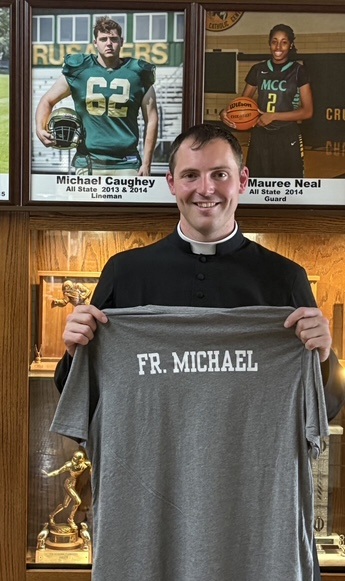
He was then able to roam the halls of MCC for the first time as a priest, stopping to take pictures next to his all-state photo in the school’s “Hall of Fame,” and realizing that, as much as things have changed, the process to greatness remains the same.
“I remember playing tackle and telling the guard next to me, Jacob Holt, that we need to double-team the tackle and then get to the next level,” Caughey said. “The goal back then was to get our running backs into the end zone, which we did a pretty job of.
“Our goal now is to get our parishioners into heaven. The goal is just a little bigger now, I guess.”
2025 Made In Michigan
July 31: After Enjoying Pro Golf Stardom, Flynn Relishing Roles as Instructor, Sports Mom - Report
July 29: Marckel Supplies Marketing Magic to Hunter's Heisman-Winning Campaign - Report
July 28: Union City to Omaha: Skirka Takes Murray State Baseball to 1st College World Series - Report
July 22: TC West's Wheelock Still 'Living My Dreams' as CMU Assistant Soccer Coach - Report
July 17: Stevenson's Travels Following Lake Orion Success Include Space Force, Penn, NYC - Report
July 15: 'Who Will Cheer for the Nimrods?' Peterson IV, Watersmeet Found Fans Worldwide - Report
July 10: Feeding 'Drive to Win,' Loy Norrix Grad Morgan Impresses with Strong USBC Showing - Report
July 9: After Blazing Multiple Volleyball Trails, Bastianelli Charting Next Career Path - Report
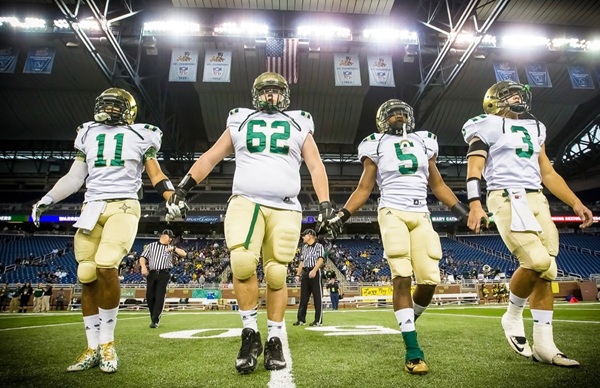
PHOTOS (Top) At left, Michael Caughey rushes the quarterback in a playoff game against Mendon. At right, Father Michael Caughey, FSSP, was ordained a Catholic priest on May 28 in Lincoln, Neb. (Middle) Caughey poses in front of his all-state picture in Muskegon Catholic Central's Hall of Fame. (Below) Caughey (62) walks onto the turf at Ford Field before the 2014 Division 8 championship game as one of Muskegon Catholic Central's four captains. (MCC action photos by Tim Reilly; recent photos courtesy of Shawn Caughey.)
1st & Goal: 2025 Playoffs Week 1 Preview
By
Geoff Kimmerly
MHSAA.com senior editor
October 30, 2025
The MHSAA begins its second half-century of football playoffs this weekend, the 51st aspiring to the same goal as our first in 1975 – to provide an unforgettable experience while celebrating Michigan’s best high school football teams.
 A total of 288 will begin postseason play, with the 8-player brackets concluding in four weeks and the 11-player divisions cheering their champions in five.
To kick things off, there are 129 games scheduled for Friday and 15 for Saturday. Tickets to both District and Regional Semifinals this weekend cost $7 and can be purchased at GoFan.co. The majority of our playoff openers also will be broadcast and available to watch with subscription on the NFHS Network.
Below are glances at some of the most intriguing first-round matchups in each division:
11-Player Division 1
Davison (8-1) at Clarkston (8-1) WATCH
These two powers will meet in the playoffs for the first time since 2022, and the matchup will likely be one of the most attended this first weekend. Clarkston is coming off winning the Oakland Activities Association Red championship, with its only loss by just six points in Week 2 to still-undefeated Harper Woods. Davison’s loss also came to a still-unbeaten team, Grand Blanc, in Week 7 in what ended up the deciding game in the Saginaw Valley League South.
Keep an eye on these FRIDAY Brighton (6-3) at West Bloomfield (7-2) WATCH, Dearborn Fordson (7-2) at Farmington (7-2) WATCH, Macomb Dakota (6-3) vs. Utica (7-2) WATCH at Sterling Heights Stevenson.
11-Player Division 2
Traverse City Central (5-4) at Traverse City West (5-4) WATCH
Just a week ago, West won the annual Patriot Game matchup between these two at Thirlby Field in overtime, 21-20. They’ll return to the stadium they share for their first playoff meeting since 2017. The first round was decided in part by the Titans blocking Central’s overtime extra-point attempt, then following up with the tying touchdown and game-winning PAT. That ran West’s winning streak in the rivalry to three and pushed the Titans ahead of the Trojans in playoff-point average and into position to be the home team for this game.
Keep an eye on these FRIDAY East Lansing (4-5) at White Lake Lakeland (7-2) WATCH, Bloomfield Hills Brother Rice (5-4) at Walled Lake Western (7-2) WATCH, St. Clair Shores Lakeview (7-2) at Port Huron Northern (7-2) WATCH.
11-Player Division 3
Zeeland West (6-3) at Niles (9-0) WATCH
These two both ended last season at Ford Field, although a few things have changed since last Thanksgiving weekend. Zeeland West is the reigning Division 3 champion and under new leadership with Jeff Bolhouse taking over this season for retired John Shillito and taking the Dux back to the playoffs for the 16th-straight season. Niles finished last fall as Division 4 runner-up before moving into Division 3 this season and running its regular-season winning streak to 17.
Keep an eye on these FRIDAY Cedar Springs (8-1) at East Grand Rapids (7-2) WATCH, Zeeland East (6-3) at St. Joseph (5-4) WATCH, Linden (6-3) at Mason (5-4) WATCH. SATURDAY Marysville (7-2) at Port Huron (6-3) WATCH.
11-Player Division 4
Big Rapids (8-1) at Ludington (9-0)
Ludington will carry its first undefeated regular season since 1989 into a rematch of last season’s District Semifinal, won by Big Rapids 28-21. The Orioles have thrived on both sides of the ball, but it’s hard to not notice they’ve scored 40 or more points in all but one game, when they put up just 32. Big Rapids’ only loss came Week 8 against Coopersville, 38-28. But over its other eight games, the Cardinals allowed only 40 points total.
Keep an eye on these FRIDAY Redford Union (7-2) at Madison Heights Lamphere (6-3) WATCH, Grand Rapids South Christian (4-5) at Portland (9-0), Tecumseh (6-3) at Dearborn Divine Child (8-1) WATCH. SATURDAY Freeland (7-2) at Escanaba (8-1) WATCH.
11-Player Division 5
Detroit Denby (7-2) at Detroit Southeastern (6-3), Saturday
Denby will represent the best of its division of the Detroit Public School League after winning the Gold regular-season and city championships. Southeastern was among the leaders in the PSL Blue, tying for second thanks to a loss to Division 3 contender Martin Luther King, and all three of its regular-season defeats came to playoff qualifiers. Denby has won seven straight games (including a forfeit victory) since opening 0-2 with losses to playoff team Chelsea and Ohio power Garfield Heights.
Keep an eye on these FRIDAY Dowagiac (5-3) at Berrien Springs (5-2) WATCH, Flat Rock (6-3) at Monroe Jefferson (8-1), Armada (6-3) at Richmond (8-1) WATCH, Negaunee (6-3) at Ogemaw Heights (8-1) WATCH.
11-Player Division 6
Flint Elite (8-1) at Montrose (9-0) WATCH
Elite, a cooperative of Flint New Standard Academy and Burton Madison Academy, is in its sixth season and has qualified for the playoffs for the first time (not counting COVID-shortened 2020, when nearly all teams made the field). Elite also won the Genesee Area Conference title, with its only loss coming 20-16 to Genesee in Week 2. Facing Montrose – in the playoffs for the 16th-straight season – is definitely another opportunity for the Warriors to raise their profile. The Rams have given up 34 points all season and played only one game closer than two touchdowns.
Keep an eye on these FRIDAY Kent City (9-0) at Olivet (8-1) WATCH. SATURDAY Boyne City (6-3) at Traverse City St. Francis (6-2) WATCH, Calumet (7-2) at Kingsley (7-2) WATCH, Durand (7-2) at Flint Hamady (6-3) WATCH.
11-Player Division 7
Ottawa Lake Whiteford (8-1) at Clinton (7-2) WATCH
These two are meeting in a playoff opener for the second-straight season, with Clinton claiming last year’s 38-32. Whiteford moved this season to the Toledo Area Athletic Conference and won that league, while Clinton finished second in the Lenawee County Athletic Association to undefeated Hudson, which along with Monroe St. Mary Catholic Central provided the Redwolves’ losses. Whiteford’s defeat came to still-unbeaten Harbor Beach.
Keep an eye on these FRIDAY McBain (7-2) at Charlevoix (8-1) WATCH, Ithaca (6-3) at Saginaw Valley Lutheran (9-0), Constantine (6-3) at Lawton (7-2) WATCH. SATURDAY Saranac (7-2) at North Muskegon (6-3) WATCH.
11-Player Division 8
White Pigeon (7-2) at Decatur (7-2)
Decatur secured the Southwest 10 Conference title this season with a six-point double-overtime win over Bronson in Week 2 and then an eight-point win over White Pigeon in Week 8. That was also the Raiders’ first win over White Pigeon since 2022, and this will be their first season with a playoff rematch since 2021. Decatur has won six games in a row, losing only to Lawton and still-undefeated Springport over the first three weeks. The Chiefs’ only other loss came to Bronson, and they bounced back from two straight defeats with a 46-20 win over Stockbridge last week.
Keep an eye on these FRIDAY Saginaw Michigan Lutheran Seminary (6-3) at Saginaw Nouvel Catholic Central (7-2) WATCH, Fowler (6-3) at New Lothrop (6-3) WATCH, Auburn Hills Oakland Christian (5-4) at Madison Heights Madison (8-1), Frankfort (6-3) at East Jordan (6-3) WATCH.
8-Player Division 1
Pickford (7-1) at Indian River Inland Lakes (9-0) WATCH
This is a massive matchup for opening weekend of the postseason, and a rematch of one of last year’s Semifinals. Pickford won that 2024 meeting 34-18, going on to finish Division 1 runner-up with a two-point loss to Deckerville in the championship game. The Pirates’ only loss this season came against still-undefeated Norway, but no one else came close. Similarly, Inland Lakes’ closest game this fall was last week’s 27-point win over Gaylord St. Mary to clinch the Ski Valley Conference title.
Keep an eye on these FRIDAY Gogebic (8-1) at Norway (9-0) WATCH, Climax-Scotts (7-2) at Gobles (7-2) WATCH, Capac (7-2) at Brown City (7-2) WATCH.
8-Player Division 2
Morrice (8-1) at Deckerville (8-1), Saturday WATCH
The Eagles won the Division 1 title a year ago and 20 straight games before falling to Capac by eight points in Week 8. Morrice, meanwhile, also played at the Superior Dome to end last season, as the Division 2 runner-up. These two last met in a 2023 playoff opener – a 46-40 Deckerville win – and it’s difficult to forecast how this one will turn out as both defeated their one common opponent by a significant margin. Morrice’s only loss came to Portland St. Patrick, which is undefeated and could end up seeing the winner of this game in a Semifinal in two weeks.
Keep an eye on these FRIDAY Gaylord St. Mary (7-2) at Mio (8-1) WATCH, Pittsford (7-2) at Britton Deerfield (8-1) WATCH. SATURDAY Powers North Central (7-2) at Lake Linden-Hubbell (7-2) WATCH.
MHSAA.com's weekly “1st & Goal” previews and reviews are powered by MI Student Aid, a division within the Department of Lifelong Education, Advancement, and Potential (MiLEAP). MI Student Aid encourages students to pursue postsecondary education by providing access to student financial resources and information. MI Student Aid administers the state’s scholarship and grant programs that help make college Accessible, Affordable and Attainable for you. Click to connect with MI Student Aid and find more information on Facebook and Twitter @mistudentaid.
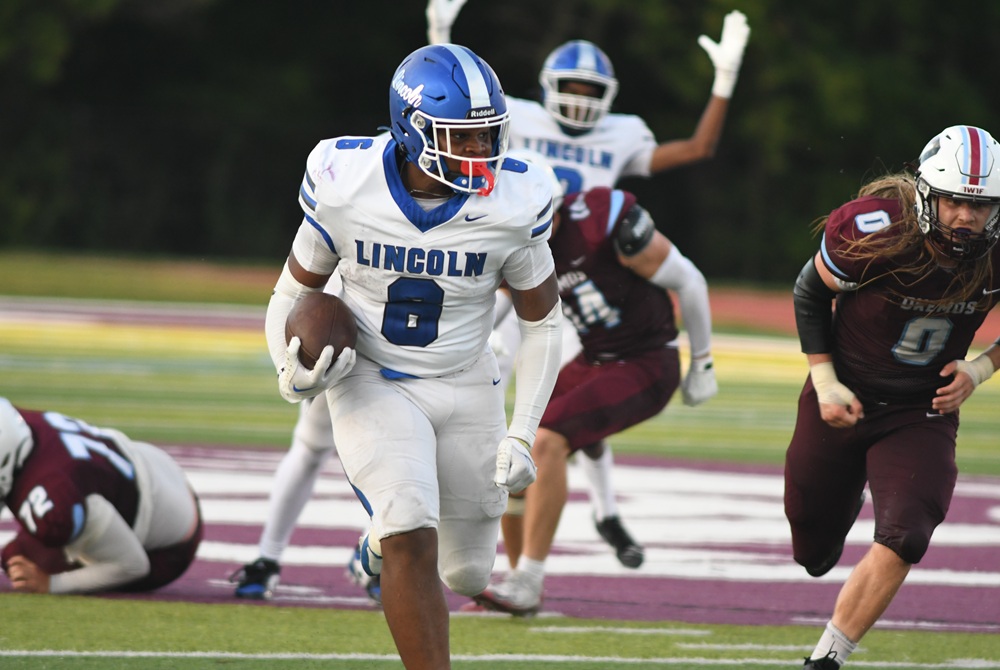
PHOTO (Top) Ypsilanti’s Roshard Slater (8) breaks into the open during his team’s season-opening win over Okemos. (Photo by John Johnson.)